Lamentations 5 – “A Prayer of Longing”

Glowing_FireplaceHebrew-English Text
I. Summary
The people complain about their wretched state, admit their guilt, and ask God to restore their previous glory.

II. Photo
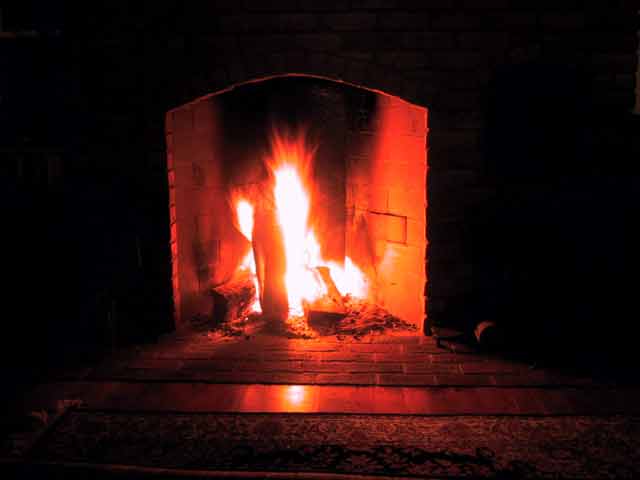
The people cry out in v. 10: “Our skin glows like an oven, With the fever of famine!”

III. Important Verses
vv. 2-3: Our heritage has passed to aliens, Our homes to strangers. We have become orphans, fatherless; Our mothers are like widows.
v. 4: We must pay to drink our own water, Obtain our own kindling at a price.
v. 7: Our fathers sinned and are no more; And we must bear their guilt.
v. 8: Slaves are ruling over us, With none to rescue us from them.
vv. 11-12: They have ravished women in Zion, Maidens in the towns of Judah. Princes have been hanged by them; No respect has been shown to elders.
v. 16: The crown has fallen from our head; Woe to us that we have sinned!

IV. Outline
1. Invocation, initial plea
2-18. Communal complaint
19. Hymnic address
20-22. Petition

V. Comment
No comment today. I hope to revisit this chapter at the end of the cycle. Stay tuned.

VI. Works Used
(see “Commentaries” page)
Gerstenberger, Psalms Part 2 and Lamentations (Forms of Old Testament Literature)
Photo taken from http://peppermintcottage.com/Glowing_Fireplace.jpg

Lamentations 4 – “A Shocking Lament”

camelbirdHebrew-English Text
I. Summary
Lamentations 4 is an acrostic lament. The speaker describes Jerusalem in lurid detail, leads a communal prayer, and curses the Edomites.

II. Photo
Verses 3-4 say: “But my poor people has turned cruel, Like ostriches of the desert. The tongue of the suckling cleaves To its palate for thirst. Little children beg for bread; None gives them a morsel.”

III. Important Verses
v. 2: The precious children of Zion; Once valued as gold — Alas, they are accounted as earthen pots, Work of a potter’s hands!
v. 5: Those who feasted on dainties Lie famished in the streets; Those who were reared in purple Have embraced refuse heaps.
vv. 6-8: The guilt of my poor people Exceeded the iniquity of Sodom, Which was overthrown in a moment, Without a hand striking it. Her elect were purer than snow, Whiter than milk; Their limbs were ruddier than coral, Their bodies were like sapphire. Now their faces are blacker than soot, They are not recognized in the streets; Their skin has shriveled on their bones, It has become dry as wood.
v. 10: With their own hands, tenderhearted women Have cooked their children; Such became their fare, In the disaster of my poor people.
v. 12: The kings of the earth did not believe, Nor any of the inhabitants of the world, That foe or adversary could enter The gates of Jerusalem.
v. 16: The LORD’s countenance has turned away from them, He will look on them no more. They showed no regard for priests, No favor to elders.
v. 21: Rejoice and exult, Fair Edom, Who dwell in the land of Uz! To you, too, the cup shall pass, You shall get drunk and expose your nakedness.

IV. Outline
1-16. Descriptive lament
17-20. Communal lament
21-22. Imprecation of Edom

V. Comment
No comment today. I hope to revisit this chapter at the end of the cycle. Stay tuned.

VI. Works Used
(see “Commentaries” page)
Gerstenberger, Psalms Part 2 and Lamentations (Forms of Old Testament Literature)
Photo taken from http://www.orusovo.com/guidebook/images/camelbird.jpg

Lamentations 3 – “Complaint, Confidence, and Petition”

melrose-trashHebrew-English Text
I. Summary
Lamentations 3 is an acrostic poem, and each letter takes up three verses. The speaker complains about his miserable state, encourages others to turn to God, leads them in a prayer, and begs God to punish his enemies with a vengeance.

II. Photo
The people complain to God in v. 45: “You have made us filth and refuse In the midst of the peoples!”

III. Important Verses
vv. 3-8: On none but me He brings down His hand Again and again, without cease. He has worn away my flesh and skin; He has shattered my bones. All around me He has built Misery and hardship; He has made me dwell in darkness, Like those long dead. He has walled me in and I cannot break out; He has weighed me down with chains. And when I cry and plead, He shuts out my prayer.
vv. 21-23: But this do I call to mind, Therefore I have hope: The kindness of the LORD has not ended, His mercies are not spent. They are renewed every morning — Ample is Your grace!
vv. 24-26: “The LORD is my portion,” I say with full heart; Therefore will I hope in Him. The LORD is good to those who trust in Him, To the one who seeks Him; It is good to wait patiently Till rescue comes from the LORD.
vv. 37-38: Whose decree was ever fulfilled, Unless the Lord willed it? Is it not at the word of the Most High, That weal and woe befall?
vv. 40-41: Let us search and examine our ways, And turn back to the LORD; Let us lift up our hearts with our hands To God in heaven.
vv. 55-56:  I have called on Your name, O LORD, From the depths of the Pit. Hear my plea; Do not shut Your ear To my groan, to my cry!

IV. Outline
1-20. Complaint
21-36. Affirmation of confidence
37-54. Communal confession and complaint
55-66. Petition

V. Comment
No comment today. I hope to revisit this chapter at the end of the cycle. Stay tuned.

VI. Works Used
(see “Commentaries” page)
Gerstenberger, Psalms Part 2 and Lamentations (Forms of Old Testament Literature)
Photo taken from  http://www.geofffox.com/MT/images/melrose-trash.jpg

Lamentations 2 – “God’s Wrath”

FlamesHebrew-English Text
I. Summary
Lamentations 2 is an acrostic lament. The narrator describes Jerusalem’s frightful state and urges its inhabitants to turn to God.

II. Photo
God’s anger is described in v. 4: “He poured out His wrath like fire In the Tent of Fair Zion.”

III. Important Verses
v. 5: The Lord has acted like a foe, He has laid waste Israel, Laid waste all her citadels, Destroyed her strongholds. He has increased within Fair Judah Mourning and moaning.
v. 9: Her gates have sunk into the ground, He has smashed her bars to bits; Her king and her leaders are in exile, Instruction is no more; Her prophets, too, receive No vision from the LORD.
vv. 15-16: All who pass your way Clap their hands at you; They hiss and wag their head At Fair Jerusalem: “Is this the city that was called Perfect in Beauty, Joy of All the Earth?” All your enemies Jeer at you; They hiss and gnash their teeth, And cry: “We’ve ruined her! Ah, this is the day we hoped for; We have lived to see it!”
vv. 19-20: Arise, cry out in the night At the beginning of the watches, Pour out your heart like water In the presence of the Lord! Lift up your hands to Him For the life of your infants, Who faint for hunger At every street corner, See, O LORD, and behold, To whom You have done this! Alas, women eat their own fruit, Their new-born babes! Alas, priest and prophet are slain In the Sanctuary of the Lord!

IV. Outline
1-16. Misery described
17-19. Admonitions
20-22. Plea and lament

V. Comment
No comment today. I hope to revisit this chapter at the end of the cycle. Stay tuned.

VI. Works Used
(see “Commentaries” page)
Gerstenberger, Psalms Part 2 and Lamentations (Forms of Old Testament Literature)
Photo taken from  http://www.ces.ncsu.edu/johnston/homehort2/fire_ant/Flames.jpg

Lamentations 1 – “Jerusalem: The Forsaken City”

tearHebrew-English Text
I. Summary
Chapter 1 is an acrostic lament. A narrator describes Jerusalem’s abandonment, and personified Jerusalem laments her miserable state.

II. Photo
Jerusalem speaks in v. 16: “For these things do I weep, My eyes flow with tears: Far from me is any comforter Who might revive my spirit; My children are forlorn, For the foe has prevailed.”

III. Important Verses
v. 4: Zion’s roads are in mourning, Empty of festival pilgrims; All her gates are deserted. Her priests sigh, Her maidens are unhappy — She is utterly disconsolate!
v. 5: Her enemies are now the masters, Her foes are at ease, Because the LORD has afflicted her For her many transgressions; Her infants have gone into captivity Before the enemy.
v. 8: Jerusalem has greatly sinned, Therefore she is become a mockery. All who admired her despise her, For they have seen her disgraced; And she can only sigh And shrink back.
v. 18: The LORD is in the right, For I have disobeyed Him. Hear, all you peoples, And behold my agony: My maidens and my youths Have gone into captivity!

IV. Outline
1-11. Jerusalem’s pitiful state
12-22. Jerusalem’s individual lament

V. Comment
No comment today. I hope to revisit this chapter at the end of the cycle. Stay tuned.

VI. Works Used
(see “Commentaries” page)
Gerstenberger, Psalms Part 2 and Lamentations (Forms of Old Testament Literature)

Photo taken from  http://blogs.app.com/saywhat/files/2009/01/tear.jpg

Song of Songs 8 – “Assorted Love Songs”

gazelle-pictureHebrew-English Text
I. Summary
Chapter 8 consists of many discrete sections: the woman describes a desire for public affection, an occurrence under an apple tree is alluded to, the power of love is described, a younger sister is appraised for marriage, the man boasts about his lover, and the man and woman engage in an amorous dialogue.

II. Photo
The book ends with an invitation (v. 14): “Hurry, my beloved, Swift as a gazelle or a young stag, To the hills of spices!”

III. Important Verses
vv. 1-2: If only it could be as with a brother, As if you had nursed at my mother’s breast: Then I could kiss you When I met you in the street, And no one would despise me. I would lead you, I would bring you To the house of my mother, Of her who taught me — I would let you drink of the spiced wine, Of my pomegranate juice.
vv. 6-7: Let me be a seal upon your heart, Like the seal upon your hand. For love is fierce as death, Passion is mighty as Sheol; Its darts are darts of fire, A blazing flame. Vast floods cannot quench love, Nor rivers drown it. If a man offered all his wealth for love, He would be laughed to scorn.
vv. 8-10:  “We have a little sister, Whose breasts are not yet formed. What shall we do for our sister When she is spoken for? If she be a wall, We will build upon it a silver battlement; If she be a door, We will panel it in cedar.” I am a wall, My breasts are like towers. So I became in his eyes As one who finds favor.

IV. Outline
1-2. The woman’s wish for public affection (“if my lover were my brother…”)
3-4. The woman speaks to her friends
5. An occurrence under an apple tree
6-7. Fidelity; The power of love
8-10. A sister’s marriage arrangement
11-12. The man boasts about his vineyard (= woman) which is greater than King Solomon’s
13-14. Finale: the man’s request and the woman’s invitation

V. Comment
No comment today. I hope to revisit this chapter at the end of the cycle. Stay tuned.

VI. Works Used
(see “Commentaries” page)
Murphy, Wisdom Literature (Forms of Old Testament Literature)
Photo taken from  http://animal.discovery.com/mammals/gazelle/pictures/gazelle-picture.jpg

Song of Songs 7 – “A Maiden Described; A Lustful Dialogue”

p_grapes

Hebrew-English Text
I. Summary
A maiden dances, and her body is described. The man then describes his intense physical desires in great detail, and the woman responds affirmatively. She then invites him to join her in the vineyards.

II. Photo
The woman invites her lover in v. 13: “Let us go early to the vineyards; Let us see if the vine has flowered, If its blossoms have opened, If the pomegranates are in bloom. There I will give my love to you.”

III. Important Verses
v. 1:  Turn back, turn back, O maid of Shulem! Turn back, turn back, That we may gaze upon you. “Why will you gaze at the Shulammite In the Mahanaim dance?”
vv. 8-10: Your stately form is like the palm, Your breasts are like clusters. I say: Let me climb the palm, Let me take hold of its branches; Let your breasts be like clusters of grapes, Your breath like the fragrance of apples, And your mouth like choicest wine. “Let it flow to my beloved as new wine Gliding over the lips of sleepers.”
vv. 12-13: Come, my beloved, Let us go into the open; Let us lodge among the henna shrubs. Let us go early to the vineyards; Let us see if the vine has flowered, If its blossoms have opened, If the pomegranates are in bloom. There I will give my love to you.

IV. Outline
1. Desire to gaze upon the Shulammite
2-6. A description of the Shulammite (feet, thighs, navel and belly, breasts, neck, eyes, nose, head, hair)
7-10. The man describes his physical desire for the woman
11. The woman responds affirmatively
12-14. The woman invites the man to join her in the vineyards so that she can give him her love.

V. Comment
No comment today. I hope to revisit this chapter at the end of the cycle. Stay tuned.

VI. Works Used
(see “Commentaries” page)
Murphy, Wisdom Literature (Forms of Old Testament Literature)
Photo taken from http://worthenbury.com/images/p_grapes.jpg

Song of Songs 6 – “A Love Relationship; Praise”

pomegranate_2900595.jpegHebrew-English Text
I. Summary
The woman tells her friends about the relationship she has with her lover. The man then praises the woman’s beauty and uniqueness. At the end of the chapter an occurrence in a nut garden is alluded to.
II. Photo
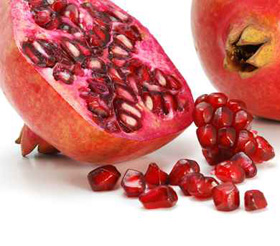
The man tells his lover that “The brow behind your veil [gleams] like a pomegranate split open.” (v. 7)

III. Important Verses
vv. 2-3: My beloved has gone down to his garden, To the beds of spices, To browse in the gardens And to pick lilies. I am my beloved’s And my beloved is mine; He browses among the lilies.
vv. 8-9: There are sixty queens, And eighty concubines, And damsels without number. Only one is my dove, My perfect one, The only one of her mother, The delight of her who bore her. Maidens see and acclaim her; Queens and concubines, and praise her.

IV. Outline
1. Friends ask about the whereabouts of the lover
2-3. The woman reiterates that the two belong to each other
4-10. The man praises the woman
11-12. An occurrence at a nut grove

V. Comment
No comment today. I hope to revisit this chapter at the end of the cycle. Stay tuned.

VI. Works Used
(see “Commentaries” page)
Murphy, Wisdom Literature (Forms of Old Testament Literature)
Photo taken from  http://www.thenibble.com/zine/archives/pomegranate_2900595.jpeg

Song of Songs 5 – “Love Lost”

Pillars

Hebrew-English Text
I. Summary
The woman expects to unite with her lover, but he is nowhere to be found. She then describes his physical characteristics to her friends.

II. Photo
The woman describes her lover in v. 15: “His legs are like marble pillars…”

III. Important Verses
v. 1: I have come to my garden, My own, my bride; I have plucked my myrrh and spice, Eaten my honey and honeycomb, Drunk my wine and my milk. Eat, lovers, and drink: Drink deep of love!
vv. 5-6: I rose to let in my beloved; My hands dripped myrrh — My fingers, flowing myrrh — Upon the handles of the bolt. I opened the door for my beloved, But my beloved had turned and gone. I was faint because of what he said. I sought, but found him not; I called, but he did not answer.
v. 8: I adjure you, O maidens of Jerusalem! If you meet my beloved, tell him this: That I am faint with love.
vv. 9-10: How is your beloved better than another, O fairest of women? How is your beloved better than another That you adjure us so? My beloved is clear-skinned and ruddy, Preeminent among ten thousand.

IV. Outline
1a. The man unites with the woman
1b. Exhortation for others to enjoy love
2-7. The woman loses her lover
8. Adjuration to friends
9. Friends request a description of the lover
10-16. The woman describes her lover’s body (complexion, head, hair, eyes, cheeks, lips, arms, torso, legs, mouth)

V. Comment
No comment today. I hope to revisit this chapter at the end of the cycle. Stay tuned.

VI. Works Used
(see “Commentaries” page)
Murphy, Wisdom Literature (Forms of Old Testament Literature)
Photo taken from http://www.ammlegal.com/images/Pillars.gif

Song of Songs 4 – “Praise and Desire”

AlfredoNetoMakeupEyesHebrew-English Text
I. Summary
The man praises his lover’s body. He then attempts to woo her, and she reciprocates.

II. Photo
The man speaks to his lover in v. 1: “Ah, you are fair, my darling, Ah, you are fair. Your eyes are like doves Behind your veil…”

III. Important Verses

v. 1: Ah, you are fair, my darling, Ah, you are fair. Your eyes are like doves Behind your veil. Your hair is like a flock of goats Streaming down Mount Gilead.
v. 5: Your breasts are like two fawns, Twins of a gazelle, Browsing among the lilies.
v. 7: Every part of you is fair, my darling, There is no blemish in you.
vv. 10-11: How sweet is your love, My own, my bride! How much more delightful your love than wine, Your ointments more fragrant Than any spice! Sweetness drops From your lips, O bride; Honey and milk Are under your tongue; And the scent of your robes Is like the scent of Lebanon.
v. 16: Awake, O north wind, Come, O south wind! Blow upon my garden, That its perfume may spread. Let my beloved come to his garden And enjoy its luscious fruits!

IV. Outline

1-7. The man tells his lover abour her beauty
    1a. Introduction
    1b-5. Praise of eyes, hair, teeth, mouth, face, neck, and breasts
    6. Declaration of intent
    7. Conclusion
8-15. The man’s song of admiration
    8. Invitation
    9-15. Descriptive metaphors
16. The woman invites the man

V. Comment
Chapter 4 contains two major units: the man’s description of his lover’s body (vv. 1-7), and the man’s song of admiration for his lover accompanied by her response (vv. 8-16). In terms of structure, the chapter contains the following inclusios: (1) v. 1 says hinnakh yafah “Ah, you are fair” and v. 7 says kullakh yafah “Every part of you is fair,” (2) v. 8 says itiy milevanon “From Lebanon come with me” and v. 11 says kereach levanon “like the scent of Lebanon,” and (3) v. 12 says gan na’ul “A garden locked” and v. 16 says ma‘yan gannim “a garden spring.” In regards to genre, Murphy writes that the first section is “a description of the physical beauty of one’s beloved. Such a description, which enumerates parts of the body in sequence, has become known by the Arabic term wasf. It has a long history in the Near East” (p. 114). For other examples of wasf in the Song of Songs, see 5:10-16 and 7:1-6.

The man invites the woman in v. 8: “From Lebanon come with me; From Lebanon, my bride, with me! Trip down from Amana’s peak, From the peak of Senir and Hermon, From the dens of lions, From the hills of leopards.” What does the mentioning of a mountain indicate? Also, are the lions and leopards significant? Garrett thinks that mountains and lions were associated with Ishtar, the Mesopotamian goddess of love and sexuality. He writes (p. 192, parentheses removed): “This strophe depicts the woman in goddesslike terms. She is high in the mountains of the north where she dwells with lions and leopards. Keel points out that the Anti-Lebanon range is the highest in the vicinity of Israel, attaining to a height of 3,088 meters above sea level… Keel also notes that cylinder seals from the Akkad period (ca. 2200) depict Ishtar ascending a mountain or standing with her foot on the back of a leashed lion, and he reproduces an Egyptian image of a nude goddess standing on a lion.” Thus, it is possible that the man is alluding to a conventional love motif when he speaks of mountains and lions.

The chapter is permeated with metaphors, many of which sound strange. For example, v. 2 says: “Your teeth are like a flock of ewes Climbing up from the washing pool; All of them bear twins, And not one loses her young.” Garrett tries to explain this phenomenon. He writes (p. 199): “A man from the southern United States might well compare his beloved’s beauty to that of a magnolia blossom or declare that his love for her is as enduring as the flow of the Mississippi. A man from Colorado or Alberta might in his mind merge his love for his wife with his love for the Rocky Mountains. A man from the coast of Maine might experience something of the same feelings when he looks at waves breaking into stony cliffs or smells the sea air as when he looks upon his wife or smells her fragrance. This does not mean that the woman is an allegory for these regions or that the local natural history is an allegory for the woman. Still less does it mean that the woman actually looks like or smells like the regional metaphors. One’s love of homeland is often localized in particulars—the bluebonnet flowers of Texas, the desert flora of Arizona, or the magpies of Korea. When a man loves his wife and loves his homeland, the two loves can merge in a way that is complementary and not competitive. So strong is this bond that a soldier at war in a distant land may perceive himself to be fighting to protect wife and country almost as though they were one and the same… For us who are outsiders to the ancient land of Israel and its pastoral ways, many of these comparisons sound strange if not comical. But for the audience that knew and loved this land and its ways, his praise of her would have been evocative of deep sentiments and thus would have told them why the man so loved this woman. Love for one’s spouse, like love for one’s homeland, is specific and bound to particulars.”

Before finishing the comment, it is important to note that the word kallah “bride” appears five times in vv. 8-12 (it appears once more in 5:1). Indeed, Hakham titles this chapter “The Bride’s Praise.” Garrett belives that “this canto depicts a bridegroom calling his new bride on their wedding night to their first union. He tenderly woos her, in effect seducing her rather than simply claiming his right as husband to her body… The point is that to truly be a bride she must descend to him and open her garden to him. Finally in Song 5:1, at the celebration of their sexual union (as I interpret it), he calls her “bride” for the last time. From that point forward, she is no longer a bride but a wife.”

VI. Works Used
(see “Commentaries” page)
Murphy, Wisdom Literature (Forms of Old Testament Literature)
Hakham, Chamesh Megillot: Shir Hashirim (Daat Mikra [Hebrew])
Garrett, Song of Songs (Word Biblical Commentary)

Photo taken from  http://www.bellydance-for-life.net/images/AlfredoNetoMakeupEyes.jpg