Daniel 4 – “The Feral King”

1075390_giant_tree_41Hebrew-English Text
I. Summary
Nebuchadnezzar has a dream, and Daniel interprets it for him as follows: God will humble Nebuchadnezzar by sending him off to the wilderness to live a feral lifestyle for seven years, but he will eventually be humbled before God and return to power. The prophecy comes true, and after seven years of animal life, Nebuchadnezzar returns to his throne as a God-fearing servant.

II. Photo
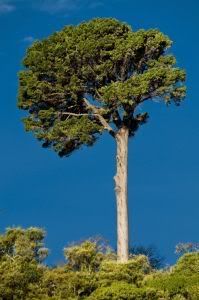
Nebuchadnezzar dreams of a giant tree : ”In the visions of my mind in bed I saw a tree of great height in the midst of the earth; The tree grew and became mighty; Its top reached heaven…” (vv. 7-8)

III. Important Verses
v. 5: Finally, Daniel, called Belteshazzar after the name of my god, in whom the spirit of the holy gods was, came to me, and I related the dream to him.
v. 16: Then Daniel, called Belteshazzar, was perplexed for a while, and alarmed by his thoughts. The king addressed him, “Let the dream and its meaning not alarm you.” Belteshazzar replied, “My lord, would that the dream were for your enemy and its meaning for your foe!
vv. 22, 24: You will be driven away from men and have your habitation with the beasts of the field. You will be fed grass like cattle, and be drenched with the dew of heaven; seven seasons will pass over you until you come to know that the Most High is sovereign over the realm of man, and He gives it to whom He wishes… Therefore, O king, may my advice be acceptable to you: Redeem your sins by beneficence and your iniquities by generosity to the poor; then your serenity may be extended.”
v. 34: So now I, Nebuchadnezzar, praise, exalt, and glorify the King of Heaven, all of whose works are just and whose ways are right, and who is able to humble those who behave arrogantly.”

IV. Outline
1-6. Nebuchadnezzar invites Daniel to interpret a dream
7-15. The dream is related
16-24. Daniel’s interpretation
25-34. Nebuchadnezzar is sent away for seven years, but returns to his previous glory and praises God

V. Comment
Like chapter 2, chapter 4 consists of Daniel’s interpreting one of Nebuchadnezzar’s dreams. In the story, Nebuchadnezzar is cast to the wilderness to live like an animal for seven years. He then returns to his throne, and just stops short of converting to Judaism. A major question of modern scholarship is, “Did this ever happen?” Collins writes: “Needless to say, there is no evidence that the historical Nebuchadnezzar was ever forced to eat grass like the beasts of the field. Attempts to diagnose his medical condition are beside the point. Indeed, we know something of the way in which this story developed. The last king of Babylon, Nabonidus, was absent from Babylon for several years. He spent the time in Teima, in the Arabian wilderness, and devoted himself to the worship of the moon-god. Because of his absence, he was reviled by the priests of Marduk in Babylon. Scholars have long suspected that the story of Nebuchadnezzar’s madness was originally a story about Nabonidus. This suspicion was confirmed by the discovery among the Dead Sea Scrolls of an Aramaic text called the Prayer of Nabonidus. This text is introduced as ‘the words of the prayer that Nabonidus… prayed,’ but the fragments do not preserve a prayer. Instead they preserve Nabonidus’s account of how he was ‘stricken with an evil disease by the decree of God in Teima.’ He was smitten for seven years, but was eventually restored when a Jewish diviner explained to him that he should pray, not to idols, but to the true God. The story in Daniel 4 is evidently an elaboration of this tradition.” (560) If the story is indeed about Nabonidus, why would the story be attributed to Nebuchadnezzar? Collins speculates: “The name of Nebuchadnezzar was substituted for that of Nabonidus, because he was much better known.” Indeed, chapter 5 speaks about how the empire “Nebuchadnezzar’s son” was overthrown, but historically speaking it was actually Nabonidus’ son who was overtaken.

Seeing that the prayer of Nabonidus is quite short, I will quote it in full (Context of Scripture, 1.89):
Superscription: The Afflictions of Nabonidus (1–2a)
(Concerning) words of p[ra]yer of Nabonidus, king of [Ba]bylon, [the Great] King, [when he was stricken] with a pernicious inflammation by the decree of G[o]d, in [the municipality of] Teman.

A First-Person Account of Nabonidus’ Affliction and Healing (2b-4a)
I was stricken for seven years, and ever since [that time] I became comparable [with the beasts. Then I prayed before God], and (as for) my offense  – he forgave it.

Recapitulation: It was a Jewish Diviner who Revealed to Nabonidus How He Could Be Healed (4b-8)
A diviner, who was himself a Jew fro[m among the exilic community of Judea], provided an interpretation, and wrote (instructions) to render honor and greatness to the name of G[od. And so did he write]: “You were stricken with a pernicious inflammation [by the decree of God in the municipality of Teman, but ] you continued for seven years to pray [before] gods of silver and gold, [bronze and iron], wood and stone (and) clay, because [you were of the opin]ion that t[hey were] (true) divinities.”

VI. Works Used
(see “Commentaries” page)
Collins, John J. Introduction to the Hebrew Bible (Minneaolis: Fortress Press, 2004).
Photo taken from  http://i357.photobucket.com/albums/oo14/swangirl/1075390_giant_tree_41.jpg

Daniel 3 – “The Fiery Furnace”

Oberon-Studios-Inferno-68068Hebrew-English Text
I. Summary
Nebucchadnezzar creates a golden statue, but Hananiah, Mishael, and Azariah (a.k.a. Shadrach, Meshach, and Abed-nego) refuse to bow before it. The three are thrown into a fiery furnace, but they emerge unscathed. Nebuchadnezzar is impressed; he promotes the three to important public positions and emphatically praises their God.

II. Photo
The furnace that Hananiah, Mishael, and Azariah are thrown into is described in v. 19: “Nebuchadnezzar was so filled with rage at Shadrach, Meshach, and Abed-nego that his visage was distorted, and he gave an order to heat up the furnace to seven times its usual heat!”

III. Important Verses
vv. 4-6: The herald proclaimed in a loud voice, “You are commanded, O peoples and nations of every language, when you hear the sound of the horn, pipe, zither, lyre, psaltery, bagpipe, and all other types of instruments, to fall down and worship the statue of gold that King Nebuchadnezzar has set up. Whoever will not fall down and worship shall at once be thrown into a burning fiery furnace.”
vv. 16-18: Shadrach, Meshach, and Abed-nego said in reply to the king, “O Nebuchadnezzar, we have no need to answer you in this matter, for if so it must be, our God whom we serve is able to save us from the burning fiery furnace, and He will save us from your power, O king. But even if He does not, be it known to you, O king, that we will not serve your god or worship the statue of gold that you have set up.”
vv. 24-25: Then King Nebuchadnezzar was astonished and, rising in haste, addressed his companions, saying, “Did we not throw three men, bound, into the fire?” They spoke in reply, “Surely, O king.” He answered, “But I see four men walking about unbound and unharmed in the fire and the fourth looks like a divine being.”
vv. 31-33: “King Nebuchadnezzar to all people and nations of every language that inhabit the whole earth: May your well-being abound! The signs and wonders that the Most High God has worked for me I am pleased to relate. How great are His signs; how mighty His wonders! His kingdom is an everlasting kingdom, and His dominion endures throughout the generations.”

IV. Outline
1-7. Nebuchadnezzar builds a statue, and all must bow down
8-12. Chaldeans inform the king that Hananiah, Mishael, and Azariah will not bow
13-18. The three refuse the king’s command to bow
19-27. The three men survive a trial by fire and emerge unscathed
28-29. Nebuchadnezzar blesses their God
30. The three are promoted
31-33. Nebuchadnezzar’s hymn to God

V. Comment
Like the chapters before it, Daniel 3 relates how piety prevails in the face of danger. Yet, we are also told that the three friends do not expect to be saved: “Shadrach, Meshach, and Abed-nego said in reply to the king, ‘O Nebuchadnezzar, we have no need to answer you in this matter, for if so it must be, our God whom we serve is able to save us from the burning fiery furnace, and He will save us from your power, O king. But even if He does not, be it known to you, O king, that we will not serve your god or worship the statue of gold that you have set up.’” (vv. 16-18) In regards to composition, Scholars note that Daniel does not play a significant role in chapter 3, and the three friends are almost non-existent in chapter 2. This has led some to believe that there was once two stories – one of Daniel and one of the three friends – that were eventually combined.

Collins notes a significant difference between the Greek and Hebrew versions of the text: “In Daniel 3, of course, the heroes are delivered unscathed. The king sees a fourth person in the furnace who has the appearance of a god. The Greek edition of the story has a fuller text at this point: ‘the angel of the Lord came down into the furnace… and made the inside of the furnace as though a moist wind were whistling through it.’ The Greek version also contains two long prayers, the Prayer of Azariah and the Song of the Three Young Men, which have no counterpart in Hebrew.” (559) Indeed, the Greek version is much longer. While the Masoretic text has 33 verses, the embellished LXX has 98 (!).

VI. Works Used
(see “Commentaries” page)

Collins, John J. Introduction to the Hebrew Bible (Minneaolis: Fortress Press, 2004).

Photo taken from http://images.easyart.com/i/prints/rw/lg/6/8/Oberon-Studios-Inferno-68068.jpg

Daniel 2 – “Daniel Interprets Nebuchadnezzar’s Dream”

Jewelry Site ImagesHebrew-English Text
I. Summary
Nebuchadnezzar is agitated by a dream, and he demands that his sorcerers relate its contents to him. The Babylonian sorcerers are unable to meet the challenge, but God relates the dream to Daniel. Daniel tells Nebuchadnezzar that he dreamed of a statue made of four metals, and that it was crushed by a stone. The dream indicates that there will be four kingdoms after Nebuchadnezzar’s, and the final one will last forever.

II. Photo
Nebuchadnezzar dreams of a statue made of heterogeneous metals: “The head of that statue was of fine gold; its breast and arms were of silver; its belly and thighs, of bronze; its legs were of iron, and its feet part iron and part clay.” (vv. 32-33)

III. Important Verses
vv. 5-6: The king said in reply to the Chaldeans, “I hereby decree: If you will not make the dream and its meaning known to me, you shall be torn limb from limb and your houses confiscated. But if you tell the dream and its meaning, you shall receive from me gifts, presents, and great honor; therefore, tell me the dream and its meaning.”
v. 10: The Chaldeans said in reply to the king, “There is no one on earth who can satisfy the king’s demand, for great king or ruler — none has ever asked such a thing of any magician, exorcist, or Chaldean.
vv. 19-20: The mystery was revealed to Daniel in a night vision; then Daniel blessed the God of Heaven. Daniel spoke up and said: “Let the name of God be blessed forever and ever, For wisdom and power are His…”
vv. 28-29: [Daniel said to Nebuchadnezzar:] “There is a God in heaven who reveals mysteries, and He has made known to King Nebuchadnezzar what is to be at the end of days. This is your dream and the vision that entered your mind in bed: O king, the thoughts that came to your mind in your bed are about future events; He who reveals mysteries has let you know what is to happen.”
v. 44: [Daniel related:] “And in the time of those kings, the God of Heaven will establish a kingdom that shall never be destroyed, a kingdom that shall not be transferred to another people. It will crush and wipe out all these kingdoms, but shall itself last forever.”
vv. 46-47: Then King Nebuchadnezzar prostrated himself and paid homage to Daniel and ordered that a meal offering and pleasing offerings be made to him. The king said in reply to Daniel, “Truly your God must be the God of gods and Lord of kings and the revealer of mysteries to have enabled you to reveal this mystery.”
vv. 48-49: The king then elevated Daniel and gave him very many gifts, and made him governor of the whole province of Babylon and chief prefect of all the wise men of Babylon. At Daniel’s request, the king appointed Shadrach, Meshach, and Abed-nego to administer the province of Babylon; while Daniel himself was at the king’s court.

IV. Outline

1. Nebuchadnezzar is agitated by a dream
2-11. None of the ministers could relate the kings dream
12. All wise men were condemned to death
13-19. The dream is revealed to Daniel
20-23. Daniel’s hymn in praise of God
24-45. Daniel relates the dream to Nebuchadnezzar
    24-30. Introduction
    31-35. The dream
    36-45. The interpretation
46-47. Nebuchadnezzar genuflects before Daniel
48-49. Daniel and the friends’ rise in stature

V. Comment
Due to the fact that it speaks about a nation which will rise to power and “last forever,” Daniel 2 is a paragon of “apocalyptic” literature. While Daniel does not divulge the everlasting nation’s identity, he is probably speaking about the Jewish nation.

Nebuchadnezzar’s dream was about a statue with four types of metal (gold, silver, bronze, and iron mixed with clay). Collins writes: “There are ancient parallels for the representation of history by a sequence of metals of declining value, even if they are not in the form of a statue. The Greek poet Hesiod, who wrote about 700 B.C.E., described history as a sequence of five ages – golden, silver, bronze, a fourth that is not identified with a metal, and iron… A closer parallel to Daniel is found in a Persian text, the Bahman Yasht, chapter 1. There we read that the supreme god, Ahura Mazda, revealed to Zoroaster “the wisdom of all-knowledge” in a vision of a tree with four branches. One branch was of gold, one of silver, one of bronze, and the fourth of mixed iron. The golden age was the time of Zoroaster. The iron age would be dominated by the “divs with disheveled hair,” which is generally taken as a reference to the Greeks. The Bahman Yasht in its current form is relatively late (after the sixth century C.E.), but it is likely that the original Yasht dates from the early Hellenistic period. We need not assume, however, that Daniel was directly influenced by the Persian text, although that is possible. More likely, the schema by which ages or kingdoms were represented by metals was widely known in the ancient Near East.” (556-557)

In regards to another ancient Near Eastern parallel, Collins writes: “Daniel’s interpretation of the statue also draws on another widely known pattern: the idea that a sequence of four kingdoms would be followed by a lasting fifth one. Several Greek and Roman sources describe the sequence as follows: first Assyria, second Media, third Persia, fourth Greece, and finally Rome. This view of history seems to have developed in Persia, since Media never had an important role in the west. People in the Near East would not have looked to Rome as the final kingdom, but would rather have hoped for a restoration of their native kingship, which had beeen overrun by Alexander the Great in 334-323 B.C.E.” (557)

Who are the four kingdoms? Daniel already told Nebuchadnezzar that his kingdom (Babylon) is the first (vv. 37-38). Although Daniel doesn’t divulge any additional information in this chapter, it is clear from 9:1 that Media is next in line, and the Medes are followed by Persia (10:1) and Greece (10:20). Thus, the four kingdoms are Babylon, Media, Persia, and Greece. Collins notes that “The presence of Media, however, can be explained only by reference to the schema of the four kingdoms. Media never ruled over the Jews, and no such person as Darius the Mede ever existed. (There were three Persian kings called Darius, all after Cyrus.)” (557)

VI. Works Used
(see “Commentaries” page)
Collins, John J. Introduction to the Hebrew Bible (Minneaolis: Fortress Press, 2004).
Photo taken from http://www.khulsey.com/jewelry/main_metals.jpeg

Daniel 1 – “Four Judean Boys Arrive in Babylon”

legumesHebrew-English Text
I. Summary
King Nebuchadnezzar captures Judea, and he takes a group of first-rate boys back with him to Babylon. Although Daniel, Hananiah, Mishael, and Azariah choose to abstain from the king’s food and wine, God grants them strength, health, and wisdom. They quickly distinguish themselves from the rest of the group and find favor with the king.

II. Photo
While Nebuchadnezzar’s guards want to force-feed the boys, Daniel responds: “Please test your servants for ten days, giving us legumes to eat and water to drink. Then compare our appearance with that of the youths who eat of the king’s food, and do with your servants as you see fit.” (vv. 12-13) The plan worked – the four boys looked healthier than their counterparts.

III. Important Verses
vv. 3-6: Then the king ordered Ashpenaz, his chief officer, to bring some Israelites of royal descent and of the nobility — youths without blemish, handsome, proficient in all wisdom, knowledgeable and intelligent, and capable of serving in the royal palace — and teach them the writings and the language of the Chaldeans. The king allotted daily rations to them from the king’s food and from the wine he drank. They were to be educated for three years, at the end of which they were to enter the king’s service.  Among them were the Judahites Daniel, Hananiah, Mishael and Azariah.
v. 8: Daniel resolved not to defile himself with the king’s food or the wine he drank, so he sought permission of the chief officer not to defile himself,
v. 17: God made all four of these young men intelligent and proficient in all writings and wisdom, and Daniel had understanding of visions and dreams of all kinds.
vv. 19-20: The king spoke with them, and of them all none was equal to Daniel, Hananiah, Mishael and Azariah; so these entered the king’s service. Whenever the king put a question to them requiring wisdom and understanding, he found them to be ten times better than all the magicians and exorcists throughout his realm.

IV. Outline
1-2. Nebuchadnezzar conquers Judah
3-5. A group of noble Judeans are chosen to serve serve Nebuchadnezzar
6-7. Daniel, Hananiah, Mishael, and Azariah are introduced as being amongst the group
8-16. The four choose to eat legumes and drink water in place of the king’s food and wine, and they are in better shape than their peers
17. God grants the four wisdom
18-21. The four impress the king and outperform the other necromancers

V. Comment
Chapter 1 begins by relating how Daniel and his friends arrive in Babylon, and how they act once they arrived. Collins, who gives a succinct and discerning introduction to the book, writes the following: “The book of Daniel is exceptional in many respects. It is probably the latest composition in the Hebrew Bible. Like the book of Ezra, it is written partly in Hebrew and partly in Aramaic… Daniel is placed among the Writings [in the Hebrew Bible]. It may be that the canon of prophetic writings was already closed when Daniel was written. It may also be that the rabbis saw the book as having more in common with the Writings than with the Prophets.” (553)

He outlines the book as follows: “As found in the Hebrew Bible, the book falls into two sections. The first six chapters are stories about Daniel and his friends, who were allegedly among the exiles deported from Jerusalem by Nebuchadnezzar, at the Babylonian and Persian courts. The second half of the book, chapters 7-12, consists of a series of revelations to Daniel, which are explained to him by an angel… One of the oddities of the book is that the division by language does not fully coincide with the division by genre. Chapters 2-7 (strictly, 2:4b-7:28) are in Aramaic. Chapter 1 and chapters 8-12 are in Hebrew.” (ibid.)

In order to understand why the book takes the particular shape that it does, scholars speculate about the process of its composition. Collins writes, “It seems that the book was written in stages. The Aramaic stories in chapters 2-6 originally circulated independently. Chapter 1 was written as an introduction to these stories, presumably in Aramaic. The first of the visions, in chapter 7, was composed in Aramaic for continuity with the tales. The remaining chapters were added in Hebrew, presumably because of patriotic fervor at the time of the Maccabean revolt. The opening chapter was then translated into Hebrew, so that the beginning and end of the book would be in Hebrew, forming an inclusio. This explanation is, of course, hypothetical, but it gives a plausible account of the way the book took shape.” (553-554)

VI. Works Used
(see “Commentaries” page)
Collins, John J. Introduction to the Hebrew Bible (Minneaolis: Fortress Press, 2004).
Photo taken from  http://www.dietriffic.com/wp-content/uploads/2007/09/legumes.jpg

Esther 10 – “Epilogue”

070615.persian-180Hebrew-English Text
I. Summary
The book ends with a brief epilogue that describes Mordecai’s considerable power and unwavering allegiance to his people.

II. Photo
Mordecai’s story was written down: “All his mighty and powerful acts, and a full account of the greatness to which the king advanced Mordecai, are recorded in the Annals of the Kings of Media and Persia.” (v. 2)

III. Important Verses
v. 2: All his mighty and powerful acts, and a full account of the greatness to which the king advanced Mordecai, are recorded in the Annals of the Kings of Media and Persia.
v. 3: For Mordecai the Jew ranked next to King Ahasuerus and was highly regarded by the Jews and popular with the multitude of his brethren; he sought the good of his people and interceded for the welfare of all his kindred.

IV. Outline
1. Ahasuerus’ tax
2. A historical note
3. Mordecai’s power, popularity, and Jewish commitment

V. Comment
No comment today. Stay tuned.

VI. Works Used
(see “Commentaries” page)
Murphy, Wisdom Literature (Forms of Old Testament Literature)
Photo taken from  http://www-news.uchicago.edu/releases/07/images/070615.persian-180.jpg

Esther 9 – “Jewish Revenge; The Holiday of Purim”

T312327AHebrew-English Text
I. Summary
The Jews of the empire attack their enemies on the 13th and 14th of the month of Adar. Mordecai and Esther then institute the holiday of Purim for the 14th and 15th of Adar, the days when the Jewish people first experienced relief.

II. Photo
The origins of the name “Purim” is described in vv. 24, 26: “For Haman son of Hammedatha the Agagite, the foe of all the Jews, had plotted to destroy the Jews, and had cast pur — that is, the lot — with intent to crush and exterminate them… For that reason these days were named Purim, after pur…”

III. Important Verses
v. 6: In the fortress Shushan the Jews killed a total of five hundred men.
vv. 16-19: The rest of the Jews, those in the king’s provinces, likewise mustered and fought for their lives. They disposed of their enemies, killing seventy-five thousand of their foes; but they did not lay hands on the spoil. That was on the thirteenth day of the month of Adar; and they rested on the fourteenth day and made it a day of feasting and merrymaking. (But the Jews in Shushan mustered on both the thirteenth and fourteenth days, and so rested on the fifteenth, and made it a day of feasting and merrymaking.) That is why village Jews, who live in unwalled towns, observe the fourteenth day of the month of Adar and make it a day of merrymaking and feasting, and as a holiday and an occasion for sending gifts to one another.
vv. 24, 26:  For Haman son of Hammedatha the Agagite, the foe of all the Jews, had plotted to destroy the Jews, and had cast pur — that is, the lot — with intent to crush and exterminate them… For that reason these days were named Purim, after pur…
v. 28: Consequently, these days are recalled and observed in every generation: by every family, every province, and every city. And these days of Purim shall never cease among the Jews, and the memory of them shall never perish among their descendants.

IV. Outline
1-10. The Jews of Shushan kill their enemies on the 13th of Adar
11-15. The Jews of Shushan repeat the carnage on the 14th of Adar
16. The Jews in the provinces kill seventy-five thousand of their foes
17-19. A note about Purim’s observance
20-23. Mordecai institutes the Purim holiday
24-26a. The name “Purim”
26b-28. The Jews accept the holiday for all generations
29-32. Esther corroborates Mordecai’s decree

V. Comment
No comment today. Stay tuned.

VI. Works Used
(see “Commentaries” page)
Murphy, Wisdom Literature (Forms of Old Testament Literature)
Photo taken from  http://images.encarta.msn.com/xrefmedia/sharemed/targets/images/pho/t312/T312327A.jpg

Esther 8 – “A Period of Jewish Strength and Pride”

Satin_Royal_Blue_jpgHebrew-English Text
I. Summary
Ahasuerus appoints Mordecai to replace Haman and to take hold of his estate. Mordecai issues a new decree in favor of the Jews, and the Jews enjoy a period of strength and pride.

II. Photo
Mordecai’s status is elevated in v. 15: “Mordecai left the king’s presence in royal robes of blue and white, with a magnificent crown of gold and a mantle of fine linen and purple wool…”

III. Important Verses
v. 2: The king slipped off his ring, which he had taken back from Haman, and gave it to Mordecai; and Esther put Mordecai in charge of Haman’s property.
vv. 10-12: He had them written in the name of King Ahasuerus and sealed with the king’s signet. Letters were dispatched by mounted couriers, riding steeds used in the king’s service, bred of the royal stud, to this effect: The king has permitted the Jews of every city to assemble and fight for their lives; if any people or province attacks them, they may destroy, massacre, and exterminate its armed force together with women and children, and plunder their possessions — on a single day in all the provinces of King Ahasuerus, namely, on the thirteenth day of the twelfth month, that is, the month of Adar.
vv. 16-17: The Jews enjoyed light and gladness, happiness and honor. And in every province and in every city, when the king’s command and decree arrived, there was gladness and joy among the Jews, a feast and a holiday. And many of the people of the land professed to be Jews, for the fear of the Jews had fallen upon them.

IV. Outline
1-2. Mordecai’s rise to power
3-14. Haman’s decree is repealed
15-17. Jewish pride and jubilation

V. Comment
No comment today. Stay tuned.

VI. Works Used
(see “Commentaries” page)
Murphy, Wisdom Literature (Forms of Old Testament Literature)
Photo taken from http://www.cheapchaircovers.com/_images/ProductIcons/SatinLarge/Satin_Royal_Blue_jpg.jpg

Esther 7 – “The Death of Haman”

noose2Hebrew-English Text
I. Summary
Esther pleads with Ahasuerus on behalf of her people, and incriminates Haman in the process. Haman is subsequently killed on the same gallows that he had prepared for Mordecai.

II. Photo
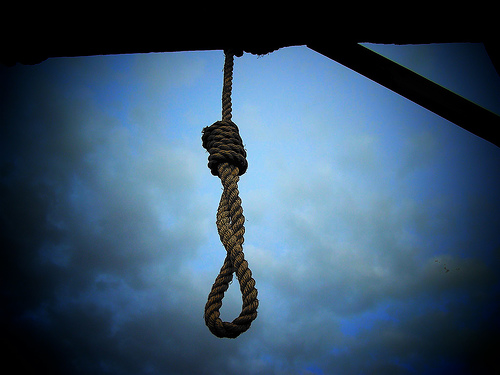
Haman is hanged in v. 10: “So they hanged Haman on the gallows that he had prepared for Mordecai. Then the king’s wrath subsided.”

III. Important Verses
vv.  3-4: Queen Esther replied: “If Your Majesty will do me the favor, and if it pleases Your Majesty, let my life be granted me as my wish, and my people as my request. For we have been sold, my people and I, to be destroyed, massacred, and exterminated. Had we only been sold as bondmen and bondwomen, I would have kept silent; for the adversary is not worthy of the king’s trouble.”
v. 8: When the king returned from the palace garden to the banquet room, Haman was lying prostrate on the couch on which Esther reclined. “Does he mean,” cried the king, “to ravish the queen in my own palace?” No sooner did these words leave the king’s lips than Haman’s face was covered.
v. 10: So they impaled Haman on the stake which he had put up for Mordecai, and the king’s fury abated.

IV. Outline
1-8. Esther blames Haman
9-10. Haman is killed

V. Comment
No comment today. Stay tuned.

VI. Works Used
(see “Commentaries” page)
Murphy, Wisdom Literature (Forms of Old Testament Literature)
Photo taken from  http://nicolen.files.wordpress.com/2007/10/noose2.jpg