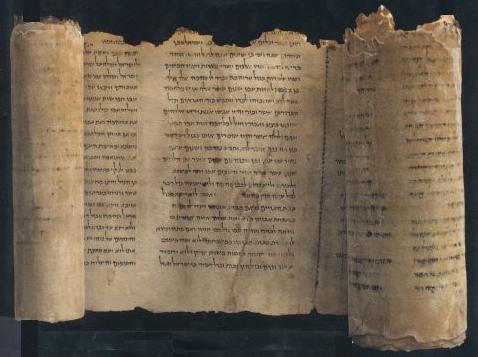
Zechariah 7 – “God Criticizes the People”

Hebrew-English Text
I. Summary
God tells the people to keep fasting and blames them for their exile.

II. Photo
God parrots the people: “Just as when [God] called they would not listen, ‘So,’ said the Lord of Hosts, ‘let them call and I will not listen.’” (v. 13)

III. Select Verses
5-7: Say to all the people of the land and to the priests: When you fasted and lamented in the fifth and seventh months all these seventy years, did you fast for my benefit? And when you eat and drink, who but you does the eating, and who but you does the drinking?  Look, this is the message that the LORD proclaimed through the earlier prophets, when Jerusalem and the towns about her were peopled and tranquil, when the Negeb and the Shephelah were peopled.
9-10: Thus said the LORD of Hosts: Execute true justice; deal loyally and compassionately with one another. Do not defraud the widow, the orphan, the stranger, and the poor; and do not plot evil against one another.
11-12: But they refused to pay heed. They presented a balky back and turned a deaf ear. They hardened their hearts like adamant against heeding the instruction and admonition that the LORD of Hosts sent to them by His spirit through the earlier prophets; and a terrible wrath issued from the LORD of Hosts.
14: I dispersed them among all those nations which they had not known, and the land was left behind them desolate, without any who came and went. They caused a delightful land to be turned into a desolation.

IV. Outline

1-3. Introduction
    1. Time period
    2-3. A message for God
4-7. Oracle #1
    4. Introduction
    5-7. God tells the people to fast
8-14. Oracle #2
    8. Introduction
    9-10. Live with kindness and fairness
    11-13. The people ignored God
    14. God exiled the people and desolated their land

V. Comment
Chapter 7 begins with people asking about the fast of the seventh month. In fact, Smith points out that fasting is a common theme in the book of Zechariah: “Four different fasts are mentioned by Zechariah: one in the fourth month (8:18), the fifth month (7:3; 8:18), the seventh month (7:5, 8:18), and the tenth month (8:18). Zechariah does not identify the specific day of each of these tour months on which the fasts were held or the occasion(s) commemorated by the fasts. Ackroyd (207) suggests that the fast of the tenth month was in memory of the siege of Jerusalem in 588 BC (cf 2 Kgs 25:1). The fast of the fourth month probably commemorated the capture of Jerusalem in 587 BC (cf 2 Kgs 25:2–3; Jer 39:2). The fast of the fifth month was for the burning of the temple in 587 BC (2 Kgs 25:8), and the fast of the seventh month was probably for remembering the assassination of Gedaliah, the governor of Judah after the fall of Jerusalem (2 Kgs 25:25; Jer 41:1–2). However, the fast of the seventh month could refer to the Day of Atonement.” (222-223)

VI. Works Used
(see “Commentaries” page)
Collins, John J. “Introduction to the Hebrew Bible,” (Minneapolis: Fortress Press, 2004).
Smith, Ralph L. “Micah – Malachi” World Biblical Commentary v. 32 (Word Books: 1984).
Photo taken from http://img528.imageshack.us/img528/3294/headachexm6.gif

Zechariah 6 – “Four Chariots; Tzemah the Temple Builder”

Hebrew-English Text
I. Summary
Zechariah sees four chariots and God tells him that a man named Zemah will build the temple.

II. Photo
Zechariah has a vision: “Four chariots were coming out from between the two mountains… the horses of the second chariot were black.” (vv. 1-2)

III. Select Verses
1-5: I looked up again, and I saw: Four chariots were coming out from between the two mountains; the mountains were of copper. The horses of the first chariot were bay, the horses of the second chariot were black;  the horses of the third chariot were white, and the horses of the fourth chariot were spotted — dappled. And I spoke up and asked the angel who talked with me: “What are those, my lord?” In reply, the angel said to me, “Those are the four winds of heaven coming out after presenting themselves to the Lord of all the earth.
11-13: Take silver and gold and make crowns. Place [one] on the head of High Priest Joshua son of Jehozadak, and say to him, “Thus said the LORD of Hosts: Behold, a man called the Branch shall branch out from the place where he is, and he shall build the Temple of the LORD. He shall build the Temple of the LORD and shall assume majesty, and he shall sit on his throne and rule. And there shall also be a priest seated on his throne, and harmonious understanding shall prevail between them.”
15: Men from far away shall come and take part in the building of the Temple of the LORD, and you shall know that I have been sent to you by the LORD of Hosts — if only you will obey the LORD your God!

IV. Outline

1-8. Vision of four chariots and the interpretation
    1-3. The vision
    4-8. The interpretation
9-15. God speaks to Zechariah
    9. Introduction
    10-11. Crowning Joshua the high priest
    12-13. Tzemah, the builder of the temple
    14. The two crowns
    15. The builders of the temple

V. Comment
No comment today. Stay tuned.

VI. Works Used
(see “Commentaries” page)
Collins, John J. “Introduction to the Hebrew Bible,” (Minneapolis: Fortress Press, 2004).
Photo taken from http://znn2009.freeblog.hu/files/horses%20in%20the%20snow.png

Zechariah 5 – “Two More Visions”

Hebrew-English Text
I. Summary
Zechariah has visions of a flying scroll and a magical pot.

II. Photo
Zechariah has a vision: “’What do you see?’ he asked. And I replied, ‘A flying scroll, twenty cubits long and ten cubits wide.’” (v. 2)

III. Select Verses
1-4: I looked up again, and I saw a flying scroll.  “What do you see?” he asked. And I replied, “A flying scroll, twenty cubits long and ten cubits wide.”  “That,” he explained to me, “is the curse which goes out over the whole land. For everyone who has stolen, as is forbidden on one side [of the scroll], has gone unpunished; and everyone who has sworn [falsely], as is forbidden on the other side of it, has gone unpunished.  [But] I have sent it forth — declares the LORD of Hosts — and [the curse] shall enter the house of the thief and the house of the one who swears falsely by My name, and it shall lodge inside their houses and shall consume them to the last timber and stone.”
7-11: And behold, a disk of lead was lifted, revealing a woman seated inside the tub.  “That,” he said, “is Wickedness”; and, thrusting her down into the tub, he pressed the leaden weight into its mouth. I looked up again and saw two women come soaring with the wind in their wings — they had wings like those of a stork — and carry off the tub between earth and sky.  “Where are they taking the tub?” I asked the angel who talked with me. And he answered, “To build a shrine for it in the land of Shinar; [a stand] shall be erected for it, and it shall be set down there upon the stand.”

IV. Outline
1-4. Vision of a flying scroll and its interpretation
5-11. Vision of a lead tub, a sitting woman, and two women with wings

V. Comment
Chapter 5 relates two vision reports, the first about a scroll and the second about a lead vessel that is brought to the land of Shinar. Where is the land of Shinar? Davila writes that Shinar is “a name for the region of Babylonia (Gen 10:10). It can be called either the “land of Shinar” or simply “Shinar.” The first mention of the “land of Shinar” (Gen 10:10…) calls it the mainstay or beginning of the kingdom of Nimrod. In it were found the cities Babel (Babylon), Accad (Agade), Erech (Uruk), and possibly Calneh. According to Gen 11:2 the early human race settled in a valley in the “land of Shinar” and began to build the abortive Tower of Babel. Abraham had a hostile encounter with a coalition of four kings, one of whom was “Amraphel king of Shinar” (Gen 14:1, 9). When the Israelites were thwarted in their conquest of Ai because Achan had stolen some of the “devoted things,” one of the items he stole was a (presumably valuable) “cloak of Shinar” (Josh 7:21). An oracle in the book of Isaiah promises that a remnant of Yahweh’s people will be returned from many places, including “Shinar” (Isa 11:11). After the Exile the prophet Zechariah saw a vision in which the sin of the people, personified as a woman, is transported to the “land of Shinar” in an ephah (a large container) and set up in a temple there (Zech 5:11). The book of Daniel relates that Nebuchadnezzar, king of Babylon, removed some of the vessels from the temple of God in Jerusalem and took them to the “land of Shinar,” where he placed them in the temple treasury of his own god (Dan 1:2).
“The meaning of Shinar is clear from the biblical references. It is the area known to the Mesopotamians as “the land of Sumer and Akkad,” corresponding to the portion of modern Iraq S of Baghdad. This meaning is confirmed by the LXX, Targum Onqelos, and the Genesis Apocryphon. All three sometimes translate “Shinar” as Babylon(ia).
“The question of the origin of the name “Shinar” is more difficult. It first appears in Egypt in the 15th century B.C.E. as Sngr. In cuneiform texts of roughly the same period it is SÁanh˙aru. One suggestion is that Shinar is derived from “Sumer.” This identification, however, is phonologically impossible, since it cannot explain the origin of the third consonant ({ayin, original géayin), which never appears in any form of “Sumer.” A more plausible etymology has recently been proposed by Ran Zadok (1984). He believes that Shinar derives from cuneiform Samh˙aru®, apparently the name of a Kassite tribe. The Kassites were rulers of Babylon during the period when the term “Shinar” was used in Egyptian and cuneiform sources. There is no strong phonological objection to this etymology, and it may be that peoples W of the Euphrates generalized the name of a familiar Kassite tribe until it became a term for the whole region of Babylonia. Such generalizations are common. For example, the Greeks called themselves “Hellenes,” but the Roman word for them was “Greeks,” Graeci, Graii, after a Hellene tribal name or geographical location.”  (“Shinar (Place), Anchor Bible Dictionary, 5:1,220)

VI. Works Used
(see “Commentaries” page)
Collins, John J. “Introduction to the Hebrew Bible,” (Minneapolis: Fortress Press, 2004).
Photo taken from http://www.johnpratt.com/items/docs/lds/meridian/2003/images/scroll.jpg

Zechariah 4 – “A Message for Zerubbabel”

Hebrew-English Text
I. Summary
Zerubbabel will successfully build the temple.

II. Photo
Zechariah has a vision: “He said to me, ‘What do you see?’ And I answered, ‘I see a lampstand all of gold, with a bowl above it.’” (v. 2a)

III. Select Verses
1: The angel who talked with me came back and woke me as a man is wakened from sleep.
2-3: He said to me, “What do you see?” And I answered, “I see a lampstand all of gold, with a bowl above it. The lamps on it are seven in number, and the lamps above it have seven pipes; and by it are two olive trees, one on the right of the bowl and one on its left.”
6-7: Then he explained to me as follows: “This is the word of the LORD to Zerubbabel: Not by might, nor by power, but by My spirit — said the LORD of Hosts. Whoever you are, O great mountain in the path of Zerubbabel, turn into level ground! For he shall produce that excellent stone; it shall be greeted with shouts of ‘Beautiful! Beautiful!’”
10b-14: “Those seven are the eyes of the LORD, ranging over the whole earth.” “And what,” I asked him, “are those two olive trees, one on the right and one on the left of the lampstand?”  And I further asked him, “What are the two tops of the olive trees that feed their gold through those two golden tubes?”  He asked me, “Don’t you know what they are?” And I replied, “No, my lord.” Then he explained, “They are the two anointed dignitaries who attend the Lord of all the earth.”

IV. Outline
1. Zechariah is woken
2-3. The seven branched lamp and the olive trees
4-6a. Introduction to the interpretation
6b-7. Oracle for Zerubbabel
8. Second Introduction
9-10a. Zerubbabel will succeed with God’s help
10b-14. The interpretation

V. Comment
No comment today. Stay tuned.

VI. Works Used
(see “Commentaries” page)
Collins, John J. “Introduction to the Hebrew Bible,” (Minneapolis: Fortress Press, 2004).
Photo taken from http://theartblog.org/blog/wp-content/uploaded/bowl.jpg

Zechariah 3 – “Joshua Encounters God”

Hebrew-English Text
I. Summary
Zechariah sees Joshua the high priest standing before a divine council. God rebukes the Satan, promises to remove Israel’s guilt, and vows to bring peace to the land.

II. Photo
God will bring prosperity: “In that day — declares the Lord of Hosts — you will be inviting each other to the shade of vines and fig trees.” (v. 10)

III. Select Verses
1-2: He further showed me Joshua, the high priest, standing before the angel of the LORD, and the Accuser standing at his right to accuse him. But the angel of the LORD said to the Accuser,“The LORD rebuke you, O Accuser; may the LORD who has chosen Jerusalem rebuke you! For this is a brand plucked from the fire.”
3-4: Now Joshua was clothed in filthy garments when he stood before the angel.  The latter spoke up and said to his attendants, “Take the filthy garments off him!” And he said to him, “See, I have removed your guilt from you, and you shall be clothed in [priestly] robes.”
6-7: And the angel of the LORD charged Joshua as follows:  “Thus said the LORD of Hosts: If you walk in My paths and keep My charge, you in turn will rule My House and guard My courts, and I will permit you to move about among these attendants.
10: In that day — declares the LORD of Hosts — you will be inviting each other to the shade of vines and fig trees.”

IV. Outline
1. Joshua stands with God’s angel and the Satan
2. God will reprimand the Satan
3-4. Joshua removes his filthy clothes and the interpretation
5. Joshua is given a headband
6-7. Joshua is told to follow God and promised a reward
8-9. Act and its interpretation
10. Future blessing

V. Comment
No comment today. Stay tuned.

VI. Works Used
(see “Commentaries” page)
Collins, John J. “Introduction to the Hebrew Bible,” (Minneapolis: Fortress Press, 2004).
Photo taken from http://www.roomu.net/files/user2/parras.jpg

Zechariah 2 – “Visions and Interpretations; God Will Return to Jerusalem”

Hebrew-English Text
I. Summary
Zechariah has visions and his angel relates their meaning. God promises to return to Jerusalem.

II. Photo
Zechariah has a vision: “I looked up, and I saw a man holding a measuring line. ‘Where are you going?’ I asked. ‘To measure Jerusalem,’ he replied, ‘to see how long and wide it is to be.’” (vv. 5-6)

III. Selected Verses
1-4: I looked up, and I saw four horns. I asked the angel who talked with me, “What are those?” “Those,” he replied, “are the horns that tossed Judah, Israel, and Jerusalem.” Then the LORD showed me four smiths.  “What are they coming to do?” I asked. He replied: “Those are the horns that tossed Judah, so that no man could raise his head; and these men have come to throw them into a panic, to hew down the horns of the nations that raise a horn against the land of Judah, to toss it.”
11-12: Away, escape, O Zion, you who dwell in Fair Babylon! For thus said the LORD of Hosts — He who sent me after glory — concerning the nations that have taken you as spoil: “Whoever touches you touches the pupil of his own eye.
14: Shout for joy, Fair Zion! For lo, I come; and I will dwell in your midst — declares the LORD.
16: The LORD will take Judah to Himself as His portion in the Holy Land, and He will choose Jerusalem once more.

IV. Outline

1-2. Vision of horns and the interpretation
3-4. Vision of artisans and the interpretation
5-9. Vision of a man measuring Jerusalem and its interpretation
10-14. Oracle
    10-11. Zion should return
    12-13. The punishers will be punished
    14. God will return to Zion
15a. The nations will return to God
15b. Recognition of God formula
16. God will return to Jerusalem
17. Awe of God

V. Comment
No comment today. Stay tuned.

VI. Works Used
(see “Commentaries” page)
Collins, John J. “Introduction to the Hebrew Bible,” (Minneapolis: Fortress Press, 2004).
Photo taken from http://www.treklens.com/gallery/photo19154.htm

Zechariah 1 – “God’s Plea; Zechariah’s Night Vision”

Hebrew-English Text
I. Summary
God urges the people to return to him, Zechariah sees a man with supernatural horses, and an angel convinces God to rebuild the temple.

II. Photo
Zechariah has a night vision: “In the night, I had a vision. I saw a man, mounted on a bay horse, standing among the myrtles in the deep.” (v. 8a)

III. Selected Verses
1: In the eighth month of the second year of Darius, this word of the LORD came to the prophet Zechariah son of Berechiah son of Iddo.
3b-4: Thus said the LORD of Hosts: Turn back to me — says the LORD of Hosts — and I will turn back to you — said the LORD of Hosts. Do not be like your fathers! For when the earlier prophets called to them, “Thus said the LORD of Hosts: Come, turn back from your evil ways and your evil deeds, they did not obey or give heed to Me — declares the LORD.
12-13: Thereupon the angel of the LORD exclaimed, “O LORD of Hosts! How long will You withhold pardon from Jerusalem and the towns of Judah, which You placed under a curse seventy years ago?” The LORD replied with kind, comforting words to the angel who talked with me.
16-17: Assuredly, thus said the LORD: I graciously return to Jerusalem. My House shall be built in her — declares the LORD of Hosts — the measuring line is being applied to Jerusalem. Proclaim further: Thus said the LORD of Hosts: My towns shall yet overflow with bounty. For the LORD will again comfort Zion; He will choose Jerusalem again.”

IV. Outline

1-6. Oracle
    1. Superscription
    2. God’s anger at the fathers
    3-6. Plea for the people to return to God, unlike their fathers
7-17. Vision report
    7. Superscription
    8-11. A man with horses that roam the earth
    12. An angel petitions God about Jerusalem
    13. God comforts the angel
    14-15. Oracle: God is angry for Jerusalem
    16-17. God will rebuild the temple and Jerusalem

V. Comment
The book of Zechariah can be broken into two units, chapters 1-8 and 9-14, and some scholars call these sections First and Second Zechariah. While little is known about the man Zechariah, we are told that he prophesied during the second year of Darius (=520 BCE). This is corroborated by the book of Ezra: “Then the prophets, Haggai the prophet and Zechariah son of Iddo, prophesied to the Jews in Judah and Jerusalem, inspired by the God of Israel.” (Ezra 5:1) Similarly, Ezra 6:14-15 says: “So the elders of the Jews progressed in the building, urged on by the prophesying of Haggai the prophet and Zechariah son of Iddo, and they brought the building to completion under the aegis of the God of Israel and by the order of Cyrus and Darius and King Artaxerxes of Persia. The house was finished on the third of the month of Adar in the sixth year of the reign of King Darius.”

Chapter 1 begins with an oracle asking the people to return to God, and concludes with a vision report. Zechariah, who is accompanied by an angel, sees a man with horses who travel around world. Collins notes that Zechariah, who prophesied at the beginning of the Persian period, can be viewed as a “link” between the early prophets and the apocalyptic writers of the late and post biblical periods: “These visions are innovative in another respect: they are interpreted for the prophet by an angel (who is often called ‘the interpreting angel or angelus interpres in modern scholarship). There is some precedent for this kind of vision in the book of Amos, where the Lord asks Amos what he sees and then explains it to him (e.g., Amos 8:1-2, where a basket of summer fruit symbolizes the ‘end’ that is coming on Israel). Zechariah visions are more elaborate than those of Amos, but less elaborate than what we will find in the later apocalyptic visions of the book of Daniel. It may be significant that symbolic visions of this kind are also known in Persian tradition.  (In the Bahman Yasht, Zoroaster sees a tree with metal branches, which is explained to hum by the god Ahura Mazda.) It is possible that Zechariah’s visions reflect Persian influence, but the point cannot be proven. In any case, the introduction of the interpreting angel is a significant innovation in the Hebrew prophetic tradition. With respect to their literary form the visions of Zechariah may be said to mark a transitional stage between the visions of the older prophets and the later apocalyptic writers.” (405)

VI. Works Used
(see “Commentaries” page)
Collins, John J. “Introduction to the Hebrew Bible,” (Minneapolis: Fortress Press, 2004).
Photo taken from http://ucp.totfarm.com/pics/pic_11922174902222.jpg

Habakkuk 3 – “Habakkuk Praises Yahweh”

Hebrew-English Text
I. Summary
Habakkuk praises Yahweh’s glory, might, and control of nature.

II. Photo
Habakkuk describes Yahweh: “You will smash the roof of the villain’s house, raze it from foundation to top!” (v. 13)

III. Selected Verses
3-4: God is coming from Teman, The Holy One from Mount Paran. Selah. His majesty covers the skies, His splendor fills the earth: It is a brilliant light Which gives off rays on every side — And therein His glory is enveloped.
6: When He stands, He makes the earth shake; When He glances, He makes nations tremble. The age-old mountains are shattered, The primeval hills sink low. His are the ancient routes.
16: I heard and my bowels quaked, My lips quivered at the sound; Rot entered into my bone, I trembled where I stood. Yet I wait calmly for the day of distress, For a people to come to attack us.
17-19: Though the fig tree does not bud And no yield is on the vine, Though the olive crop has failed And the fields produce no grain, Though sheep have vanished from the fold And no cattle are in the pen, Yet will I rejoice in the LORD, Exult in the God who delivers me. My Lord GOD is my strength: He makes my feet like the deer’s And lets me stride upon the heights.

IV. Outline
1. Introduction
2a. Invocation
2b. Praise
2c. Petition for God to make himself known
3-6. God’s glory
7-9a. God’s might
9b-11. God’s control of nature
12-15. God will deliver his nation by punishing the villains
16. Habakkuk’s fear
17-19a. Trust in God
19b. Conclusion

V. Comment
Chapter 3 is a theophoric description of God’s glory and might. Habakkuk describes God as a divine warrior battling the “sea” (vv. 8, 15), and this theme is found in many other passages of the Hebrew Bible. Yet, this theme wasn’t explored with great detail until the 19th century. Oden Jr. writes: “Already at the end of the 19th century the great scholar of Israel’s preliterary traditions, Hermann Gunkel, noted that a careful reading of the Hebrew Bible revealed allusions to a common ANE cosmogony based upon a primordial combat between the creator and the forces of chaos (Gunkel 1895). Prior to the uncovering and translation of the Ugaritic texts, the source of these traditions was regularly seen to be Mesopotamia, the location of the creation tale Enuma Elish with its account of the battle between the god Marduk and the dragon goddess Tiamat, and perhaps too in Egypt, which knew the tradition of a fundamental combat between the creator god Re and the dragon Apophis. The mythological texts from Ugarit in Syria now demonstrate that there is no need to go so far afield in the search for the literary and theological models which Israelite poets found so useful. These texts, as best the narratives they relate can be reconstructed at present, tell of a primeval battle between the god Ba’l Haddu (familiar as Ba’al in the Hebrew Bible) and the forces of chaotic destruction and death. The latter are called by such titles as Prince Sea (ym) and Judge River (nhr) in the primary version of this combat tale, while what appear to be alternate versions of the same, basic tale label these forces Lotan (ltn, the equivalent of the biblical Leviathan) or the seven-headed serpent (Herdner 1963: CTCA Text 2 or 5).
“On the basis of these texts from ancient Syria and of their transformations in the Hebrew Bible, a common Syria-Palestinian pattern for the shape of the cosmogonic battle myth can be reconstructed. This pattern consists of four rounds: (1) a Divine Warrior goes forth to battle the chaotic monsters, variously called Sea, Death, Leviathan, Tannin; (2) the world of nature responds to the wrath of the Divine Warrior and the forces of chaos are defeated; (3) the Divine Warrior assumes his throne on a mountain, surrounded by a retinue of other deities; and (4) the Divine Warrior utters his powerful speech, which leads nature to produce the created world (CMHE, 162–63). Though there is no single biblical text which relates this battle in its fullest form, once the pattern is made clear, it seems undeniable that it lies behind and is responsible for a great number of biblical allusions which should be accounted as cosmogonic. For example, the titles Leviathan, Sea, River, Sea Monster (tann’în or the like), and Dragon (rahab) all are used of opponents of [God] the God of Israel in settings describing the earlier days of the cosmos…
“The cumulative effect of all these allusions, tantalizingly brief and vague though each may seem when seen in isolation, is impressive. The texts’ very brevity bears witness to the familiarity with the cosmic battle pattern that the author of each could assume on behalf of his listeners. Just as the briefest mention of words and phrases like the Pilgrims, the Founding Fathers, or the Gettysburg Address will resonate widely to an American audience, so too the very spare report of the Sea, the Dragon, or of [God]’s splitting a sea monster will have called forth for an Israelite audience the entire myth in which these cosmic enemies attempt to play their destructive roles.
“Earlier scholars were troubled by the implications of these battle scenes, since they so clearly compromise later Jewish and Christian understandings of the Hebrew Bible as consistently monotheistic. But the Hebrew Bible itself bears clear witness to monotheism as a slowly developing notion within early Israel, and one that for many centuries found no difficulty in portraying [God]’s creative activity in the terms of the familiar cosmogonic battle pattern.” (5:1,165-1,166)

VI. Works Used
(see “Commentaries” page)
Oden Jr., Robert A. “COSMOGONY, COSMOLOGY,” Anchor Yale Bible Dictionary, 5:1,165-1,166.
Collins, John J. “Introduction to the Hebrew Bible,” (Minneapolis: Fortress Press, 2004).
Photo taken from http://www.pixelperfectdigital.com/free_stock_photos/data/547/medium/Imagem059.jpg

Habakkuk 2 – “Divine Justice”

Hebrew-English Text
I. Summary
Yahweh tells Habakkuk that the righteous will be rewarded and that the wicked will be punished.

II. Photo
Yahweh ridicules idol making: “What has the carved image availed, that he who fashioned it has carved it for an image and a false oracle — that he who fashioned his product has trusted in it, making dumb idols?” (v. 18)

III. Selected Verses
1: I will stand on my watch, Take up my station at the post, And wait to see what He will say to me, What He will reply to my complaint.
2: The LORD answered me and said: Write the prophecy down, Inscribe it clearly on tablets, So that it can be read easily.
8: Because you plundered many nations, All surviving peoples shall plunder you — For crimes against men and wrongs against lands, Against cities and all their inhabitants.
18-20:  What has the carved image availed, That he who fashioned it has carved it For an image and a false oracle — That he who fashioned his product has trusted in it, Making dumb idols? Ah, you who say, “Wake up” to wood, “Awaken,” to inert stone! Can that give an oracle? Why, it is encased in gold and silver, But there is no breath inside it. But the LORD in His holy Abode — Be silent before Him all the earth!

IV. Outline
1-2a. Introduction: Habakkuk awaits a response
2b. God tells Habakkuk to write the message down
3. A prophecy will be fulfilled
4-6a. Justice for the righteous and wicked
6b-8. Woe #1: the plunderer will be plundered
9-11. Woe #2: the wicked abode will fall
12-14. Woe #3: the towns will be filled with awe
15-17. Woe #4: the wicked will succumb to lawlessness and attack
18-20. Woe #5: discrediting idolatry

V. Comment
No comment today. Stay tuned.

VI. Works Used
(see “Commentaries” page)
Collins, John J. “Introduction to the Hebrew Bible,” (Minneapolis: Fortress Press, 2004).
Photo taken from http://farm4.static.flickr.com/3183/2852918206_edd58a862a_b.jpg

Habakkuk 1 – “Yahweh Rejects Habakkuk’s Plea”

Hebrew-English Text
I. Summary
Habakkuk begs Yahweh to relieve the people’s pain, but Yahweh promises to send the mighty Babylonians instead.

II. Photo
Habakkuk laments what the Babylonians have done: “Mankind are like the fish of the sea… [Babylon] has fished them all up with a line, pulled them up in his trawl, and gathered them in his net!” (vv. 14b-15a)

III. Important Verses
2: How long, O LORD, shall I cry out And You not listen, Shall I shout to You, “Violence!” And You not save?
5-8: “Look among the nations, Observe well and be utterly astounded; For a work is being wrought in your days Which you would not believe if it were told. For lo, I am raising up the Chaldeans, That fierce, impetuous nation, Who cross the earth’s wide spaces To seize homes not their own.  They are terrible, dreadful; They make their own laws and rules. Their horses are swifter than leopards, Fleeter than wolves of the steppe. Their steeds gallop — their steeds Come flying from afar. Like vultures rushing toward food,
13: You whose eyes are too pure to look upon evil, Who cannot countenance wrongdoing, Why do You countenance treachery, And stand by idle While the one in the wrong devours The one in the right?
14-15: You have made mankind like the fish of the sea, Like creeping things that have no ruler. He has fished them all up with a line, Pulled them up in his trawl, And gathered them in his net. That is why he rejoices and is glad.

IV. Outline
1. Superscription
2-4. Petition: God only looks at the wrong
5-11. Oracle: God will bring the mighty Chaldeans
12-17. Petition: the mighty are destroying the weak

V. Comment
One of the major problems in studying the book of Habakkuk is that it isn’t known when Habakkuk lived. Sweeney writes: “the absence of personal information about Habakkuk continues to confound attempts to identify his historical background. A wide range of dates have been proposed, from Sennacherib’s invasion of Judah in the late 8th century (Betteridge 1903) to Alexander the Great’s conquest of the Near East in the 4th century (Duhm 1906; Torrey 1935). On the basis of Hab 1:6, which mentions the establishment of the Chaldeans, most contemporary scholars maintain that Habakkuk lived during the rise of the Neo-Babylonian Empire in the latter part of the 7th century, from the latter years of Josiah (640–609) to the reign of Jehoiakim (609–598) or perhaps Jehoiachin (598).” (2)

VI. Works Used
(see “Commentaries” page)

Sweeney, Marvin. “Habakkuk, Book Of” Anchor Yale Bible Dictionary, III:2.

Collins, John J. “Introduction to the Hebrew Bible,” (Minneapolis: Fortress Press, 2004).
Photo taken from http://cresswmc.files.wordpress.com/2010/04/dsc_6874_edited-12.jpg