Joshua 24 – “Joshua’s Death”

person boulderHebrew-English Text

I. Summary

Joshua recounts the history of Israel, convinces the people to commit to Yahweh, and sets up a stone as a witness. Joshua dies and is buried in Ephraim.

II. Photo

Joshua sets up a stone to remind the people of their commitment: “He took a great stone and set it up at the foot of the oak tree in Yahweh’s holy place.” (v. 26)

III. Select Verses

2-13: Then Joshua said to all the people, “Thus said the LORD, the God of Israel: In olden times, your forefathers — Terah, father of Abraham and father of Nahor — lived beyond the Euphrates and worshiped other gods.  But I took your father Abraham from beyond the Euphrates and led him through the whole land of Canaan and multiplied his offspring. I gave him Isaac, and to Isaac I gave Jacob and Esau. I gave Esau the hill country of Seir as his possession, while Jacob and his children went down to Egypt. Then I sent Moses and Aaron, and I plagued Egypt with [the wonders] that I wrought in their midst, after which I freed you — I freed your fathers — from Egypt, and you came to the Sea. But the Egyptians pursued your fathers to the Sea of Reeds with chariots and horsemen. They cried out to the LORD, and He put darkness between you and the Egyptians; then He brought the Sea upon them, and it covered them. Your own eyes saw what I did to the Egyptians. “After you had lived a long time in the wilderness,  I brought you to the land of the Amorites who lived beyond the Jordan. They gave battle to you, but I delivered them into your hands; I annihilated them for you, and you took possession of their land.  Thereupon Balak son of Zippor, the king of Moab, made ready to attack Israel. He sent for Balaam son of Beor to curse you,   but I refused to listen to Balaam; he had to bless you, and thus I saved you from him. Then you crossed the Jordan and you came to Jericho. The citizens of Jericho and the Amorites, Perizzites, Canaanites, Hittites, Girgashites, Hivites, and Jebusites fought you, but I delivered them into your hands.  I sent a plague ahead of you, and it drove them out before you — [just like] the two Amorite kings — not by your sword or by your bow.  I have given you a land for which you did not labor and towns which you did not build, and you have settled in them; you are enjoying vineyards and olive groves which you did not plant.

29-30: After these events, Joshua son of Nun, the servant of the LORD, died at the age of one hundred and ten years.  They buried him on his own property, at Timnath-serah in the hill country of Ephraim, north of Mount Gaash.

32: The bones of Joseph, which the Israelites had brought up from Egypt, were buried at Shechem, in the piece of ground which Jacob had bought for a hundred kesitahs from the children of Hamor, Shechem’s father, and which had become a heritage of the Josephites.

IV. Outline

1. Joshua gathers the twelve tribes at Shechem

2-15. Joshua’s message

    2-13. A history of Israel and Yahweh’s good deeds

        2-4. The patriarchs: Terah, Abraham, Isaac, Jacob, and Esau

        5-7. Moses, Aaron, and the punishment of Egypt

        8-9. The victory against the Amorites; Balaam’s blessing

        11-13. Yahweh’s gift of the land 

    14-15a. Message: abandon idols and serve Yahweh alone

    15b. Joshua’s commitment to Yahweh

16-18. The people pledge allegiance to Yahweh 

19-25. The covenant to serve Yahweh

26a. Joshua records the events in a book

26b-27. Joshua sets up a stone as a witness

28. Joshua dismisses the people

29-30. Joshua’s death and burial in Ephraim

31. Statement about Israel’s loyalty to Yahweh

32. Joseph’s bones, brought from Egypt, are buried in Shechem

33. Eleazar’s death and burial in Ephraim

V. Comment

No comment today. Stay tuned.

VI. Works Used

(see “Commentaries” page)

Photo copied from http://s3.amazonaws.com/rapgenius/1371327848_momentum_rock.jpg

Joshua 23 – “Joshua’s Sermon”

one against many - chessHebrew-English Text

I. Summary

Joshua gathers the people in his old age, praises Yahweh for conquering the land, and warns that intermarriage and idolatry will cause calamity.


II. Photo

Joshua explains how Yahweh supported individuals: “A single man of you would put a thousand to flight, for Yahweh your God himself has been fighting for you, as he promised you.” (v. 10)


III. Select Verses

3-5: You have seen all that the LORD your God has done to all those nations on your account, for it was the LORD your God who fought for you.  See, I have allotted to you, by your tribes, [the territory of] these nations that still remain, and that of all the nations that I have destroyed, from the Jordan to the Mediterranean Sea in the west.  The LORD your God Himself will thrust them out on your account and drive them out to make way for you, and you shall possess their land as the LORD your God promised you.

6-8:  But be most resolute to observe faithfully all that is written in the Book of the Teaching of Moses, without ever deviating from it to the right or to the left, and without intermingling with these nations that are left among you. Do not utter the names of their gods or swear by them; do not serve them or bow down to them.  But hold fast to the LORD your God as you have done to this day.

10: A single man of you would put a thousand to flight, for the LORD your God Himself has been fighting for you, as He promised you.

11-13:  For your own sakes, therefore, be most mindful to love the LORD your God.  For should you turn away and attach yourselves to the remnant of those nations — to those that are left among you — and intermarry with them, you joining them and they joining you,  know for certain that the LORD your God will not continue to drive these nations out before you; they shall become a snare and a trap for you, a scourge to your sides and thorns in your eyes, until you perish from this good land that the LORD your God has given you.

16: If you break the covenant that the LORD your God enjoined upon you, and go and serve other gods and bow down to them, then the LORD’s anger will burn against you, and you shall quickly perish from the good land that He has given you.


IV. Outline

1-2a. Joshua summons all of Israel in his old age

2b. Joshua’s age

3. Yahweh fought for Israel

4. The land is allotted

5. Yahweh will conquer the remaining nations

6-8. Warning: follow the Torah of Moses, avoid the gods of other nations

9-10. Yahweh has miraculously fought for Israel

11. Love Yahweh

12-13. Intermarriage leads to Yahweh’s abandonment and death

14a. Joshua’s age

14b. Yahweh’s promises have come true

15-16. Breaking the covenant leads to punishment and death


V. Comment

No comment today. Stay tuned.


VI. Works Used

(see “Commentaries” page)

Photo copied from http://www.wallpapermay.com/Mood/Alone/chess_chess_pieces_1920x1200_wallpaper_20264/download_2560x1600

Joshua 22 – “Civil War Avoided”

loading gunHebrew-English Text

I. Summary

Joshua sends the Transjordanian tribes home and they make an altar along the way. This enrages the Cisjordanian tribes. War is averted when the Transjordanians explain that their “altar” is actually a memorial that is not meant for sacrifice.

II. Photo

The Cisjordanian Israelites are ready for war: “When the Israelites heard this, the whole community of the Israelites assembled at Shiloh to make war on them.” (v. 12)

III. Select Verses

7a: To the one half-tribe of Manasseh Moses had assigned territory in Bashan, and to the other Joshua assigned [territory] on the west side of the Jordan, with their kinsmen.

7b-10: Furthermore, when Joshua sent them off to their homes, he blessed them and said to them, “Return to your homes with great wealth — with very much livestock, with silver and gold, with copper and iron, and with a great quantity of clothing. Share the spoil of your enemies with your kinsmen.”  So the Reubenites, the Gadites, and the half-tribe of Manasseh left the Israelites at Shiloh, in the land of Canaan, and made their way back to the land of Gilead, the land of their own holding, which they had acquired by the command of the LORD through Moses.   When they came to the region of the Jordan in the land of Canaan, the Reubenites and the Gadites and the half-tribe of Manasseh built an altar there by the Jordan, a great conspicuous altar.

12: When the Israelites heard this, the whole community of the Israelites assembled at Shiloh to make war on them.

24-27: We did this thing only out of our concern that, in time to come, your children might say to our children, ‘What have you to do with the LORD, the God of Israel? The LORD has made the Jordan a boundary between you and us, O Reubenites and Gadites; you have no share in the LORD!’ Thus your children might prevent our children from worshiping the LORD. So we decided to provide [a witness] for ourselves by building an altar — not for burnt offerings or [other] sacrifices, but as a witness between you and us, and between the generations to come — that we may perform the service of the LORD before Him with our burnt offerings, our sacrifices, and our offerings of well-being; and that your children should not say to our children in time to come, ‘You have no share in the LORD.’

30: When the priest Phinehas and the chieftains of the community — the heads of the contingents of Israel — who were with him heard the explanation given by the Reubenites, the Gadites, and the Manassites, they approved.

33: The Israelites were pleased, and the Israelites praised God; and they spoke no more of going to war against them, to ravage the land in which the Reubenites and Gadites dwelt.

IV. Outline

1-6a. Joshua praises, blesses, and warns Reuben, Gad, and Half Manasseh

6b. These tribes return to their tents

7a. Review: Manasseh was allotted land by both Moses and Joshua

7b-8. Joshua’s blessing

9. These tribes set off for Gilead

10. They build an altar before crossing the Jordan

11-12. The Cisjordanian Israelites prepare for war

13-15. Phinehas and ten leaders approach the tribes

16-20. The delegation reprimands the 2 1/2 tribes

21-29. The 2 1/2 tribes respond: the altar is not for sacrifice, it is a replica as a witness

30-31. The delegation accepts the response

32-33. The Cisjordanian Israelites accept the report

34. The witness altar is named

V. Comment

It is interesting to note that the tribe of Manasseh, which was dealt land by both Moses and Joshua (v. 7), is seemingly ready to do battle against itself in vv. 11-20. This is because the Cisjordanians sent 11 emissaries, one priest (a Levite) and ten leaders, presumably one from each of the 10 Cisjordanian tribes, Manasseh included. This means that a leader from Cisjordanian Manasseh was willing to go to war against his Transjordanian brethren. Also note that Joshua, who is still alive at this point in the narrative, does not play a role in avoiding the civil war.

VI. Works Used

(see “Commentaries” page)

Photo copied from http://www.photo-dictionary.com/photofiles/list/8957/12208gun_loading.jpg

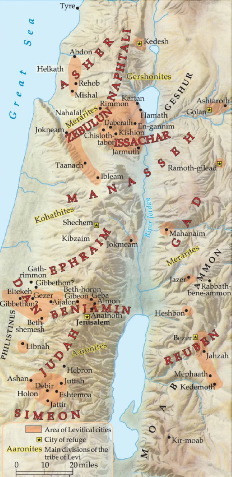
Joshua 21 – “The 48 Levitical Cities”

hammock rest vacationHebrew-English Text

I. Summary

The Levites are given forty eight cities from the territories of the twelve tribes. The conquest and settlement of the land comes to an end.

II. Photo

The conquest of the land is complete: “Yahweh gave them rest on all sides, just as He had promised to their fathers on oath.” (v. 42)

III. Select Verses

1-3: The heads of the ancestral houses of the Levites approached the priest Eleazer, Joshua son of Nun, and the heads of the ancestral houses of the Israelite tribes,  and spoke to them at Shiloh in the land of Canaan, as follows: “The LORD commanded through Moses that we be given towns to live in, along with their pastures for our livestock.”  So the Israelites, in accordance with the LORD’s command, assigned to the Levites, out of their own portions, the following towns with their pastures:

4-7: The [first] lot among the Levites fell to the Kohathite clans. To the descendants of the priest Aaron, there fell by lot 13 towns from the tribe of Judah, the tribe of Simeon, and the tribe of Benjamin;  and to the remaining Kohathites [there fell] by lot 10 towns from the clans of the tribe of Ephraim, the tribe of Dan, and the half-tribe of Manasseh. To the Gershonites [there fell] by lot 13 towns from the clans of the tribe of Issachar, the tribe of Asher, the tribe of Naphtali, and the half-tribe of Manasseh in Bashan. [And] to the Merarites, by their clans — 12 towns from the tribe of Reuben, the tribe of Gad, and the tribe of Zebulun.

39: All the towns of the Levites within the holdings of the Israelites came to 48 towns, with their pastures.

41-43: The LORD gave to Israel the whole country which He had sworn to their fathers that He would assign to them; they took possession of it and settled in it.  The LORD gave them rest on all sides, just as He had promised to their fathers on oath. Not one man of all their enemies withstood them; the LORD delivered all their enemies into their hands.  Not one of the good things which the LORD had promised to the House of Israel was lacking. Everything was fulfilled.

IV. Outline

1-2. The Levites ask for their cities

3. The leaders decide to grant their wish

4-7. Introduction

    4. The Aaronite Kohathites receive 13 cities 

    5. The remaining Kohathites receive 10 cities 

    6. The Gershonites receive 13 cities

    7. The Merarites receive 12 cities 

Levitical Cities9-19. The Aaronite Kohathite cities

    9-16. The cities from Reuben and Simeon

    17-18. The cities from Benjamin

    19. Summary statement

20-26. The other Kohathite cities

    20-22. The cities from Ephraim

    23-24. The cities from Dan

    25. The cities from Half Manasseh

    26. Summary statement

27-33. The Gershonite cities

    27. The cities from Half Manasseh

    28-29. The cities from Issachar

    30-31. The cities from Asher

    32. The cities from Naphtali

    33. Summary statement

34-38. The Merarite cities

    34-35. The cities from Zebulun

    36-37. The cities from Gad

    38. Summary statement

39-40. Summary statement regarding the Levitical cities

41. Summary statement of the tribal allotments

42. Peace in the land

43. Affirmation regarding Yahweh’s promises

V. Comment

Note that Reuben, who is supposed to give cities to the Merarites (v. 7), is missing in verses 34-38. According to the parallel in 1 Chronicles 6:63-64, Reuben gave the cities of Bezer, Jahaz, Kedemoth, and Mephaath.

For help with the geography, see the map on page 162 of A. F. Rainey and R S. Notley, The Sacred Bridge: Carta’s Atlas of the Biblical World (Jerusalem: Carta, 2006).

VI. Works Used

(see “Commentaries” page)

Photo copied from http://img210.imageshack.us/img210/6789/vacation03hw3.jpg