Joshua 22 – “Civil War Avoided”

loading gunHebrew-English Text

I. Summary

Joshua sends the Transjordanian tribes home and they make an altar along the way. This enrages the Cisjordanian tribes. War is averted when the Transjordanians explain that their “altar” is actually a memorial that is not meant for sacrifice.

II. Photo

The Cisjordanian Israelites are ready for war: “When the Israelites heard this, the whole community of the Israelites assembled at Shiloh to make war on them.” (v. 12)

III. Select Verses

7a: To the one half-tribe of Manasseh Moses had assigned territory in Bashan, and to the other Joshua assigned [territory] on the west side of the Jordan, with their kinsmen.

7b-10: Furthermore, when Joshua sent them off to their homes, he blessed them and said to them, “Return to your homes with great wealth — with very much livestock, with silver and gold, with copper and iron, and with a great quantity of clothing. Share the spoil of your enemies with your kinsmen.”  So the Reubenites, the Gadites, and the half-tribe of Manasseh left the Israelites at Shiloh, in the land of Canaan, and made their way back to the land of Gilead, the land of their own holding, which they had acquired by the command of the LORD through Moses.   When they came to the region of the Jordan in the land of Canaan, the Reubenites and the Gadites and the half-tribe of Manasseh built an altar there by the Jordan, a great conspicuous altar.

12: When the Israelites heard this, the whole community of the Israelites assembled at Shiloh to make war on them.

24-27: We did this thing only out of our concern that, in time to come, your children might say to our children, ‘What have you to do with the LORD, the God of Israel? The LORD has made the Jordan a boundary between you and us, O Reubenites and Gadites; you have no share in the LORD!’ Thus your children might prevent our children from worshiping the LORD. So we decided to provide [a witness] for ourselves by building an altar — not for burnt offerings or [other] sacrifices, but as a witness between you and us, and between the generations to come — that we may perform the service of the LORD before Him with our burnt offerings, our sacrifices, and our offerings of well-being; and that your children should not say to our children in time to come, ‘You have no share in the LORD.’

30: When the priest Phinehas and the chieftains of the community — the heads of the contingents of Israel — who were with him heard the explanation given by the Reubenites, the Gadites, and the Manassites, they approved.

33: The Israelites were pleased, and the Israelites praised God; and they spoke no more of going to war against them, to ravage the land in which the Reubenites and Gadites dwelt.

IV. Outline

1-6a. Joshua praises, blesses, and warns Reuben, Gad, and Half Manasseh

6b. These tribes return to their tents

7a. Review: Manasseh was allotted land by both Moses and Joshua

7b-8. Joshua’s blessing

9. These tribes set off for Gilead

10. They build an altar before crossing the Jordan

11-12. The Cisjordanian Israelites prepare for war

13-15. Phinehas and ten leaders approach the tribes

16-20. The delegation reprimands the 2 1/2 tribes

21-29. The 2 1/2 tribes respond: the altar is not for sacrifice, it is a replica as a witness

30-31. The delegation accepts the response

32-33. The Cisjordanian Israelites accept the report

34. The witness altar is named

V. Comment

It is interesting to note that the tribe of Manasseh, which was dealt land by both Moses and Joshua (v. 7), is seemingly ready to do battle against itself in vv. 11-20. This is because the Cisjordanians sent 11 emissaries, one priest (a Levite) and ten leaders, presumably one from each of the 10 Cisjordanian tribes, Manasseh included. This means that a leader from Cisjordanian Manasseh was willing to go to war against his Transjordanian brethren. Also note that Joshua, who is still alive at this point in the narrative, does not play a role in avoiding the civil war.

VI. Works Used

(see “Commentaries” page)

Photo copied from http://www.photo-dictionary.com/photofiles/list/8957/12208gun_loading.jpg

Joshua 21 – “The 48 Levitical Cities”

hammock rest vacationHebrew-English Text

I. Summary

The Levites are given forty eight cities from the territories of the twelve tribes. The conquest and settlement of the land comes to an end.

II. Photo

The conquest of the land is complete: “Yahweh gave them rest on all sides, just as He had promised to their fathers on oath.” (v. 42)

III. Select Verses

1-3: The heads of the ancestral houses of the Levites approached the priest Eleazer, Joshua son of Nun, and the heads of the ancestral houses of the Israelite tribes,  and spoke to them at Shiloh in the land of Canaan, as follows: “The LORD commanded through Moses that we be given towns to live in, along with their pastures for our livestock.”  So the Israelites, in accordance with the LORD’s command, assigned to the Levites, out of their own portions, the following towns with their pastures:

4-7: The [first] lot among the Levites fell to the Kohathite clans. To the descendants of the priest Aaron, there fell by lot 13 towns from the tribe of Judah, the tribe of Simeon, and the tribe of Benjamin;  and to the remaining Kohathites [there fell] by lot 10 towns from the clans of the tribe of Ephraim, the tribe of Dan, and the half-tribe of Manasseh. To the Gershonites [there fell] by lot 13 towns from the clans of the tribe of Issachar, the tribe of Asher, the tribe of Naphtali, and the half-tribe of Manasseh in Bashan. [And] to the Merarites, by their clans — 12 towns from the tribe of Reuben, the tribe of Gad, and the tribe of Zebulun.

39: All the towns of the Levites within the holdings of the Israelites came to 48 towns, with their pastures.

41-43: The LORD gave to Israel the whole country which He had sworn to their fathers that He would assign to them; they took possession of it and settled in it.  The LORD gave them rest on all sides, just as He had promised to their fathers on oath. Not one man of all their enemies withstood them; the LORD delivered all their enemies into their hands.  Not one of the good things which the LORD had promised to the House of Israel was lacking. Everything was fulfilled.

IV. Outline

1-2. The Levites ask for their cities

3. The leaders decide to grant their wish

4-7. Introduction

    4. The Aaronite Kohathites receive 13 cities 

    5. The remaining Kohathites receive 10 cities 

    6. The Gershonites receive 13 cities

    7. The Merarites receive 12 cities 

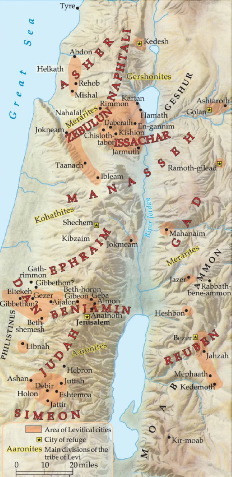
Levitical Cities9-19. The Aaronite Kohathite cities

    9-16. The cities from Reuben and Simeon

    17-18. The cities from Benjamin

    19. Summary statement

20-26. The other Kohathite cities

    20-22. The cities from Ephraim

    23-24. The cities from Dan

    25. The cities from Half Manasseh

    26. Summary statement

27-33. The Gershonite cities

    27. The cities from Half Manasseh

    28-29. The cities from Issachar

    30-31. The cities from Asher

    32. The cities from Naphtali

    33. Summary statement

34-38. The Merarite cities

    34-35. The cities from Zebulun

    36-37. The cities from Gad

    38. Summary statement

39-40. Summary statement regarding the Levitical cities

41. Summary statement of the tribal allotments

42. Peace in the land

43. Affirmation regarding Yahweh’s promises

V. Comment

Note that Reuben, who is supposed to give cities to the Merarites (v. 7), is missing in verses 34-38. According to the parallel in 1 Chronicles 6:63-64, Reuben gave the cities of Bezer, Jahaz, Kedemoth, and Mephaath.

For help with the geography, see the map on page 162 of A. F. Rainey and R S. Notley, The Sacred Bridge: Carta’s Atlas of the Biblical World (Jerusalem: Carta, 2006).

VI. Works Used

(see “Commentaries” page)

Photo copied from http://img210.imageshack.us/img210/6789/vacation03hw3.jpg

Joshua 20 – “The Six Cities of Refuge”

bloody hands womanHebrew-English Text

I. Summary

In accordance with Yahweh’s command, the people designate six cities of refuge for those who kill by mistake.


II. Photo

Yahweh is concerned for those who kill by mistake: “Speak to the Israelites: Designate the cities of refuge — about which I commanded you through Moses —  to which a manslayer who kills a person by mistake, unintentionally, may flee.” (v. 1)


III. Select Verses

1-6: The LORD said to Joshua: “Speak to the Israelites: Designate the cities of refuge — about which I commanded you through Moses —  to which a manslayer who kills a person by mistake, unintentionally, may flee. They shall serve you as a refuge from the blood avenger.  He shall flee to one of those cities, present himself at the entrance to the city gate, and plead his case before the elders of that city; and they shall admit him into the city and give him a place in which to live among them.  Should the blood avenger pursue him, they shall not hand the manslayer over to him, since he killed the other person without intent and had not been his enemy in the past.  He shall live in that city until he can stand trial before the assembly, and remain there until the death of the high priest who is in office at that time. Thereafter, the manslayer may go back to his home in his own town, to the town from which he fled.”

7-8:  So they set aside Kedesh in the hill country of Naphtali in Galilee, Shechem in the hill country of Ephraim, and Kiriath-arba — that is, Hebron — in the hill country of Judah. And across the Jordan, east of Jericho, they assigned Bezer in the wilderness, in the Tableland, from the tribe of Reuben; Ramoth in Gilead from the tribe of Gad; and Golan in Bashan from the tribe of Manasseh.

9: Those were the towns designated for all the Israelites and for aliens residing among them, to which anyone who killed a person unintentionally might flee, and not die by the hand of the blood avenger before standing trial by the assembly.


Cities of RefugeIV. Outline

1-6. Yahweh’s command to build cities of refuge

7-8. The six cities

9. Summary

V. Comment

For help with the geography, see the following map from Accordance Bible software.


VI. Works Used

(see “Commentaries” page)

Photo copied from http://4.bp.blogspot.com/–GEI_L6-9W0/UNUtT20F0HI/AAAAAAAASY4/P9uUPPMsWVU/s1600/bloody+hands.jpg

Joshua 19 – “The Territories of Simeon, Zebulun, Issachar, Asher, Naphtali, and Dan”

Rolling_green_hills land expansiveHebrew-English Text

I. Summary

Joshua allots territories of land to Simeon, Zebulun, Issachar, Asher, Naphtali, and Dan. Joshua is given the town (Timnath-serah) he requests in the territory of Ephraim.

II. Photo

The tribe of Judah has too much land: “Since the share of the Judites was larger than they needed, the Simeonites received a portion inside their portion.” (v. 9)

III. Select Verses

9: The portion of the Simeonites was part of the territory of the Judites; since the share of the Judites was larger than they needed, the Simeonites received a portion inside their portion.

47: But the territory of the Danites slipped from their grasp. So the Danites migrated and made war on Leshem. They captured it and put it to the sword; they took possession of it and settled in it. And they changed the name of Leshem to Dan, after their ancestor Dan.

49-50: When they had finished allotting the land by its boundaries, the Israelites gave a portion in their midst to Joshua son of Nun.  At the command of the LORD they gave him the town that he asked for, Timnath-serah in the hill country of Ephraim; he fortified the town and settled in it.

51:  These are the portions assigned by lot to the tribes of Israel by the priest Eleazar, Joshua son of Nun, and the heads of the ancestral houses, before the LORD at Shiloh, at the entrance of the Tent of Meeting.

IV. Outline

1-9. The towns of Simeon, inside the territory of Judah

10-16. The boundary and towns of Zebulun

17-23. The boundary and towns of Issachar

24-31. The boundary and towns of Asher

32-39. The boundary and towns of Naphtali

40-46. The boundary and towns of Dan

47-48. Dan conquered and moved to Leshem

49-50. Joshua is given a town in Ephraim

51. Summary statement

Northern Tribes - Sacred BridgeV. Comment

For help with the geography, see the map on page 182 of A. F. Rainey and R S. Notley. The Sacred Bridge: Carta’s Atlas of the Biblical World. Jerusalem: Carta, 2006.

VI. Works Used

(see “Commentaries” page)

Photo copied from http://upload.wikimedia.org/wikipedia/commons/3/31/Rolling_green_hills.jpg

Joshua 18 – “Joshua’s Scouts; The Territory of Benjamin”

three men hiking hikers mountain climbingHebrew-English Text

I. Summary

Joshua sends scouts to explore and divide the  land into seven portions for the remaining seven tribes. Benjamin is allotted its portion of land.


II. Photo

Joshua sends scouts to explore and divide the land: “So the men went and traversed the land; they described it in a document, town by town, in seven parts, and they returned to Joshua in the camp at Shiloh.” (v. 9)


III. Select Verses

1: The whole community of the Israelite people assembled at Shiloh, and set up the Tent of Meeting there. The land was now under their control.

2-5a: But there remained seven tribes of the Israelites which had not yet received their portions.  3 So Joshua said to the Israelites, “How long will you be slack about going and taking possession of the land which the LORD, the God of your fathers, has assigned to you?  Appoint three men of each tribe; I will send them out to go through the country and write down a description of it for purposes of apportionment, and then come back to me.  They shall divide it into seven parts.

8-10: The men set out on their journeys. Joshua ordered the men who were leaving to write down a description of the land — “Go, traverse the country and write down a description of it. Then return to me, and I will cast lots for you here at Shiloh before the LORD.”  So the men went and traversed the land; they described it in a document, town by town, in seven parts, and they returned to Joshua in the camp at Shiloh.  Joshua cast lots for them at Shiloh before the LORD, and there Joshua apportioned the land among the Israelites according to their divisions.

11: The lot of the tribe of the Benjaminites, by their clans, came out first. The territory which fell to their lot lay between the Judites and the Josephites.

28: Zela, Eleph, and Jebus — that is, Jerusalem — Gibeath [and] Kiriath: 14 towns, with their villages. That was the portion of the Benjaminites, by their clans.


IV. Outline

1. The people congregate at Shiloh

2. Seven tribes need land

3-7. Joshua’s plan to scout the remaining land

8-10. The plan is executed

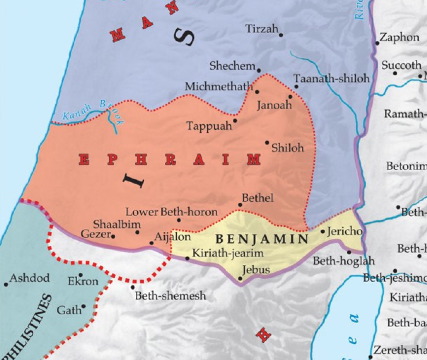
Benjamin -Sacred Bridge11-20. The boundary description of Benjamin

21-28. The town list of Benjamin

V. Comment

For help with the geography, see the map on page 182 of A. F. Rainey and R S. Notley. The Sacred Bridge: Carta’s Atlas of the Biblical World. Jerusalem: Carta, 2006.


VI. Works Used

(see “Commentaries” page)

Photo copied from https://s3.amazonaws.com/adventure_collection/images/search_headers/activity_interests/main_climbing.jpg

Joshua 17 – “The Portion of Manasseh”

women farmers working landHebrew-English Text

I. Summary

The sons and daughters of Manasseh are given their portion but cannot dispossess the Canaanites. When they ask for more land, Joshua tells them to clear the forests and to conquer the Canaanites in the valleys.

II. Photo

The daughters of Zelophehad inherit alongside the men: “In accordance with the Lord’s instructions, they were granted a portion among their father’s kinsmen.” (v. 4)

III. Select Verses

1: And this is the portion that fell by lot to the tribe of Manasseh — for he was Joseph’s first-born. Since Machir, the first-born of Manasseh and the father of Gilead, was a valiant warrior, Gilead and Bashan were assigned to him.

3-4: Now Zelophehad son of Hepher son of Gilead son of Machir son of Manasseh had no sons, but only daughters. The names of his daughters were Mahlah, Noah, Hoglah, Milcah, and Tirzah. They appeared before the priest Eleazer, Joshua son of Nun, and the chieftains, saying: “The LORD commanded Moses to grant us a portion among our male kinsmen.” So, in accordance with the LORD’s instructions, they were granted a portion among their father’s kinsmen.

5: Ten districts fell to Manasseh, apart from the lands of Gilead and Bashan, which are across the Jordan.

12-13: The Manassites could not dispossess [the inhabitants of] these towns, and the Canaanites stubbornly remained in this region.  When the Israelites became stronger, they imposed tribute on the Canaanites; but they did not dispossess them.

14-18: The Josephites complained to Joshua, saying, “Why have you assigned as our portion a single allotment and a single district, seeing that we are a numerous people whom the LORD has blessed so greatly?”  “If you are a numerous people,” Joshua answered them, “go up to the forest country and clear an area for yourselves there, in the territory of the Perizzites and the Rephaim, seeing that you are cramped in the hill country of Ephraim.”  “The hill country is not enough for us,” the Josephites replied, “and all the Canaanites who live in the valley area have iron chariots, both those in Beth-shean and its dependencies and those in the Valley of Jezreel.” But Joshua declared to the House of Joseph, to Ephraim and Manasseh, “You are indeed a numerous people, possessed of great strength; you shall not have one allotment only. The hill country shall be yours as well; true, it is forest land, but you will clear it and possess it to its farthest limits. And you shall also dispossess the Canaanites, even though they have iron chariots and even though they are strong.”

Manasseh West of the JordanIV. Outline

1a. Introduction

1b. Machir receives Gilead and Bashan

2. Manasseh’s other male descendants

3-4. The daughters of Zelophehad in Machir

5. Manasseh has 12 regions, 2 in Transjordan and 10 in Cisjordan

6. The daughters of Manasseh inherited in Bashan

7-11. The boundaries of Manasseh; Isolated towns within and without

12-13. The Canaanites remained, but were subject to forced labor

14-18. The house of Joseph requests more land (in Manasseh) and Joshua tells them to clear the forest and conquer the valleys

V. Comment

For help with the geography, see the map on page 182 of A. F. Rainey and R S. Notley. The Sacred Bridge: Carta’s Atlas of the Biblical World. Jerusalem: Carta, 2006.

VI. Works Used

(see “Commentaries” page)

Photo copied from http://www.farmfodder.org/wp-content/uploads/2013/04/10094_042s.jpg

Joshua 16 – “The Portion of Ephraim”

hard-labor-work-heavy loadHebrew-English Text

I. Summary

Ephraim is allotted its portion but is unable to dispossess the Canaanites from Gezer.


II. Photo

The Canaanites work for Ephraim: “The Canaanites remained in the midst of Ephraim, as is still the case. But they had to perform forced labor.” (v. 10)


III. Select Verses

4: Thus the Josephites — that is, Manasseh and Ephraim — received their portion.

10: However, they failed to dispossess the Canaanites who dwelt in Gezer; so the Canaanites remained in the midst of Ephraim, as is still the case. But they had to perform forced labor.


IV. Outline

1-4. The southern border of the Ephraim and Manasseh

5-9. The other borders of Ephraim

10. The Canaanites remained in Gezer as forced laborers


EphraimV. Comment

For help with the geography, see the map on page 182 of A. F. Rainey and R S. Notley. The Sacred Bridge: Carta’s Atlas of the Biblical World. Jerusalem: Carta, 2006.


VI. Works Used

(see “Commentaries” page)

Photo copied from http://www.self-catering-breaks.com/blog/wp-content/uploads/2009/09/hard-labor.jpg

Joshua 15 – “The Territory of Judah”

wedding-dress-on-hangerHebrew-English Text

I. Summary

The boundaries and cities of Judah’s territory are enumerated. Caleb conquers his land and gives his daughter Achsah in marriage to Othniel, the man who conquers Kiriath-Sepher.

II. Photo

Achsah is married off: “Caleb announced, ‘I will give my daughter Achsah in marriage to the man who attacks and captures Kiriath-sepher.’” (v. 16)

III. Select Verses

13-17:  In accordance with the LORD’s command to Joshua, Caleb son of Jephunneh was given a portion among the Judites, namely, Kiriath-arba — that is, Hebron. ([Arba] was the father of Anak.)  Caleb dislodged from there the three Anakites: Sheshai, Ahiman, and Talmai, descendants of Anak.  From there he marched against the inhabitants of Debir — the name of Debir was formerly Kiriath-sepher —   and Caleb announced, “I will give my daughter Achsah in marriage to the man who attacks and captures Kiriath-sepher.”  His kinsman Othniel the Kenizzite captured it; and Caleb gave him his daughter Achsah in marriage.

18-19: When she came [to him], she induced him to ask her father for some property. She dismounted from her donkey, and Caleb asked her, “What is the matter?”  She replied, “Give me a present; for you have given me away as Negeb-land; so give me springs of water.” And he gave her Upper and Lower Gulloth.

63. But the Judites could not dispossess the Jebusites, the inhabitants of Jerusalem; so the Judites dwell with the Jebusites in Jerusalem to this day.

IV. Outline

1-12. The boundaries of Judah

13-19. Caleb’s portion

    13-14. Caleb’s portion and conquest

    15-17. Caleb’s daughter is given to Othniel for capturing Kiriath-sepher

    18-19. Caleb’s daugter requests land and is given Gulloth

20-63. The the Judahite towns

    20. Introduction

    21-32. A group of 29 towns

    33-36. A group of 14 towns 

    37-41. A group of 16 towns

    42-44. A group of 9 towns

    45-47. Ekron, Ashdod, and Gaza

    48-51. A group of 11 towns 

    52-54. A group of 9 towns

    55-57. A group of 10 towns

    58-59. A group of 6 towns

    60. A group of 2 towns

    61-62. A group of 6 towns

    63. The Jebusites remain with the Judahites in Jerusalem

V. Comment

Map of Judah from Sacred BrFor help with the geography, see the map on page 12 of A. F. Rainey and R S. Notley, The Sacred Bridge: Carta’s Atlas of the Biblical World, Jerusalem: Carta, 2006.

See http://www.carta-jerusalem.com

VI. Works Used

(see “Commentaries” page)

Photo copied from http://www.andytailor.com/blog/wp-content/uploads/2013/09/wedding-dress-on-hanger.jpg

Joshua 14 – “Caleb’s Portion of the Land”

Minolta DSCHebrew-English Text

I. Summary

Joshua grants Caleb the city of Hebron, just as Moses promised.

II. Photo

Caleb approaches Joshua: “Here I am today, eighty-five years old, I am still as strong today as on the day that Moses sent me; my strength is the same now as it was then, for battle and for activity.” (vv. 10-11)

III. Select Verses

1-2: And these are the allotments of the Israelites in the land of Canaan, that were apportioned to them by the priest Eleazar, by Joshua son of Nun, and by the heads of the ancestral houses of the Israelite tribes, the portions that fell to them by lot, as the LORD had commanded through Moses for the nine and a half tribes.

4:  For whereas the descendants of Joseph constituted two tribes, Manasseh and Ephraim, the Levites were assigned no share in the land, but only some towns to live in, with the pastures for their livestock and cattle.

6-12:  The Judites approached Joshua at Gilgal, and Caleb son of Jephunneh the Kenizzite said to him: “You know what instructions the LORD gave at Kadesh-barnea to Moses, the man of God, concerning you and me. I was forty years old when Moses the servant of the LORD sent me from Kadesh-barnea to spy out the land, and I gave him a forthright report.  While my companions who went up with me took the heart out of the people, I was loyal to the LORD my God. On that day, Moses promised on oath, ‘The land on which your foot trod shall be a portion for you and your descendants forever, because you were loyal to the LORD my God.’ Now the LORD has preserved me, as He promised. It is forty-five years since the LORD made this promise to Moses, when Israel was journeying through the wilderness; and here I am today, eighty-five years old. I am still as strong today as on the day that Moses sent me; my strength is the same now as it was then, for battle and for activity. So assign to me this hill country as the LORD promised on that day. Though you too heard on that day that Anakites are there and great fortified cities, if only the LORD is with me, I will dispossess them, as the LORD promised.”

15: The name of Hebron was formerly Kiriath-arba: Arba was the great man among the Anakites. And the land had rest from war.

IV. Outline

1-5. Introduction

    1-2. Eleazar, Joshua, and the Tribal leaders are in charge of the lots

    3a. The Transjordanian 2 1/2 tribes

    3b-4. The Levites have no portion, but Joseph has two portions

    5. The law of Moses

6-15. Caleb’s portion

    6-12a. Caleb’s claim on the land

    12b. Hope to dispossess the Anakites

    13. Joshua assigns Hebron to Caleb

    14. Summary

    15a. The original name of Hebron

    15b. Rest in the land

V. Comment

No comment today. Stay tuned.

VI. Works Used

(see “Commentaries” page)

Photo copied from http://designyoutrust.com/wp-content/uploads/2010/09/oldhandslast.jpeg

Joshua 13 – “The Territories of Reuben, Gad, and Half Manasseh”

Elderly-hand-holding-walking-cane-oldHebrew-English Text

I. Summary

Yahweh tells Joshua, who has grown old, to apportion the land west of the Jordan to the Israelite tribes. The land that Moses apportioned east of the Jordan is described.

II. Photo

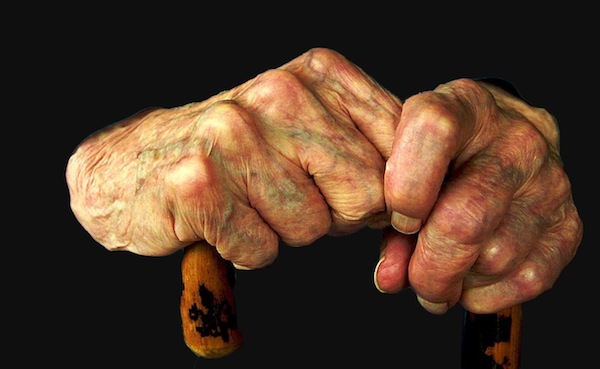
Joshua’s age begins to show: “Joshua was now old, advanced in years. Yahweh said to him, ‘You have grown old, you are advanced in years.’” (v. 1)

III. Select Verses

1-2:  Joshua was now old, advanced in years. The LORD said to him, “You have grown old, you are advanced in years; and very much of the land still remains to be taken possession of.

6-7:  I Myself will dispossess those nations for the Israelites; you have only to apportion their lands by lot among Israel, as I have commanded you.  Therefore, divide this territory into hereditary portions for the nine tribes and the half-tribe of Manasseh.”

8: Now the Reubenites and the Gadites, along with the other half-tribe, had already received the shares which Moses assigned to them on the east side of the Jordan — as assigned to them by Moses the servant of the LORD.

13: But the Israelites failed to dispossess the Geshurites and the Maacathites, and Geshur and Maacath remain among Israel to this day.

14: No hereditary portion, however, was assigned to the tribe of Levi, their portion being the fire offerings of the LORD, the God of Israel, as He spoke concerning them.

IV. Outline

1-13. Yahweh’s speech to Joshua

    1a. Introduction

    1b. Joshua’s age

    2-6a. The land yet to be conquered

    6b. Yahweh will conquer the land 

    6c-7. Joshua must apportion the land

8-12. Summary of the previously conquered Transjordanian land assigned to Reuben, Gad, and Manasseh

13. The land of the Geshurites and Maacathites remained unconquered

14. Levi has no portion in the land

15-23. Reuben’s cities on the tableland and the chiefs defeated by Moses

24-28. Gad’s cities

29-31. Manasseh’s cities

32. Summary of Moses allotments

33. Levi has no tribal allotment (again)

V. Comment

No comment today. Stay tuned.

VI. Works Used

(see “Commentaries” page)

Photo copied from http://www.rawstory.com/rs/wp-content/uploads/2013/03/Elderly-hand-holding-walking-cane-via-Shutterstock.jpg