Genesis 16: The Birth of Ishmael

woman desert aloneHebrew-English Text

I. Summary

Abram impregnates Hagar, the slave of his barren wife Sarai. Sarai beats Hagar, who flees, and an angel informs Hagar that her son Ishmael will multiply greatly. Hagar returns to Abram and gives birth to Ishmael.

II. Photo

Hagar runs away: “Sarai dealt harshly with her, and she ran away from her.” (v.6)

III. Select Verses

1-6: Now Sarai, Abram’s wife, bore him no children. She had an Egyptian slave-girl whose name was Hagar, and Sarai said to Abram, “You see that the LORD has prevented me from bearing children; go in to my slave-girl; it may be that I shall obtain children by her.” And Abram listened to the voice of Sarai. So, after Abram had lived ten years in the land of Canaan, Sarai, Abram’s wife, took Hagar the Egyptian, her slave-girl, and gave her to her husband Abram as a wife. He went in to Hagar, and she conceived; and when she saw that she had conceived, she looked with contempt on her mistress. Then Sarai said to Abram, “May the wrong done to me be on you! I gave my slave-girl to your embrace, and when she saw that she had conceived, she looked on me with contempt. May the LORD judge between you and me!” But Abram said to Sarai, “Your slave-girl is in your power; do to her as you please.” Then Sarai dealt harshly with her, and she ran away from her.

7-12: The angel of the LORD found her by a spring of water in the wilderness, the spring on the way to Shur. And he said, “Hagar, slave-girl of Sarai, where have you come from and where are you going?” She said, “I am running away from my mistress Sarai.” The angel of the LORD said to her, “Return to your mistress, and submit to her.” The angel of the LORD also said to her, “I will so greatly multiply your offspring that they cannot be counted for multitude.” And the angel of the LORD said to her, “Now you have conceived and shall bear a son; you shall call him Ishmael, for the LORD has given heed to your affliction. He shall be a wild ass of a man, with his hand against everyone, and everyone’s hand against him; and he shall live at odds with all his kin.”

IV. Outline

1-6. Abram impregnates Hagar

    1a. Sarai was barren

    1b-2. Sarai tells Abram to have children with Hagar, Sarai's slave

    3-4a. Abram impregnates Hagar 

    4b-5. Sarai hates Hagar and blames Abram

    6. Sarai beats Hagar, who flees

7-14. Hagar and the angel

    7. An angel finds Hagar at a well

    8-9. Hagar is to return to Sarai

    10. Hagar's offspring will multiply greatly

    11. The child shall be named Ishmael (god has listened)

    12. Ishmael will be a stubborn, wild, nomad

    13-14. Hagar names the angel and the site of the vision 

15-16. Hagar gives birth to Ishmael when Abram was 86 years old

V. Comment

No comment today. Stay tuned.

VI. Works Used

(see “Commentaries” page)

Photo copied from http:// data.whicdn .com/images/88820486/original .jpg

Genesis 15: Promises of Offspring and Land

Telescope-006Hebrew-English Text

I. Summary

Abram is promised offspring as well as the land. As a sign of the covenant, Yahweh sends fire between the animal parts laid out by Abram.

II. Photo

Yahweh shows Abram the night sky: “He brought him outside and said, ‘Look toward heaven and count the stars, if you are able to count them.’ Then he said to him, ‘So shall your descendants be.'” (v. 5)

III. Select Verses

3-5: And Abram said, “You have given me no offspring, and so a slave born in my house is to be my heir.” But the word of the LORD came to him, “This man shall not be your heir; no one but your very own issue shall be your heir.” He brought him outside and said, “Look toward heaven and count the stars, if you are able to count them.” Then he said to him, “So shall your descendants be.”

13-14, 16:  Then the LORD said to Abram, “Know this for certain, that your offspring shall be aliens in a land that is not theirs, and shall be slaves there, and they shall be oppressed for four hundred years; but I will bring judgment on the nation that they serve, and afterward they shall come out with great possessions. As for yourself, you shall go to your ancestors in peace; you shall be buried in a good old age. And they shall come back here in the fourth generation; for the iniquity of the Amorites is not yet complete.”

17: When the sun had gone down and it was dark, a smoking fire pot and a flaming torch passed between these pieces.

18: On that day the LORD made a covenant with Abram, saying, “To your descendants I give this land, from the river of Egypt to the great river, the river Euphrates,

IV. Outline

1-6. Promise of offspring

    1a. Yahweh reveals himself to Abram in a vision

    1b. Yahweh is Abram's shield

    2-3. Abram's complaint: the lack of an heir

    4-5. Yahweh promises Abram offspring as numerous as the stars

    6. Abraham believes Yahweh

7-21. Yahweh's sign that Abram will inherit the land

    7. Yahweh promises the land

    8. Abram asks for a sign

    9. Yahweh asks for a cow, a goat, a ram, a tutledove, and a pigeon

    10. Abram cuts the animals in half, save for the birds

    11. Abram drives away the birds of prey

    12. Abram falls asleep

    13-14. Abram's children will be foreign slaves for 400 years before leaving with wealth

    15. Abram will die peacefully in old age

    16. His descendants will return after four generations

    17. Flames passed between the animal parts at night

    18-21. Summary statement: Abram will inherit the land from Egypt to the Euphrates


V. Comment

No comment today. Stay tuned.

VI. Works Used

(see “Commentaries” page)

Photo copied from http://static.guim.co.uk/sys-images/Books/Pix/pictures/2010/8/18/1282123244953/Telescope-006.jpg

Genesis 14: Abram Travels North to Save Lot

bread-wineHebrew-English Text

I. Summary

Lot is captured by the four kings of Mesopotamia, who defeat the five kings of the Jordan Valley. Abram saves Lot by defeating the four kings in the north past Damascus. Abram is blessed by the king of Salem and returns the plunder to the king of Sodom.

II. Photo

Abram is blessed: “And King Melchizedek of Salem brought out bread and wine; he was a priest of God Most High. He blessed him, saying, ‘Blessed be Abram of God Most High, Creator of heaven and earth.'” (vv. 18-19)

III. Select Verses

1-2: Now, when King Amraphel of Shinar, King Arioch of Ellasar, King Chedorlaomer of Elam, and King Tidal of Goiim made war on King Bera of Sodom, King Birsha of Gomorrah, King Shinab of Admah, King Shemeber of Zeboiim, and the king of Bela, which is Zoar,

11-12: [The invaders] seized all the wealth of Sodom and Gomorrah and all their provisions, and went their way. They also took Lot, the son of Abram’s brother, and his possessions, and departed; for he had settled in Sodom.

14-16: When Abram heard that his kinsman had been taken captive, he mustered his retainers, born into his household, numbering three hundred and eighteen, and went in pursuit as far as Dan. At night, he and his servants deployed against them and defeated them; and he pursued them as far as Hobah, which is north of Damascus. He brought back all the possessions; he also brought back his kinsman Lot and his possessions, and the women and the rest of the people.

18-20: And King Melchizedek of Salem brought out bread and wine; he was a priest of God Most High. He blessed him, saying, “Blessed be Abram of God Most High, Creator of heaven and earth.  And blessed be God Most High, Who has delivered your foes into your hand.” And Abram gave him a tenth of everything.

22-23: But Abram said to the king of Sodom, “I swear to the LORD, God Most High, Creator of heaven and earth: I will not take so much as a thread or a sandal strap of what is yours; you shall not say, ‘It is I who made Abram rich.’

IV. Outline

1-9. A battle is waged between the 4 kings of Mesopotamia and the 5 kings of the Jordan Valley

10. The kings of Sodom and Gomorrah hide in bitumen pits

11-12. Lot and the other Sodomites are captured

13. Abram is informed

14-15. Abram and 300 men defeat the 4 kings north of Damascus

16. Lot is returned

17. The king of Sodom meets Abram

18-20a. King Melchizedek of Salem blesses Abram and Yahweh (called “the highest God”)

20b. Abram grants the king a tenth of the plunder

21-24. Abram tells the king of Sodom that he will not keep the plunder for himself, though his servants may take

V. Comment

The primary purpose of this narrative appears to be Abram’s traveling to the north. The previous chapter ended with a blessing and commandment from Yahweh to travel the land:

And Yahweh said to Abram, after Lot had parted from him, “Raise your eyes and look out from where you are, to the north and south, to the east and west, for I give all the land that you see to you and your offspring forever. I will make your offspring as the dust of the earth, so that if one can count the dust of the earth, then your offspring too can be counted. Up, walk about the land, through its length and its breadth, for I give it to you.”

Having already travelled in the southern portion of Canaan called the Negev (Gen 12:9; 13:1), it was now up to Abram to head north. In this passage Abram travels to two northern sites. The first, Dan (v. 14), appears to be the limit of later Israelite settlement as depicted in the phrase “from Dan to Beer-sheba” found throughout the Hebrew Bible (Judg 20:1; 1 Sam 3:20; 2 Sam 3:10; 17:11; 24:2, 15; 1 Kings 5:5; Amos 8:14; 1 Chr 21:2; 2 Chr 30:5). The second, Hobah north of Damascus, appears to be a grand idealized vision of the land, as reflected in territorial descriptions found in passages such as Num 13:21; 34:8; Josh 13:5; Judg 3:3; 1 Kings 8:65; 2 Kings 14:25; Ezek 47:20; 48:1; 1 Chr 13:5; 2 Chr 7:8. The two sites are probably mentioned in order to correlate to the two competing visions of the land of ancient Israel, one limited at Dan and the other limited north of Damascus.

Abram Travels

VI. Works Used

(see “Commentaries” page)

Photo copied from https://gracethrufaith.com/assets/uploads/2014/07/bread-wine.jpg

Genesis 13: Abram and Lot Part Ways; Yahweh Blesses Abram

flock-of-sheepHebrew-English Text

I. Summary

Abram and Lot become wealthy herdsmen in Canaan, which leads to strife. Lot moves to Sodom and Abram moves to Hebron, where Yahweh blesses him with land and offspring.

II. Photo

Abram and Lot gain wealth: “Lot, who went with Abram, also had flocks and herds and tents, so that the land could not support them staying together; for their possessions were so great that they could not remain together. ” (v. 6)

III. Select Verses

2-4: Now Abram was very rich in cattle, silver, and gold. And he proceeded by stages from the Negeb as far as Bethel, to the place where his tent had been formerly, between Bethel and Ai, the site of the altar that he had built there at first; and there Abram invoked the LORD by name.

10-11: Lot looked about him and saw how well watered was the whole plain of the Jordan, all of it — this was before the LORD had destroyed Sodom and Gomorrah — all the way to Zoar, like the garden of the LORD, like the land of Egypt. So Lot chose for himself the whole plain of the Jordan, and Lot journeyed eastward. Thus they parted from each other

14-17: And the LORD said to Abram, after Lot had parted from him, “Raise your eyes and look out from where you are, to the north and south, to the east and west, for I give all the land that you see to you and your offspring forever. I will make your offspring as the dust of the earth, so that if one can count the dust of the earth, then your offspring too can be counted. Up, walk about the land, through its length and its breadth, for I give it to you.”

IV. Outline

1. Abram returns to the Negeb in Canaan

2. Abram’s wealth

3-4. Abram returns to his altar near Bethel and uses the name “Yahweh”

5-7. Strife between Abram and Lot

8-9. Abram offers to separate

10-13. Lot chooses to go east to the Jordan valley near Sodom; Abram remains

14-17. Yahweh blesses Abram with land and offspring

18. Abram moves to Hebron and builds an altar

V. Comment

No comment today. Stay tuned.

VI. Works Used

(see “Commentaries” page)

Photo copied from

https:// laliteraliteraria.files.wordpress .com/2010/10/flock-of-sheep .jpg

Genesis 12: Abram Moves to Canaan; Abram’s Trickery in Egypt

famine crop failure dryHebrew-English Text

I. Summary

Yahweh blesses Abram, who moves to Canaan and builds altars in the land. A famine strikes and Abram moves to Egypt where he presents Sarai as his sister. Pharaoh takes Sarai but returns her to Abram when a plague strikes.

II. Photo

A famine strikes the land of Canaan: “There was a famine in the land, and Abram went down to Egypt to sojourn there, for the famine was severe in the land.” (v. 10)

III. Select Verses

1-3: The LORD said to Abram, “Go forth from your native land and from your father’s house to the land that I will show you. I will make of you a great nation, And I will bless you; I will make your name great, And you shall be a blessing. I will bless those who bless you And curse him that curses you; And all the families of the earth Shall bless themselves by you.”

7: The LORD appeared to Abram and said, “I will assign this land to your heirs.” And he built an altar there to the LORD who had appeared to him.

10-19: There was a famine in the land, and Abram went down to Egypt to sojourn there, for the famine was severe in the land. As he was about to enter Egypt, he said to his wife Sarai, “I know what a beautiful woman you are.”  If the Egyptians see you, and think, ‘She is his wife,’ they will kill me and let you live.  Please say that you are my sister, that it may go well with me because of you, and that I may remain alive thanks to you.” When Abram entered Egypt, the Egyptians saw how very beautiful the woman was. Pharaoh’s courtiers saw her and praised her to Pharaoh, and the woman was taken into Pharaoh’s palace. And because of her, it went well with Abram; he acquired sheep, oxen, asses, male and female slaves, she-asses, and camels. But the LORD afflicted Pharaoh and his household with mighty plagues on account of Sarai, the wife of Abram. Pharaoh sent for Abram and said, “What is this you have done to me! Why did you not tell me that she was your wife? Why did you say, ‘She is my sister,’ so that I took her as my wife? Now, here is your wife; take her and begone!”

IV. Outline

1-9. Abram moves to Canaan

    1-3. Yahweh's command/blessing to go to a new land

    4-5a. Abram leaves Haran with his wife, nephew, and possessions 

    5h-6. Abram arrives at Shechem

    7. Yahweh appears to Abram, who builds an altar

    8. Abram builds an altar at Bethel

    9. Abram travels to the Negeb

10-20. Sarai is given to Pharaoh

    10. Abram travels to Egypt on account of famine

    11-13. Abram asks Sarai to say she is his sister

    14-16. Sarai is brought to Pharaoh while Abram gains wealth

    17. Yahweh afflicts Pharaoh with plagues

    18-19. Pharaoh confronts Abram

    20. Abram is sent off


V. Comment

No comment today. Stay tuned.

VI. Works Used

(see “Commentaries” page)

Photo copied from

http:// im.rediff .com/news/2012/apr/25nuke2 .jpg

Genesis 11: The Tower of Babylon; The Generations to Abram

stack of bricks tower  Hebrew-English Text

I. Summary

The people of Babylon build a tower and Yahweh confuses the languages of the earth to prevent their unity. The generations from Shem to Abram are enumerated. Abram’s father Terah dies in Haran on his way to Canaan.

II. Photo

The tower of Babylon is built: “And they said to one another, ‘Come, let us make bricks, and burn them thoroughly.’ And they had brick for stone, and bitumen for mortar.” (v. 3)

III. Select Verses

1-9: Now the whole earth had one language and the same words. And as they migrated from the east, they came upon a plain in the land of Shinar and settled there. And they said to one another, “Come, let us make bricks, and burn them thoroughly.” And they had brick for stone, and bitumen for mortar. Then they said, “Come, let us build ourselves a city, and a tower with its top in the heavens, and let us make a name for ourselves; otherwise we shall be scattered abroad upon the face of the whole earth.” The LORD came down to see the city and the tower, which mortals had built. And the LORD said, “Look, they are one people, and they have all one language; and this is only the beginning of what they will do; nothing that they propose to do will now be impossible for them. Come, let us go down, and confuse their language there, so that they will not understand one another’s speech.” So the LORD scattered them abroad from there over the face of all the earth, and they left off building the city. Therefore it was called Babel, because there the LORD confused the language of all the earth; and from there the LORD scattered them abroad over the face of all the earth.

27-32: Now these are the descendants of Terah. Terah was the father of Abram, Nahor, and Haran; and Haran was the father of Lot. Haran died before his father Terah in the land of his birth, in Ur of the Chaldeans. Abram and Nahor took wives; the name of Abram’s wife was Sarai, and the name of Nahor’s wife was Milcah. She was the daughter of Haran the father of Milcah and Iscah. Now Sarai was barren; she had no child. Terah took his son Abram and his grandson Lot son of Haran, and his daughter-in-law Sarai, his son Abram’s wife, and they went out together from Ur of the Chaldeans to go into the land of Canaan; but when they came to Haran, they settled there. The days of Terah were two hundred five years; and Terah died in Haran.

IV. Outline

1-9. The tower of Babylon

    1. Introduction: there was only one language

    2-4. The easterners decide to build a city and tower for glory

    5-7. Yahweh feels threatened and decides to confuse their language 

    8. The people disperse and abandon the city

    9. Etymology: Babylon is named for the confusion (Heb. *) that Yahweh caused

10-. The generations and genealogy of Shem

    10-11. Shem: 600 years

    12-13. Arpachshad: 438 years

    14-15. Shelah:433 years

    16-17. Eber: 464 years

    18-19. Peleg: 239 years

    20-21. Reu: 239 years

    22-23. Serug: 230 years

    24-25. Nahor: 148 years

    26-32. Terah: 205 years

        26. Terah's sons: Abram, Nahor, and Haran

        27. Terah's sons and grandson Lot

        28. Haran died in Ur

        29. Abram and Nahor took wives, Sarai and Milcah daughter of Haran

        30. Sarai was barren

        31. Terah, Abram, Sarai, and Lot settle in Haran on their way to Canaan

        32. Terah dies in Haran at the age of 205

V. Comment

No comment today. Stay tuned.

VI. Works Used

(see “Commentaries” page)

Photo copied from http:// ehp.niehs.nih .gov/wp-content/uploads/2013/08/ehp.121-a242.g009 .png

Genesis 10: Genealogy of Noah’s Three Sons

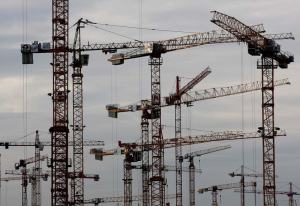
cranes construction building citiesHebrew-English Text

I. Summary

The genealogy of Noah’s three sons is presented.

II. Photo

The cities of Mesopotamia are built: “From that land Asshur went forth and built Nineveh” (v. 11)

III. Select Verses

4-5: The descendants of Javan: Elishah and Tarshish, the Kittim and the Dodanim. From these the maritime nations branched out. [These are the descendants of Japheth] by their lands — each with its language — their clans and their nations.

8-10: Cush also begot Nimrod, who was the first man of might on earth. He was a mighty hunter by the grace of the LORD; hence the saying, “Like Nimrod a mighty hunter by the grace of the LORD.” The mainstays of his kingdom were Babylon, Erech, Accad, and Calneh in the land of Shinar.

18-19: Afterward the families of the Canaanites spread abroad. And the territory of the Canaanites extended from Sidon, in the direction of Gerar, as far as Gaza, and in the direction of Sodom, Gomorrah, Admah, and Zeboiim, as far as Lasha.

IV. Outline

1. The three sons of Noah: Shem, Ham, and Japheth

2-5. The genealogy of Japheth

    2-3. Japheth's sons

    4-5. Greece and the maritime nations

6-20. The genealogy of Ham

    6. Introduction

    7-12. The warrior Nimrod and his cities in Babylon and Assyria

    13-14. Egypt and the sea peoples

    15-19. The Canaanites and their shifting territory

21-31. The genealogy of Shem

32. Conclusion

V. Comment

Verse 21, which recounts the genealogy of Shem, contains a textbook case of syntactic ambiguity. An example of syntactic ambiguity is “big tractor sale”: is there a big sale of regular tractors or is there a regular sale of big tractors?  The Hebrew phrase שם… אחי יפת הגדול contains the following words: Shem + brother + Japheth + big one. One possible translation is “Shem, the brother of the big Japheth,” i.e., Japheth is the older brother of Shem. This approach fits the context of our chapter, which presents Japheth’s genealogy before Shem’s and Ham’s (vv. 2-5), and was taken by interpreters such as Numbers Rabbah 4:8, Rabbi Kahana quoted in BT Sanhedrin 69b, Tanhuma Buber Toldos 23, Ibn Ezra, Nahmanides, etc. However, Shem is the first brother mentioned in each enumeration of Noah’s sons in the Hebrew Bible (Gen 5:32; 6:10; 7:13; 9:18; 10:1; 1 Chr 1:4), which implies that he was the oldest. For this reason many commentators choose to interpret verse 21 to mean “Shem the big one, the brother of Japheth,” i.e., Shem is the older brother. This approach is taken by interpreters such as the Septuagint, Jubilees 4:33, Radaq, Rashi, etc. The Hebrew is ambigous and could be interpreted either way. This has led commentators to either suggest the birth order as Shem, Japheth, and Ham or Japheth, Shem, and Ham (Ham is explicitly called the youngest in Gen 9:24).

VI. Works Used

(see “Commentaries” page)

Photo copied from http://www. constructionweekonline .com/pictures/gallery/Stock/cranes.Joern-Pollex.Getty .jpg

Genesis 9: The Rainbow Covenant; The Genealogy of Noah

rainbow noah israel full realHebrew-English Text

I. Summary

Yahweh blesses Noah, allows him to eat meat, and prohibits murder. The rainbow is a sign that Yahweh will never again destroy the world by flood. The genealogy of Noah is recounted and Ham the father of Canaan is cursed for not covering the nakedness of his drunken father Noah.

II. Photo

Yahweh will never destroy the world again: “I have set my bow in the clouds, and it shall serve as a sign of the covenant between me and the earth.” (v. 13)

III. Select Verses

3-6: Every creature that lives shall be yours to eat; as with the green grasses, I give you all these. You must not, however, eat flesh with its life-blood in it. But for your own life-blood I will require a reckoning: I will require it of every beast; of man, too, will I require a reckoning for human life, of every man for that of his fellow man! Whoever sheds the blood of man, By man shall his blood be shed; For in His image Did God make man.

11-13: I will maintain My covenant with you: never again shall all flesh be cut off by the waters of a flood, and never again shall there be a flood to destroy the earth.” God further said, “This is the sign that I set for the covenant between Me and you, and every living creature with you, for all ages to come. I have set My bow in the clouds, and it shall serve as a sign of the covenant between Me and the earth.

20-25: Noah, the tiller of the soil, was the first to plant a vineyard. He drank of the wine and became drunk, and he uncovered himself within his tent. Ham, the father of Canaan, saw his father’s nakedness and told his two brothers outside.  But Shem and Japheth took a cloth, placed it against both their backs and, walking backward, they covered their father’s nakedness; their faces were turned the other way, so that they did not see their father’s nakedness. When Noah woke up from his wine and learned what his youngest son had done to him, he said, “Cursed be Canaan; The lowest of slaves Shall he be to his brothers.”

IV. Outline

1-17. Yahweh's [called Elohim] message to Noah and his family

    1. Blessing to be fertile and multiply

    2. The animals shall fear man

    3-4. Animals may be eaten, just not while they are living

    5. Murder is prohibited

    6. Murder is punished by death for man was created in Yahweh's image

    7. Blessing to be fertile and multiply

    9-11. The covenant: never again will a flood destroy the world

    12-17. The sign of the covenant: rainbows in the clouds

18-29. Genealogy of Noah's family

    18-19. Noah's three sons: Shem, Ham the father of Canaan, and Japheth

    20-25. Noah curses Canaan for not covering Noah's nakedness when Noah was drunk

    26-27. Canaan will be a slave to Shem and Japheth

    28-29. The years of Noah's life: 950 (350 after the flood)

V. Comment

No comment today. Stay tuned.

VI. Works Used

(see “Commentaries” page)

Photo copied from http://www. israel21c .org/wp-content/uploads/2014/12/ashkelon_rainbow .jpg

Genesis 8: The Flood Ends


Hebrew-English Text

I. Summary

The waters recede and the land dries. Yahweh tells Noah, his family, and the animals to repopulate the land. Noah offers sacrifices and Yahweh decides to never destroy the world again.

II. Photo

Noah’s journey comes to an end: “At the end of forty days Noah opened the window of the ark that he had made.” (v. 6)

III. Select Verses

1-2: But God remembered Noah and all the wild animals and all the domestic animals that were with him in the ark. And God made a wind blow over the earth, and the waters subsided; the fountains of the deep and the windows of the heavens were closed, the rain from the heavens was restrained,

7-12: At the end of forty days Noah opened the window of the ark that he had made and sent out the raven; and it went to and fro until the waters were dried up from the earth. Then he sent out the dove from him, to see if the waters had subsided from the face of the ground; but the dove found no place to set its foot, and it returned to him to the ark, for the waters were still on the face of the whole earth. So he put out his hand and took it and brought it into the ark with him. He waited another seven days, and again he sent out the dove from the ark; and the dove came back to him in the evening, and there in its beak was a freshly plucked olive leaf; so Noah knew that the waters had subsided from the earth. Then he waited another seven days, and sent out the dove; and it did not return to him any more.

20-22: Then Noah built an altar to the LORD, and took of every clean animal and of every clean bird, and offered burnt offerings on the altar. And when the LORD smelled the pleasing odor, the LORD said in his heart, “I will never again curse the ground because of humankind, for the inclination of the human heart is evil from youth; nor will I ever again destroy every living creature as I have done. As long as the earth endures, seedtime and harvest, cold and heat, summer and winter, day and night, shall not cease.”

IV. Outline

1-2. The flood is stopped

3. The water recedes after 150 days

4. The ark rests on mount Ararat in the seventh month

5. The mountains are uncovered in the tenth month

6-12. Noah's reconnaissance with birds

    6-7. After forty days Noah sends a raven

    8-9. Noah sends a dove that returns

    10-11. Noah sends a dove that returns with an olive leaf

    12. Noah sends a dove that does not return

13-14. The earth dries

15-17. Yahweh tells Noah, his family, and the animals to disembark and reproduce

18-19. Noah, his family, and the animals disembark

20. Noah sacrifices animals and birds as an offering

21-22. Yahweh is pleased and decides to never again destroy all living creatures

Share This Photo:

Genesis 7: The Flood Arrives

flood animal swimming strandedHebrew-English Text

I. Summary

Noah, his family, and the animals enter the ark. The flood arrives and wipes out all of the living things on the ground.

II. Photo

The flood arrives: “Everything on dry land in whose nostrils was the breath of life died.” (v. 22)

III. Select Verses

12-16: The rain fell on the earth forty days and forty nights. On the very same day Noah with his sons, Shem and Ham and Japheth, and Noah’s wife and the three wives of his sons entered the ark, they and every wild animal of every kind, and all domestic animals of every kind, and every creeping thing that creeps on the earth, and every bird of every kind—every bird, every winged creature.  They went into the ark with Noah, two and two of all flesh in which there was the breath of life. And those that entered, male and female of all flesh, went in as God had commanded him; and the LORD shut him in.

18-19: The waters swelled so mightily on the earth that all the high mountains under the whole heaven were covered; the waters swelled above the mountains, covering them fifteen cubits deep.

23: He blotted out every living thing that was on the face of the ground, human beings and animals and creeping things and birds of the air; they were blotted out from the earth. Only Noah was left, and those that were with him in the ark.

IV. Outline

1-4. Yahweh's command

    1. Enter the ark

    2-3. Take 7 pairs of every clean animal and every bird and one pair of every unclean animal

    4. The flood will come in seven days

5. Noah follows Yahweh's instructions

6-9. Noah enters the ark with his family and the animals in his 600th year

10. The waters arrive

11-12. The rain begain in Noah's 600th year

13-16. Noah's family and the animals enter the ark on the day the rain begins; Yahweh shuts them in

17-24. The flood

    17-18. The flood continued for forty days, lifting the ark

    19-20. The mountains were covered

    21-23. All living things died

    24. The flood strengthened for one hundred fifty days

V. Comment

Genesis 7 has a number of striking contradictions. For example, according to verses 4-5, 6-10, Noah entered the ark seven days before the flood but according to verse 13, Noah entered the day the flood began. According to verses 12 and 17, the flood swelled forty days and forty nights, but according to verse 24 it swelled one hundred fifty days. It might be argued that verse 2 calls for seven pairs of clean animals but verses 9 and 15 only mention single pairs. In addition to contradictions such as these there are a number of unnecessary repetitions such as the three times that Noah and his family enter the ark (vv. 5, 6-9, 13-16). Verses 17-23 are perhaps most striking, for they contain two doublets and one triplet in a row:

The Ark Rises:

  • Gen. 7:17 The flood continued forty days on the earth; and the waters increased, and bore up the ark, and it rose high above the earth.
  • Gen. 7:18 The waters swelled and increased greatly on the earth; and the ark floated on the face of the waters.

The mountains are covered:

  • Gen. 7:19 The waters swelled so mightily on the earth that all the high mountains under the whole heaven were covered;
  • Gen. 7:20 the waters swelled above the mountains, covering them fifteen cubits deep.

The death of all living things:

  • Gen. 7:21 And all flesh died that moved on the earth, birds, domestic animals, wild animals, all swarming creatures that swarm on the earth, and all human beings;
  • Gen. 7:22 everything on dry land in whose nostrils was the breath of life died.
  • Gen. 7:23 He blotted out every living thing that was on the face of the ground, human beings and animals and creeping things and birds of the air; they were blotted out from the earth. Only Noah was left, and those that were with him in the ark.

While traditional commentators have been addressing these problems for centuries, doublets and contradictions in the flood story played a key role in the development of source criticism, that is, the attribution of different verses to different authors.

VI. Works Used

(see “Commentaries” page)

Photo copied from http:// media.treehugger .com/assets/images/2011/10/water-buck-starvation-island-flood-zimbabwe .jpg