Habakkuk 3 – “Habakkuk Praises Yahweh”

Hebrew-English Text
I. Summary
Habakkuk praises Yahweh’s glory, might, and control of nature.

II. Photo
Habakkuk describes Yahweh: “You will smash the roof of the villain’s house, raze it from foundation to top!” (v. 13)

III. Selected Verses
3-4: God is coming from Teman, The Holy One from Mount Paran. Selah. His majesty covers the skies, His splendor fills the earth: It is a brilliant light Which gives off rays on every side — And therein His glory is enveloped.
6: When He stands, He makes the earth shake; When He glances, He makes nations tremble. The age-old mountains are shattered, The primeval hills sink low. His are the ancient routes.
16: I heard and my bowels quaked, My lips quivered at the sound; Rot entered into my bone, I trembled where I stood. Yet I wait calmly for the day of distress, For a people to come to attack us.
17-19: Though the fig tree does not bud And no yield is on the vine, Though the olive crop has failed And the fields produce no grain, Though sheep have vanished from the fold And no cattle are in the pen, Yet will I rejoice in the LORD, Exult in the God who delivers me. My Lord GOD is my strength: He makes my feet like the deer’s And lets me stride upon the heights.

IV. Outline
1. Introduction
2a. Invocation
2b. Praise
2c. Petition for God to make himself known
3-6. God’s glory
7-9a. God’s might
9b-11. God’s control of nature
12-15. God will deliver his nation by punishing the villains
16. Habakkuk’s fear
17-19a. Trust in God
19b. Conclusion

V. Comment
Chapter 3 is a theophoric description of God’s glory and might. Habakkuk describes God as a divine warrior battling the “sea” (vv. 8, 15), and this theme is found in many other passages of the Hebrew Bible. Yet, this theme wasn’t explored with great detail until the 19th century. Oden Jr. writes: “Already at the end of the 19th century the great scholar of Israel’s preliterary traditions, Hermann Gunkel, noted that a careful reading of the Hebrew Bible revealed allusions to a common ANE cosmogony based upon a primordial combat between the creator and the forces of chaos (Gunkel 1895). Prior to the uncovering and translation of the Ugaritic texts, the source of these traditions was regularly seen to be Mesopotamia, the location of the creation tale Enuma Elish with its account of the battle between the god Marduk and the dragon goddess Tiamat, and perhaps too in Egypt, which knew the tradition of a fundamental combat between the creator god Re and the dragon Apophis. The mythological texts from Ugarit in Syria now demonstrate that there is no need to go so far afield in the search for the literary and theological models which Israelite poets found so useful. These texts, as best the narratives they relate can be reconstructed at present, tell of a primeval battle between the god Ba’l Haddu (familiar as Ba’al in the Hebrew Bible) and the forces of chaotic destruction and death. The latter are called by such titles as Prince Sea (ym) and Judge River (nhr) in the primary version of this combat tale, while what appear to be alternate versions of the same, basic tale label these forces Lotan (ltn, the equivalent of the biblical Leviathan) or the seven-headed serpent (Herdner 1963: CTCA Text 2 or 5).
“On the basis of these texts from ancient Syria and of their transformations in the Hebrew Bible, a common Syria-Palestinian pattern for the shape of the cosmogonic battle myth can be reconstructed. This pattern consists of four rounds: (1) a Divine Warrior goes forth to battle the chaotic monsters, variously called Sea, Death, Leviathan, Tannin; (2) the world of nature responds to the wrath of the Divine Warrior and the forces of chaos are defeated; (3) the Divine Warrior assumes his throne on a mountain, surrounded by a retinue of other deities; and (4) the Divine Warrior utters his powerful speech, which leads nature to produce the created world (CMHE, 162–63). Though there is no single biblical text which relates this battle in its fullest form, once the pattern is made clear, it seems undeniable that it lies behind and is responsible for a great number of biblical allusions which should be accounted as cosmogonic. For example, the titles Leviathan, Sea, River, Sea Monster (tann’în or the like), and Dragon (rahab) all are used of opponents of [God] the God of Israel in settings describing the earlier days of the cosmos…
“The cumulative effect of all these allusions, tantalizingly brief and vague though each may seem when seen in isolation, is impressive. The texts’ very brevity bears witness to the familiarity with the cosmic battle pattern that the author of each could assume on behalf of his listeners. Just as the briefest mention of words and phrases like the Pilgrims, the Founding Fathers, or the Gettysburg Address will resonate widely to an American audience, so too the very spare report of the Sea, the Dragon, or of [God]’s splitting a sea monster will have called forth for an Israelite audience the entire myth in which these cosmic enemies attempt to play their destructive roles.
“Earlier scholars were troubled by the implications of these battle scenes, since they so clearly compromise later Jewish and Christian understandings of the Hebrew Bible as consistently monotheistic. But the Hebrew Bible itself bears clear witness to monotheism as a slowly developing notion within early Israel, and one that for many centuries found no difficulty in portraying [God]’s creative activity in the terms of the familiar cosmogonic battle pattern.” (5:1,165-1,166)

VI. Works Used
(see “Commentaries” page)
Oden Jr., Robert A. “COSMOGONY, COSMOLOGY,” Anchor Yale Bible Dictionary, 5:1,165-1,166.
Collins, John J. “Introduction to the Hebrew Bible,” (Minneapolis: Fortress Press, 2004).
Photo taken from http://www.pixelperfectdigital.com/free_stock_photos/data/547/medium/Imagem059.jpg

Habakkuk 2 – “Divine Justice”

Hebrew-English Text
I. Summary
Yahweh tells Habakkuk that the righteous will be rewarded and that the wicked will be punished.

II. Photo
Yahweh ridicules idol making: “What has the carved image availed, that he who fashioned it has carved it for an image and a false oracle — that he who fashioned his product has trusted in it, making dumb idols?” (v. 18)

III. Selected Verses
1: I will stand on my watch, Take up my station at the post, And wait to see what He will say to me, What He will reply to my complaint.
2: The LORD answered me and said: Write the prophecy down, Inscribe it clearly on tablets, So that it can be read easily.
8: Because you plundered many nations, All surviving peoples shall plunder you — For crimes against men and wrongs against lands, Against cities and all their inhabitants.
18-20:  What has the carved image availed, That he who fashioned it has carved it For an image and a false oracle — That he who fashioned his product has trusted in it, Making dumb idols? Ah, you who say, “Wake up” to wood, “Awaken,” to inert stone! Can that give an oracle? Why, it is encased in gold and silver, But there is no breath inside it. But the LORD in His holy Abode — Be silent before Him all the earth!

IV. Outline
1-2a. Introduction: Habakkuk awaits a response
2b. God tells Habakkuk to write the message down
3. A prophecy will be fulfilled
4-6a. Justice for the righteous and wicked
6b-8. Woe #1: the plunderer will be plundered
9-11. Woe #2: the wicked abode will fall
12-14. Woe #3: the towns will be filled with awe
15-17. Woe #4: the wicked will succumb to lawlessness and attack
18-20. Woe #5: discrediting idolatry

V. Comment
No comment today. Stay tuned.

VI. Works Used
(see “Commentaries” page)
Collins, John J. “Introduction to the Hebrew Bible,” (Minneapolis: Fortress Press, 2004).
Photo taken from http://farm4.static.flickr.com/3183/2852918206_edd58a862a_b.jpg

Habakkuk 1 – “Yahweh Rejects Habakkuk’s Plea”

Hebrew-English Text
I. Summary
Habakkuk begs Yahweh to relieve the people’s pain, but Yahweh promises to send the mighty Babylonians instead.

II. Photo
Habakkuk laments what the Babylonians have done: “Mankind are like the fish of the sea… [Babylon] has fished them all up with a line, pulled them up in his trawl, and gathered them in his net!” (vv. 14b-15a)

III. Important Verses
2: How long, O LORD, shall I cry out And You not listen, Shall I shout to You, “Violence!” And You not save?
5-8: “Look among the nations, Observe well and be utterly astounded; For a work is being wrought in your days Which you would not believe if it were told. For lo, I am raising up the Chaldeans, That fierce, impetuous nation, Who cross the earth’s wide spaces To seize homes not their own.  They are terrible, dreadful; They make their own laws and rules. Their horses are swifter than leopards, Fleeter than wolves of the steppe. Their steeds gallop — their steeds Come flying from afar. Like vultures rushing toward food,
13: You whose eyes are too pure to look upon evil, Who cannot countenance wrongdoing, Why do You countenance treachery, And stand by idle While the one in the wrong devours The one in the right?
14-15: You have made mankind like the fish of the sea, Like creeping things that have no ruler. He has fished them all up with a line, Pulled them up in his trawl, And gathered them in his net. That is why he rejoices and is glad.

IV. Outline
1. Superscription
2-4. Petition: God only looks at the wrong
5-11. Oracle: God will bring the mighty Chaldeans
12-17. Petition: the mighty are destroying the weak

V. Comment
One of the major problems in studying the book of Habakkuk is that it isn’t known when Habakkuk lived. Sweeney writes: “the absence of personal information about Habakkuk continues to confound attempts to identify his historical background. A wide range of dates have been proposed, from Sennacherib’s invasion of Judah in the late 8th century (Betteridge 1903) to Alexander the Great’s conquest of the Near East in the 4th century (Duhm 1906; Torrey 1935). On the basis of Hab 1:6, which mentions the establishment of the Chaldeans, most contemporary scholars maintain that Habakkuk lived during the rise of the Neo-Babylonian Empire in the latter part of the 7th century, from the latter years of Josiah (640–609) to the reign of Jehoiakim (609–598) or perhaps Jehoiachin (598).” (2)

VI. Works Used
(see “Commentaries” page)

Sweeney, Marvin. “Habakkuk, Book Of” Anchor Yale Bible Dictionary, III:2.

Collins, John J. “Introduction to the Hebrew Bible,” (Minneapolis: Fortress Press, 2004).
Photo taken from http://cresswmc.files.wordpress.com/2010/04/dsc_6874_edited-12.jpg

Amos 9 – “Doom and Redemption for Northern Israel”

Hebrew-English Text
I. Summary
Yahweh promises to punish the Northern Israelites, reestablish the house of David, and bring prosperity back to the land.

II. Photo
God will send Israel into exile: “For I will give the order and shake the House of Israel — through all the nations — as one shakes [sand] in a sieve, and not a pebble falls to the ground.” (v. 9)

III. Important Verses
1-4: I saw my LORD standing by the altar, and He said: Strike the capitals so that the thresholds quake, and make an end of the first of them all. And I will slay the last of them with the sword; not one of them shall escape, and not one of them shall survive. If they burrow down to Sheol, From there My hand shall take them; And if they ascend to heaven, From there I will bring them down.  If they hide on the top of Carmel, There I will search them out and seize them; And if they conceal themselves from My sight At the bottom of the sea, There I will command The serpent to bite them. And if they go into captivity Before their enemies, There I will command The sword to slay them. I will fix My eye on them for evil And not for good.
7: To Me, O Israelites, you are Just like the Ethiopians — declares the LORD. True, I brought Israel up From the land of Egypt, But also the Philistines from Caphtor And the Arameans from Kir.
9: For I will give the order And shake the House of Israel — Through all the nations — As one shakes [sand] in a sieve, And not a pebble falls to the ground.
13-15: A time is coming — declares the LORD — ¶ When the plowman shall meet the reaper, And the treader of grapes Him who holds the [bag of] seed; When the mountains shall drip wine And all the hills shall wave [with grain]. I will restore My people Israel. They shall rebuild ruined cities and inhabit them; They shall plant vineyards and drink their wine; They shall till gardens and eat their fruits. And I will plant them upon their soil, Nevermore to be uprooted From the soil I have given them — said the LORD your God.

IV. Outline
1a. Introduction to the vision: God standing by the altar
1b-4. God will kill the Northern Israelites, no matter where they are
5-6. Amos praises God’s might and creation
7. Israel is not unique
8-10. God will “sieve” the Israelites through exile
11-12. God will reestablish the house of David
13-15. God promises a time of prosperity in the land

V. Comment
No comment today. Stay tuned.

VI. Works Used
(see “Commentaries” page)
Collins, John J. “Introduction to the Hebrew Bible,” (Minneapolis: Fortress Press, 2004).
Photo taken from http://www.myspace.com/ironicphonics/blog

Amos 8 – “Doom for Northern Israel”

Hebrew-English Text
I. Summary
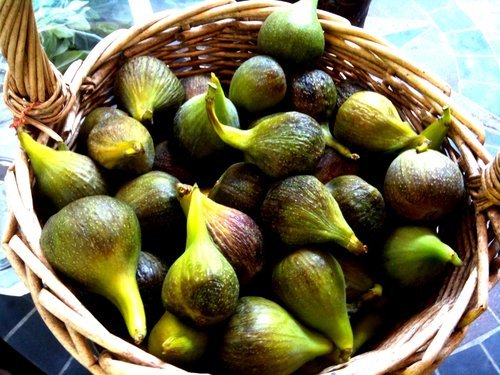
Yahweh shows Amos a basket of figs (“qayitz”) and promises to bring the kingdom of Northern Israel to an end (“qetz”).

II. Photo
Amos relates his vision: “This is what my Lord God showed me: there was a basket of figs.” (v. 1)

III. Important Verses
1-3: This is what my Lord GOD showed me: There was a basket of figs. He said, “What do you see, Amos?” “A basket of figs,” I replied. And the LORD said to me: “The hour of doom has come for My people Israel; I will not pardon them again  And the singing women of the palace shall howl on that day — declares my Lord GOD: So many corpses Left lying everywhere! Hush!”
4-7: Listen to this, you who devour the needy, annihilating the poor of the land, saying, “If only the new moon were over, so that we could sell grain; the sabbath, so that we could offer wheat for sale, using an ephah that is too small, and a shekel that is too big, tilting a dishonest scale, and selling grain refuse as grain! We will buy the poor for silver, the needy for a pair of sandals.” The LORD swears by the Pride of Jacob: “I will never forget any of their doings.”
10: I will turn your festivals into mourning And all your songs into dirges; I will put sackcloth on all loins And tonsures on every head. I will make it mourn as for an only child, All of it as on a bitter day.
11-12: A time is coming — declares my Lord GOD — when I will send a famine upon the land: not a hunger for bread or a thirst for water, but for hearing the words of the LORD.  Men shall wander from sea to sea and from north to east to seek the word of the LORD, but they shall not find it.

IV. Outline
1-3. Vision of figs (qayitz) indicating the end (qetz) of Northern Israel
4-6. Addressing the greedy
7. God knows their actions
8-10. God will punish the world in a supernatural way
11-14. People will yearn for the words of God but not find it

V. Comment
No comment today. Stay tuned.

VI. Works Used
(see “Commentaries” page)
Collins, John J. “Introduction to the Hebrew Bible,” (Minneapolis: Fortress Press, 2004).
Photo taken from http://25.media.tumblr.com/S0jhGIOh8px0q336Uq2qofOdo1_500.jpg

Amos 7 – “Amos’ Attempt to Defend the People; Amaziah and Amos”

Hebrew-English Text
I. Summary
Amos is able to pacify Yahweh on two separate occasions, but Yahweh eventually decides to punish the Northern Israelites. Amaziah betrays Amos, and Amos tells him that he and the Israelites will die in exile.

II. Photo
Amaziah berates Amos: “Seer, off with you to the land of Judah! Eat your bread there, and do your prophesying there!” (v. 12b)

III. Important Verses
1-3: This is what my Lord GOD showed me: He was creating [a plague of] locusts at the time when the late-sown crops were beginning to sprout — the late-sown crops after the king’s reaping. When it had finished devouring the herbage in the land, I said, “O Lord GOD, pray forgive. How will Jacob survive? He is so small.” The LORD relented concerning this. “It shall not come to pass,” said the LORD.

6-8: The LORD relented concerning this. “That shall not come to pass, either,” said my Lord GOD. This is what He showed me: He was standing on a wall checked with a plumb line and He was holding a plumb line. And the LORD asked me, “What do you see, Amos?” “A plumb line,” I replied. And my Lord declared, “I am going to apply a plumb line to My people Israel; I will pardon them no more.
12-13: Amaziah also said to Amos, “Seer, off with you to the land of Judah! Earn your living there, and do your prophesying there. But don’t ever prophesy again at Bethel; for it is a king’s sanctuary and a royal palace.”
16-17: And so, hear the word of the LORD. You say I must not prophesy about the House of Israel or preach about the House of Isaac; but this, I swear, is what the LORD said: Your wife shall play the harlot in the town, your sons and daughters shall fall by the sword, and your land shall be divided up with a measuring line. And you yourself shall die on unclean soil; for Israel shall be exiled from its soil.”

IV. Outline

1-3. Vision #1: Locusts
    1. Amos has a vision of locusts falling upon Israel
    2-3. Amos convinces God to abstain from this act
4-6. Vision #2: Fire
    1. Amos has a vision of fire consuming Israel
    2-3. Amos convinces God to abstain from this act
7-9. Vision #3 and explanation: God will treat Israel like a plumb line
10-11. Amaziah tells Jereboam about Amos’ sedition
12-13. Amaziah tells Amos to return to Judah
14-17. Amos’ response
    14-15. God called Amos to prophesy
    16-17. Israel will be conquered; Amaziah and its people will die in exile

V. Comment
No comment today. Stay tuned.

VI. Works Used
(see “Commentaries” page)
Collins, John J. “Introduction to the Hebrew Bible,” (Minneapolis: Fortress Press, 2004).
Photo taken from http://farm2.static.flickr.com/1189/536844422_f37bd9f5e7_b.jpg

Amos 6 – “Doom for Northern Israel”

Hebrew-English Text
I. Summary
Yahweh promises to exile the Northern Israelites.

II. Photo
God mocks the people’s stupidity: “Can horses gallop on a rock?” (v. 12)

III. Important Verses
4-8: They lie on ivory beds, Lolling on their couches, Feasting on lambs from the flock And on calves from the stalls. They hum snatches of song To the tune of the lute — They account themselves musicians like David. They drink [straight] from the wine bowls And anoint themselves with the choicest oils — But they are not concerned about the ruin of Joseph. Assuredly, right soon They shall head the column of exiles; They shall loll no more at festive meals. My Lord GOD swears by Himself: I loathe the Pride of Jacob, And I detest his fortresses. I will declare forfeit city and inhabitants alike — declares the LORD, the God of Hosts.
9-10: If ten people are left in one house, they shall die. And if someone’s kinsman — who is to burn incense for him — comes to carry the remains out of a house, and he calls to the one at the rear of the house, “Are there any alive besides you?” he will answer, “No, none.” And he will say, “Hush!” — so that no one may utter the name of the LORD.
12: Can horses gallop on a rock? Can it be plowed with oxen? Yet you have turned justice into poison weed And the fruit of righteousness to wormwood.

IV. Outline
1-8. The Northern Israelites will be exiled, just like other nations
9-10. Death in Northern Israel
11. God will destroy the buildings
12. Metaphor about Israel’s iniquity
13. Mocking the people’s pride
14. God will bring an enemy into the land

V. Comment
No comment today. Stay tuned.

VI. Works Used
(see “Commentaries” page)
Collins, John J. “Introduction to the Hebrew Bible,” (Minneapolis: Fortress Press, 2004).
Photo taken from

Amos 5 – “A Call to Repent”

Hebrew-English Text
I. Summary
Yahweh promises to exile the people and Amos urges them to repent.

II. Photo
Amos praises God: “[He is the one] who made the Pleiades and Orion, who turns deep darkness into dawn and darkens day into night!” (v. 8a)

III. Important Verses
2: Fallen, not to rise again, Is Maiden Israel; Abandoned on her soil With none to lift her up.
3: For thus said my Lord GOD About the House of Israel: The town that marches out a thousand strong Shall have a hundred left, And the one that marches out a hundred strong Shall have but ten left.
15: Hate evil and love good, And establish justice in the gate; Perhaps the LORD, the God of Hosts, Will be gracious to the remnant of Joseph.
18-20: Ah, you who wish For the day of the LORD! Why should you want The day of the LORD? It shall be darkness, not light! — As if a man should run from a lion And be attacked by a bear; Or if he got indoors, Should lean his hand on the wall And be bitten by a snake! Surely the day of the LORD shall be Not light, but darkness, Blackest night without a glimmer.
21-24: Ah, you who wish For the day of the LORD! Why should you want The day of the LORD? It shall be darkness, not light! — As if a man should run from a lion And be attacked by a bear; Or if he got indoors, Should lean his hand on the wall And be bitten by a snake! Surely the day of the LORD shall be Not light, but darkness, Blackest night without a glimmer.
27: As I drive you into exile beyond Damascus — Said the LORD, whose name is God of Hosts.

IV. Outline
1. Introduction
2-3. Northern Israel will be decimated
4-9. God warns Northern Israel to return to him
10-13. Punishment for sins
14-17. Call to repent
18-20. Disabusing the people about “the day of the Lord”
21-24. God wants justice, not sacrifice
25-26. Israel’s hypocircy
27. God will exile the Northern Israelites

V. Comment
No comment today. Stay tuned.

VI. Works Used
(see “Commentaries” page)
Collins, John J. “Introduction to the Hebrew Bible,” (Minneapolis: Fortress Press, 2004).
Photo taken from http://matmantra.files.wordpress.com/2009/10/jw_pleiades_12sc.jpg

Amos 4 – “Doom for Northern Israel”

Hebrew-English Text
I. Summary
Yahweh will exile the Northern Israelites for their sins.

II. Photo
God will exile the Northern Israelites: “Behold, days are coming upon you when you will be carried off in baskets, and, to the last one, in fish baskets!” (v. 2b)

III. Important Verses
1-3: Hear this word, you cows of Bashan ¶ On the hill of Samaria — Who defraud the poor, Who rob the needy; Who say to your husbands, “Bring, and let’s carouse!” My Lord GOD swears by His holiness: Behold, days are coming upon you When you will be carried off in baskets, And, to the last one, in fish baskets, And taken out [of the city] — Each one through a breach straight ahead — And flung on the refuse heap — declares the LORD.
4-5: Come to Bethel and transgress; To Gilgal, and transgress even more: Present your sacrifices the next morning And your tithes on the third day; And burn a thank offering of leavened bread; And proclaim freewill offerings loudly. For you love that sort of thing, O Israelites — declares my Lord GOD.
11: I have wrought destruction among you As when God destroyed Sodom and Gomorrah; You have become like a brand plucked from burning. Yet you have not turned back to Me — declares the LORD.
13: Behold, He who formed the mountains, And created the wind, And has told man what His wish is, Who turns blackness into daybreak, And treads upon the high places of the earth — His name is the LORD, the God of Hosts.

IV. Outline
1-3. The Northern Israelites will be exiled
4-5. Sarcastic call to worship at Bethel
6-11. God punished Northern Israel but it didn’t turn to him
12-13. God will punish the Northern Israelites

V. Comment
No comment today. Stay tuned.

VI. Works Used
(see “Commentaries” page)
Collins, John J. “Introduction to the Hebrew Bible,” (Minneapolis: Fortress Press, 2004).
Photo taken from http://www.susanbaileyharris.com/web_gallery/Vietnam_AngkorWat_Gallery_010808/content/bin/images/large/Fish_Baskets_BinhTay_Market_Web.jpg

Amos 3 – “God’s Warning”

Hebrew-English Text
I. Summary
Having warned the Northern Israelites to desist from sinning, Yahweh promises to send an enemy into their land.

II. Photo
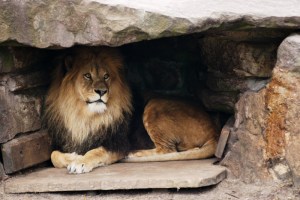
A metaphor about God’s message: “Does a young lion roar from its den without having made a capture?” (v. 4b)

III. Important Verses
1-2: Hear this word, O people of Israel, That the LORD has spoken concerning you, Concerning the whole family that I brought up from the land of Egypt: You alone have I singled out Of all the families of the earth — That is why I will call you to account For all your iniquities.
9-10: Proclaim in the fortresses of Ashdod And in the fortresses of the land of Egypt! Say: Gather on the hill of Samaria And witness the great outrages within her And the oppression in her midst. They are incapable of doing right — declares the LORD; They store up lawlessness and rapine In their fortresses.
11: Assuredly, Thus said my Lord GOD: An enemy, all about the land! He shall strip you of your splendor, And your fortresses shall be plundered.
14: That when I punish Israel for its transgressions, I will wreak judgment on the altar of Bethel, And the horns of the altar shall be cut off And shall fall to the ground.
15: I will wreck the winter palace Together with the summer palace; The ivory palaces shall be demolished, And the great houses shall be destroyed — declares the LORD.

IV. Outline
1-2. God pays special attention to Northern Israel’s sins
3-8. Metaphors about God’s warnings
9-10. Proclamations about Northern Israel
11-12. God will send a hostile enemy into the land
13-15. Doom for the altar and palaces

V. Comment
No comment today. Stay tuned.

VI. Works Used
(see “Commentaries” page)
Collins, John J. “Introduction to the Hebrew Bible,” (Minneapolis: Fortress Press, 2004).
Photo taken from http://xianrenaud.typepad.com/photos/uncategorized/2007/09/27/istock_000002921745small.jpg