Isaiah 7 – “Aram and Israel March on Jerusalem; A Prophetic Warning Concerning Assyria”

Hebrew-English Text
I. Summary
The people panic when an Aramean and Israelite army marches towards Jerusalem. Although Isaiah tells the people to stay calm, he describes how the Assyrians will destroy their land and decimate the population.

II. Photo
The people are terrified: “Now, when it was reported to the House of David that Aram had allied itself with Ephraim, their hearts and the hearts of their people trembled as trees of the forest sway before a wind.” (v. 2)

III. Important Verses
2: Now, when it was reported to the House of David that Aram had allied itself with Ephraim, their hearts and the hearts of their people trembled as trees of the forest sway before a wind.
10-12: The LORD spoke further to Ahaz:  “Ask for a sign from the LORD your God, anywhere down to Sheol or up to the sky.” But Ahaz replied, “I will not ask, and I will not test the LORD.”
13-17: “Listen, House of David,” [Isaiah] retorted, “is it not enough for you to treat men as helpless that you also treat my God as helpless? Assuredly, my Lord will give you a sign of His own accord! Look, the young woman is with child and about to give birth to a son. Let her name him Immanuel. (By the time he learns to reject the bad and choose the good, people will be feeding on curds and honey.) For before the lad knows to reject the bad and choose the good, the ground whose two kings you dread shall be abandoned. The LORD will cause to come upon you and your people and your ancestral house such days as never have come since Ephraim turned away from Judah — that selfsame king of Assyria!
23-24: For in that day, every spot where there could stand a thousand vines worth a thousand shekels of silver shall become a wilderness of thornbush and thistle. One will have to go there with bow and arrows, for the country shall be all thornbushes and thistles.

IV. Outline
1. The Arameans and Israelites march on Jerusalem
2. The people are terrified
3-9. God’s message to Ahaz: do not be afraid
10-11. Ahaz is told to ask for a sign
12. Ahaz trusts in God
13-17. Isaiah warns of worse things to come, i.e. the Assyrians
18-25. Assyria will decimate the population and turn the fields to wilderness

V. Comment
Chapter 7 concerns the events mentioned in 2 Kings 16, namely the advance of Aram and the destruction of Damascus:

  • Then King Rezin of Aram and King Pekah son of Remaliah of Israel advanced on Jerusalem for battle. They besieged Ahaz, but could not overcome [him]. At that time King Rezin of Aram recovered Elath for Aram; he drove out the Judites from Elath, and Edomites came to Elath and settled there, as is still the case. Ahaz sent messengers to King Tiglath-pileser of Assyria to say, ‘I am your servant and your son; come and deliver me from the hands of the king of Aram and from the hands of the king of Israel, who are attacking me.’ Ahaz took the gold and silver that were on hand in the House of the LORD and in the treasuries of the royal palace and sent them as a gift to the king of Assyria. The king of Assyria responded to his request; the king of Assyria marched against Damascus and captured it. He deported its inhabitants to Kir and put Rezin to death.

Although Isaiah tells the people of Jerusalem to stay calm, he warns them of the ominous threat posed by the Assyrian army. Indeed, the Assyrians pose a much greater threat than the kings of Israel and Aram.

Although they appear in a positive context elsewhere, there are two aspects of our chapter that are meant to be viewed as a threat instead of a blessing. Verse 3 mentions Isaiah’s son Shear-yashub (“a remnant shall return”): “But the LORD said to Isaiah, ‘Go out with your son Shear-jashub to meet Ahaz at the end of the conduit of the Upper Pool, by the road of the Fuller’s Field.’” Collins writes: “Isaiah’s children, like those of Hosea, are walking billboards, bearing their father’s message. In the following chapter we shall meet Maher-shalal-hash-baz (‘hasten for spoil, hurry for plunder’). The implication of the name Shear-yashub is that only a remnant shall return. At a time when no Judeans had been taken into exile, this seems like a disastrous prospect. Later, of course, the survival of a remnant would be the seed of hope. But the initial force of the child’s name was to prophesy deportation and exile.” (312)

The second aspect is the threat in vv. 15 and 22, i.e. that the people will “eat curds and honey.” While the phrase “milk and honey” conjures up an image of blessings in Exodus 3:8, 17; 13:5 etc., in our chapter it is meant as a curse. Collins writes: “Fat and milk were generally regarded as signs of abundance in the ancient Near East, and milk and honey were used in cultic activity in Mesopotamia…. [Yet,] this is brought out in a series of additions to the passage, each introduced by the formula ‘on that day.’ Isaiah 7:21-25 explains that ‘on that day’ everyone will eat curds and honey because the population will be decimated. Moreover, the vineyards will be ravaged and there will be little agriculture, but cattle will be let loose and people will live off the natural produce of the land. They will still have milk and honey, but not the vineyards and wine to which they have become accustomed.” (313) For more on this, see chapter 1 in “Nature in Our Biblical Heritage” by Nogah Hareuveni (trans. H. Frenkley; Israel: Neot Kedumim, 1980) 11-26.

VI. Works Used
(see “Commentaries” page)
Blenkinsopp, Joseph. “Isaiah 1-39” The Anchor Bible vol. 19 (New York: Doubleday, 2000).
Collins, John J. “Introduction to the Hebrew Bible,” (Minneapolis: Fortress Press, 2004).
Sweeney, Marvin A. “Isaiah 1-39 with an Introduction to Prophetic Literature” The Forms of Old Testament Literature vol. 16 (Grand Rapids, Michigan: William B. Eerdmans, 1996).
Photo taken from http://farm1.static.flickr.com/72/154838561_cae0919460.jpg

Isaiah 6 – “Isaiah’s Vision of God and His Seraphim”

Hebrew-English Text
I. Summary
Isaiah sees God sitting on his throne being attended by the six-winged Seraphim. The Seraphim purge Isaiah of his sins and send him on a mission to rebuke the rebellious people.

II. Photo
Isaiah is purged of sin: “Then one of the seraphs flew over to me with a live coal, which he had taken from the altar with a pair of tongs. He touched it to my lips and declared, ‘Now that this has touched your lips, Your guilt shall depart And your sin be purged away.’” (vv. 6-7)

III. Important Verses
1-2: In the year that King Uzziah died, I beheld my Lord seated on a high and lofty throne; and the skirts of His robe filled the Temple. Seraphs stood in attendance on Him. Each of them had six wings: with two he covered his face, with two he covered his legs, and with two he would fly.
3: And one would call to the other, “Holy, holy, holy! The LORD of Hosts! His presence fills all the earth!”
6-7:  Then one of the seraphs flew over to me with a live coal, which he had taken from the altar with a pair of tongs. He touched it to my lips and declared, “Now that this has touched your lips, Your guilt shall depart And your sin be purged away.”
11-13: I asked, “How long, my Lord?” And He replied: “Till towns lie waste without inhabitants And houses without people, And the ground lies waste and desolate — For the LORD will banish the population — And deserted sites are many In the midst of the land.  “But while a tenth part yet remains in it, it shall repent. It shall be ravaged like the terebinth and the oak, of which stumps are left even when they are felled: its stump shall be a holy seed.”

IV. Outline
1. God seated on his throne
2. Seraphs attending God
3-4. The awesome call of the Seraphim
5. Isaiah’s cry
6-7. A seraph cleanses Isaiah of his sins
8-10. Isaiah volunteers to deliver a message to the people
11-13. Isaiah will see destruction and rejuvenation

V. Comment
No comment today. Stay tuned.

VI. Works Used
(see “Commentaries” page)
Blenkinsopp, Joseph. “Isaiah 1-39” The Anchor Bible vol. 19 (New York: Doubleday, 2000).
Collins, John J. “Introduction to the Hebrew Bible,” (Minneapolis: Fortress Press, 2004).
Sweeney, Marvin A. “Isaiah 1-39 with an Introduction to Prophetic Literature” The Forms of Old Testament Literature vol. 16 (Grand Rapids, Michigan: William B. Eerdmans, 1996).
Photo taken from http://www.grillirious.com/wp-content/uploads/2009/10/Hot-Coals-2.jpg

Isaiah 5 – “The Consequences of Iniquity”

Hebrew-English Text
I. Summary
Israel’s unfaithfulness is illustrated by means of a parable. The nation’s specific sins are listed and Isaiah warns of an attack by a terrifying foreign army.

II. Photo
Isaiah addresses those who love hard drink: “Ah, those who chase liquor from early in the morning, and till late in the evening are inflamed by wine!” (v. 11)

III. Important Verses
1-7: Let me sing for my beloved A song of my lover about his vineyard. My beloved had a vineyard On a fruitful hill. He broke the ground, cleared it of stones, And planted it with choice vines. He built a watchtower inside it, He even hewed a wine press in it; For he hoped it would yield grapes. Instead, it yielded wild grapes. “Now, then, Dwellers of Jerusalem And men of Judah, You be the judges Between Me and My vineyard: What more could have been done for My vineyard That I failed to do in it? Why, when I hoped it would yield grapes, Did it yield wild grapes?  “Now I am going to tell you What I will do to My vineyard: I will remove its hedge, That it may be ravaged; I will break down its wall, That it may be trampled. And I will make it a desolation; It shall not be pruned or hoed, And it shall be overgrown with briers and thistles. And I will command the clouds To drop no rain on it.” For the vineyard of the LORD of Hosts Is the House of Israel, And the seedlings he lovingly tended Are the men of Judah. And He hoped for justice, But behold, injustice; For equity, But behold, iniquity!
11-14:  Ah, Those who chase liquor From early in the morning, And till late in the evening Are inflamed by wine! Who, at their banquets, Have lyre and lute, Timbrel, flute, and wine; But who never give a thought To the plan of the LORD, And take no note Of what He is designing. Assuredly, My people will suffer exile For not giving heed, Its multitude victims of hunger And its masses parched with thirst. Assuredly, Sheol has opened wide its gullet And parted its jaws in a measureless gape; And down into it shall go, That splendor and tumult, That din and revelry.
26-30: He will raise an ensign to a nation afar, Whistle to one at the end of the earth. There it comes with lightning speed! In its ranks, none is weary or stumbles, They never sleep or slumber; The belts on their waists do not come loose, Nor do the thongs of their sandals break. Their arrows are sharpened, And all their bows are drawn. Their horses’ hoofs are like flint, Their chariot wheels like the whirlwind. Their roaring is like a lion’s, They roar like the great beasts; When they growl and seize a prey, They carry it off and none can recover it.  But in that day, a roaring shall resound over him like that of the sea; and then he shall look below and, behold, Distressing darkness, with light; Darkness, in its lowering clouds.

IV. Outline

1-7. Parable about Israel’s iniquities and upcoming punishment
8-17. Specific sins and their consequences #1
    8-10. The wealthy will become needy for ignoring the poor
    11-14. Bacchanalianism
        11-13. Wine-drinking is the cause for Israel’s exile
        14. The revelers will go down to Sheol
    15-17. God will be raised and the haughty will be brought low
18-25. Specific sins and their consequences #2
    18-19. Duplicitous sinners
    20-21. Corrupt “wise men”
    22. Wine drinkers
    23. Corrupt judges
    24-25. God will punish them for their misdeeds
26-30. God will summon the mighty Assyrian army against Israel

V. Comment
No comment today. Stay tuned.

VI. Works Used
(see “Commentaries” page)
Blenkinsopp, Joseph. “Isaiah 1-39” The Anchor Bible vol. 19 (New York: Doubleday, 2000).
Collins, John J. “Introduction to the Hebrew Bible,” (Minneapolis: Fortress Press, 2004).
Sweeney, Marvin A. “Isaiah 1-39 with an Introduction to Prophetic Literature” The Forms of Old Testament Literature vol. 16 (Grand Rapids, Michigan: William B. Eerdmans, 1996).
Photo taken from http://farm1.static.flickr.com/73/201140544_7246ec5b0d.jpg

Isaiah 4 – “The Haughty Daughters of Zion Part II; Jerusalem’s Glorious Future”

Hebrew-English Text
I. Summary
The haughty daughters of Zion will be forced to beg for a husband. God will cleanse Jerusalem of its sinners and reward its survivors with spiritual and material benefits.

II. Photo
God’s glory will cover Jerusalem: “The Lord will create a… cloud by day and… the glory shall hang [like] a canopy, which shall serve as a pavilion for shade from heat by day and as a shelter for protection against drenching rain.” (vv. 5-6)

III. Important Verses
1: In that day, seven women shall take hold of one man, saying, “We will eat our own food And wear our own clothes; Only let us be called by your name — Take away our disgrace!”
4-6:  When my Lord has washed away The filth of the daughters of Zion, And from Jerusalem’s midst Has rinsed out her infamy — In a spirit of judgment And in a spirit of purging —  the LORD will create over the whole shrine and meeting place of Mount Zion cloud by day and smoke with a glow of flaming fire by night. Indeed, over all the glory shall hang a canopy, which shall serve as a pavilion for shade from heat by day and as a shelter for protection against drenching rain.

IV. Outline
1. The lament of the haughty daughters of Zion
2-3. Reward for the remnants of Zion
4-6. God’s glory will fill Zion after the removal of its sinners

V. Comment
No comment today. Stay tuned.

VI. Works Used
(see “Commentaries” page)
Blenkinsopp, Joseph. “Isaiah 1-39” The Anchor Bible vol. 19 (New York: Doubleday, 2000).
Collins, John J. “Introduction to the Hebrew Bible,” (Minneapolis: Fortress Press, 2004).
Sweeney, Marvin A. “Isaiah 1-39 with an Introduction to Prophetic Literature” The Forms of Old Testament Literature vol. 16 (Grand Rapids, Michigan: William B. Eerdmans, 1996).
Photo taken from http://farm2.static.flickr.com/1436/941187311_a64a659140.jpg

Isaiah 3 – “Jerusalem in Chaos; The Haughty Daughters of Zion”

Hebrew-English Text
I. Summary
Jerusalem’s society will deteriorate because of its many sins. God will bring disgrace to the haughty daughters of Zion and kill their husbands in a battle.

II. Photo
God will strip the women of their ornaments: “In that day, my Lord will strip off the finery of the anklets, the fillets, and the crescents, the eardrops, the bracelets, the veils, the turbans, the armlets, the sashes, the talismans, the amulets, the signet rings and the nose rings…” (vv. 18-21)

III. Important Verses
4-5: And He will make boys their rulers, And babes shall govern them. So the people shall oppress one another — Each oppressing his fellow: The young shall bully the old; And the despised [shall bully] the honored.
8-9: Ah, Jerusalem has stumbled, And Judah has fallen, Because by word and deed They insult the LORD, Defying His majestic glance. Their partiality in judgment accuses them; They avow their sins like Sodom, They do not conceal them. Woe to them! For ill Have they served themselves.
10-11: Hail the just man, for he shall fare well; He shall eat the fruit of his works. Woe to the wicked man, for he shall fare ill; As his hands have dealt, so shall it be done to him.
16-24: The LORD said: “Because the daughters of Zion Are so vain And walk with heads thrown back, With roving eyes, And with mincing gait, Making a tinkling with their feet” — My Lord will bare the pates Of the daughters of Zion, The LORD will uncover their heads. In that day, my LORD will strip off the finery of the anklets, the fillets, and the crescents; of the eardrops, the bracelets, and the veils; the turbans, the armlets, and the sashes; of the talismans and the amulets; the signet rings and the nose rings; of the festive robes, the mantles, and the shawls; the purses, the lace gowns, and the linen vests; and the kerchiefs and the capes. And then — Instead of perfume, there shall be rot; And instead of an apron, a rope; Instead of a diadem of beaten-work, A shorn head; Instead of a rich robe, A girding of sackcloth; A burn instead of beauty.

IV. Outline

1-7. Prophecy: Jerusalem in chaos
    1-3. God will remove the leaders
    4. Youngsters will lead
    5. Social chaos
    6-7. Descriptive example: people will shun leadership
8-15. Jerusalem’s sins and their consequences
    8-9. Jerusalem’s sins
    10-11. Proverbial justification for its fall
    12. Jerusalem’s wayward course
    13-15. God will prosecute its injustice
16-26. The humbling of the haughty women
    16. The ways of the haughty women
    17. God will strip them of their clothes
    18-23. God will strip them of their ornaments
    24. God will replace their beauty with disgrace
    25-26. Their husbands will die in battle

V. Comment
Chapter 3 describes the hostilities that will plague Jerusalem and the reasons for this punishment. It ends with a description of what will befall the haughty daughters of Zion. Verse 1 describes God with the appellation “Sovereign Lord of Hosts,” a name used in prophetic literature to describe God as a warrior. For example, see 1:24, “Assuredly, this is the declaration Of the Sovereign, the LORD of Hosts, The Mighty One of Israel: ‘Ah, I will get satisfaction from My foes; I will wreak vengeance on My enemies!’” Also see 10:33, “Lo! The Sovereign LORD of Hosts Will hew off the tree-crowns with an ax: The tall ones shall be felled, The lofty ones cut down,” and 19:4, “And I will place the Egyptians At the mercy of a harsh master, And a ruthless king shall rule them” — declares the Sovereign, the LORD of Hosts.”

Isaiah justifies Jerusalem’s punishment with a proverb in vv. 10-11: “Hail the just man, for he shall fare well; He shall eat the fruit of his works. Woe to the wicked man, for he shall fare ill; As his hands have dealt, so shall it be done to him.” As one might expect, this type of saying is common to the book of proverbs. For example, see 10:24, “What the wicked man plots overtakes him; What the righteous desire is granted,” and 10:30, “The righteous will never be shaken; The wicked will not inhabit the earth.” While this type of proverb appears dozens of times in the book of Proverbs (e.g. Prov 10:32; 15:29; 24:16), it is also appears in the book of Psalms (e.g. Ps 1:5-6; 11:5; 37:21; 58:11) and has the same message as the speeches of Job’s friends in the book of Job (e.g. 20:4-29; 22:12-20).

In fact, proverbs such as those found in vv. 10-11 seem to have been prevalent throughout the ancient Near East. Collins writes (pp. 488-489), “There is a well-attested genre of Wisdom instruction, especially in Egypt, that dates back to the third millennium BCE. Examples include the teachings of Amenemhet and Ptahhotep (third millenium), those of Amenemope and Ani (second millennium), and numerous others (Translations of these texts can be found in ANET, 412-24; and in M. Lichtheim, Ancient Egyptian Literature 1:58-80; 2:135-63.) These instructions were copied in the scribal schools, and new instructions were composed, down to Hellenistic times. They typically deal with relations with other people, both superiors and inferiors, friends and enemies. They often caution about relations with women. They are by no means opportunistic. On the contrary, they seek to inculcate moral virtues, in the belief that these ultimately lead to success.” Aside from Egypt, the Edomites seem to have been a center of Wisdom. Hence, Jeremiah 49:7 says, “Concerning Edom. Thus said the LORD of Hosts: Is there no more wisdom in Teman? Has counsel vanished from the prudent? Has their wisdom gone stale?” and Obadiah 1:8 says, “In that day — declares the LORD — I will make the wise vanish from Edom, Understanding from Esau’s mount.”

VI. Works Used
(see “Commentaries” page)
Blenkinsopp, Joseph. “Isaiah 1-39” The Anchor Bible vol. 19 (New York: Doubleday, 2000).
Collins, John J. “Introduction to the Hebrew Bible,” (Minneapolis: Fortress Press, 2004).
Sweeney, Marvin A. “Isaiah 1-39 with an Introduction to Prophetic Literature” The Forms of Old Testament Literature vol. 16 (Grand Rapids, Michigan: William B. Eerdmans, 1996).
Photo taken from http://farm2.static.flickr.com/1084/1393268492_bb88151e42.jpg

Isaiah 2 – “Exalted Jerusalem; Humbling the Haughty”

Hebrew-English Text
I. Summary
Isaiah describes a Jerusalem that is surrounded by world peace. He exhorts the people to abandon idolatry and speaks of a day when the tall things will be brought down to size.

II. Photo
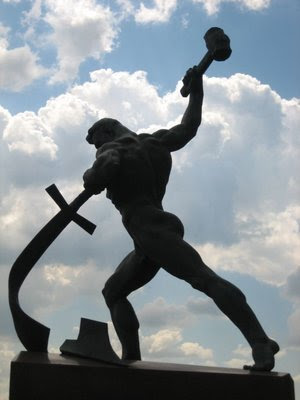
Isaiah predicts the end of war: “And [the nations] shall beat their swords into plowshares and their spears into pruning hooks: Nation shall not take up sword against nation; they shall never again know war.” (v. 4)

III. Important Verses
2-4: In the days to come, The Mount of the LORD’s House Shall stand firm above the mountains And tower above the hills; And all the nations Shall gaze on it with joy. And the many peoples shall go and say: “Come, Let us go up to the Mount of the LORD, To the House of the God of Jacob; That He may instruct us in His ways, And that we may walk in His paths.” For instruction shall come forth from Zion, The word of the LORD from Jerusalem. Thus He will judge among the nations And arbitrate for the many peoples, And they shall beat their swords into plowshares And their spears into pruning hooks: Nation shall not take up Sword against nation; They shall never again know war.
11-17:  Man’s haughty look shall be brought low, And the pride of mortals shall be humbled. None but the LORD shall be Exalted in that day. For the LORD of Hosts has ready a day Against all that is proud and arrogant, Against all that is lofty — so that it is brought low: Against all the cedars of Lebanon, Tall and stately, And all the oaks of Bashan; Against all the high mountains And all the lofty hills; Against every soaring tower And every mighty wall; Against all the ships of Tarshish And all the gallant barks. Then man’s haughtiness shall be humbled And the pride of man brought low. None but the LORD shall be Exalted in that day.
20-21: On that day, men shall fling away, To the flying foxes and the bats, The idols of silver And the idols of gold Which they made for worshiping. And they shall enter the clefts in the rocks And the crevices in the cliffs, Before the terror of the LORD And His dread majesty, When He comes forth to overawe the earth.

IV. Outline

1. Introduction
2-4. Jerusalem’s role as a universal city
    2. Jerusalem as the highest mountain
    3. The nations will turn to Jerusalem for advice
    4. The end of war
5-22. The futility of haughty man
    5. Exhorting the Israelites to follow God
    6. Foreign practices
    7-8. Lands of riches and idol-worship
    9. Man will be humbled
    10-17. A day when all high-things will be brought low
    18-21. People will rid themselves of their idols
    22. Exhortation to stop worshiping man

V. Comment
Chapter 2 has two basic units, a description of Jerusalem surrounded by world peace (vv. 2-4) and a description of the fall of tall things and idols (vv. 5-22). The chapter begins with a prediction about the aharit hayyamim “end of days”: “In the days to come, The Mount of the LORD’s House Shall stand firm above the mountains And tower above the hills; And all the nations Shall gaze on it with joy.” (v. 2) What is the aharit hayamim? Sweeney writes: “The passage is frequently described as eschatological because of the opening statement, wehaya be’aharit hayyamim, ‘and it shall come to pass in the latter days,’… But as semantic studies of the phrase have shown particularly in relation to the Akkadian ina ahrat umi, ‘in future days,’ it refers merely to a time in the future, not to the eschatological end of time… The historical setting of this passage in the reign of King Cyrus is particularly important because of Cyrus’s lenient treatment of the Jews, including his permission to return to Jerusalem and rebuild the temple (2 Chr 36:22-23; Ezra 1:1-4; 6:3-5; cf. ANET, 316). Although this policy was selectively applied… its application to Judah and the Judean exiles prompted great optimism for the reestablishment of Jerusalem and an ensuing era of peace.” (99)

Verse 10ff describes a time when all tall things will be brought low: “For the LORD of Hosts has ready a day Against all that is proud and arrogant, Against all that is lofty — so that it is brought low: Against all the cedars of Lebanon, Tall and stately, And all the oaks of Bashan…” (vv. 12-13) Man’s haughtiness is a particular target: “Man’s haughty look shall be brought low, And the pride of mortals shall be humbled. None but the LORD shall be Exalted in that day.” (v. 11) A similar theme (i.e. the fall of pride) can be found in  the book of Proverbs. For example, see 16:11: “Pride goes before ruin, Arrogance, before failure.” Similar verses are 11:2, “When arrogance appears, disgrace follows, But wisdom is with those who are unassuming,” and 18:12, “Before ruin a man’s heart is proud; Humility goes before honor.”

The chapter ends with a description of the futility of idolatry: “As for idols, they shall vanish completely… On that day, men shall fling away, To the flying foxes and the bats, The idols of silver And the idols of gold Which they made for worshiping…. Oh, cease to glorify man, Who has only a breath in his nostrils! For by what does he merit esteem?” (vv. 18, 20, 22) As Blenkinsopp points out, this is a theme that will be picked up later in the book. For examples, see 40:18-19: “To whom, then, can you liken God, What form compare to Him? The idol? A woodworker shaped it, And a smith overlaid it with gold, Forging links of silver.” Also see 44:17, “Of the rest he makes a god — his own carving! He bows down to it, worships it; He prays to it and cries, ‘Save me, for you are my god!’” and 45:20, “Come, gather together, Draw nigh, you remnants of the nations! No foreknowledge had they who carry their wooden images and pray to a god who cannot give success.”

VI. Works Used
(see “Commentaries” page)
Blenkinsopp, Joseph. “Isaiah 1-39” The Anchor Bible vol. 19 (New York: Doubleday, 2000).
Collins, John J. “Introduction to the Hebrew Bible,” (Minneapolis: Fortress Press, 2004).
Sweeney, Marvin A. “Isaiah 1-39 with an Introduction to Prophetic Literature” The Forms of Old Testament Literature vol. 16 (Grand Rapids, Michigan: William B. Eerdmans, 1996).
Photo taken from http://3.bp.blogspot.com/_djNPU4bKGN8/SSinFGQ02eI/AAAAAAAAA3k/NUqfzSWeX-8/s400/Swords+into+plowshares.JPG

Isaiah 1 – “A Conviction and Sentence for Evil Israel”

Hebrew-English Text
I. Summary
Isaiah condemns Israel for abandoning God. God denounces temple worship, bemoans murder and corruption, and vows to cleanse Israel of its sins.

II. Photo
God admonishes Israel: “For you shall be like a terebinth wilted of leaf, and like a garden that has no water.” (v. 30)

III. Important Verses
1: The prophecies of Isaiah son of Amoz, who prophesied concerning Judah and Jerusalem in the reigns of Uzziah, Jotham, Ahaz, and Hezekiah, kings of Judah.
3: An ox knows its owner, An ass its master’s crib: Israel does not know, My people takes no thought.
5-7: Why do you seek further beatings, That you continue to offend? Every head is ailing, And every heart is sick. From head to foot No spot is sound: All bruises, and welts, And festering sores — Not pressed out, not bound up, Not softened with oil. Your land is a waste, Your cities burnt down; Before your eyes, the yield of your soil Is consumed by strangers — A wasteland as overthrown by strangers!
11:  “What need have I of all your sacrifices?” Says the LORD. “I am sated with burnt offerings of rams, And suet of fatlings, And blood of bulls; And I have no delight In lambs and he-goats.”
16-17: Wash yourselves clean; Put your evil doings Away from My sight. Cease to do evil; Learn to do good. Devote yourselves to justice; Aid the wronged. Uphold the rights of the orphan; Defend the cause of the widow.
25-28: I will turn My hand against you, And smelt out your dross as with lye, And remove all your slag:  I will restore your magistrates as of old, And your counselors as of yore. After that you shall be called City of Righteousness, Faithful City.”  Zion shall be saved in the judgment; Her repentant ones, in the retribution. But rebels and sinners shall all be crushed, And those who forsake the LORD shall perish.

IV. Outline

1. Superscription
2-4. Condemnation: Israel has abandoned God
5-8. Derisive question: Hasn’t Israel had enough pain and suffering?
9. Comparison to Sodom and Gomorrah
10-20. Oracle #1
    10. Exhortative introduction
    11-13. God’s rejection of the sacrifices
    14. God’s rejection of Sabbath and new moon practices
    15. God’s rejection of prayer
    16-17. Do good and shun evil
    18. The power of repentance
    19-20. Blessing and curse
21-23. Condemnation: Jerusalem has become murderous and corrupt
24-31. Oracle #2
    24a. Introduction
    24b-25a. God’s vengeance
    25b. God will clean Israel
    26-27. Jerusalem’s righteousness will be restored
    28. Evildores will be killed
    29. Condemnation: Israel’s forbidden practices
    30-31. Curse: Israel will burn like dessicated foliage

V. Comment
The book of Isaiah is, in many editions of the Hebrew Bible, the first book of the so-called “Latter Prophets.” Although it may seem odd that the books of Joshua, Judges, Samuel, and Kings – all of which deal with “history” – are considered to be “prophetic” works, Blenkinsopp points out that “history” was the work of prophets. He writes: “That all eight books are classified as prophetic is due to the belief that emerged in the late Second Temple period that the writing of history was a prophetic activity.” (74) The following verses illustrate this idea:

  • The acts of King David, early and late, are recorded in the history of Samuel the seer, the history of Nathan the prophet, and the history of Gad the seer. (1 Chr 29:29)
  • The other events of Solomon’s reign, early and late, are recorded in the chronicle of the prophet Nathan and in the prophecies of Ahijah the Shilonite and in the visions of Jedo the seer concerning Jeroboam son of Nebat. (2 Chr 9:29)
  • The deeds of Rehoboam, early and late, are recorded in the chronicles of the prophet Shemaiah and Iddo the seer, in the manner of genealogy. There was continuous war between Rehoboam and Jeroboam. (2 Chr 12:15)
  • As for the other events of Jehoshaphat’s reign, early and late, they are recorded in the annals of Jehu son of Hanani [the prophet], which were included in the book of the kings of Israel. (2 Chr 20:34)

In fact, Isaiah is himself described as a “historian” in 2 Chronicles:

  • The other events of Uzziah’s reign, early and late, were recorded by the prophet Isaiah son of Amoz. (2 Chr 26:22)
  • The other events of Hezekiah’s reign, and his faithful acts, are recorded in the visions of the prophet Isaiah son of Amoz and in the book of the kings of Judah and Israel.  (2 Chr 32:32)

The book begins with a superscription in v. 1: “The prophecies of Isaiah son of Amoz, who prophesied concerning Judah and Jerusalem in the reigns of Uzziah, Jotham, Ahaz, and Hezekiah, kings of Judah.” Who was Isaiah the son of Amoz and when did he live? Blenkinsopp writes: “As the narrative sections of the book tell it, Isaiah was involved in Judean politics at three critical jungtures between 734 and 701 B.C.E. during the reigns of Ahaz and Hezekiah and the reigns of three Assyrian kings. The first was his intervention in the crisis of Ahaz’s reign in 734-732 while Tiglath-pileser III ruled in Assyria; then, after more than two decades, under Hezekiah during Sargon II’s Philistia campaign in 713-711; finally, in direct association with Hezekiah during Sennacherib’s campaign in southern Palestine to suppress the revolt inspired by the death of Sargon (705-701).” (98)

VI. Works Used
(see “Commentaries” page)
Blenkinsopp, Joseph. “Isaiah 1-39” The Anchor Bible vol. 19 (New York: Doubleday, 2000).
Collins, John J. “Introduction to the Hebrew Bible,” (Minneapolis: Fortress Press, 2004).
Sweeney, Marvin A. “Isaiah 1-39 with an Introduction to Prophetic Literature” The Forms of Old Testament Literature vol. 16 (Grand Rapids, Michigan: William B. Eerdmans, 1996).
Photo taken from http://4.bp.blogspot.com/_tJU-kLhAOoU/SaDRk2YiFWI/AAAAAAAACdY/ldLcQRLaD2Q/s400/Brown-Leaves-Pony-Pasture.jpg

2 Kings 25 – “Jerusalem’s Destruction; Gedaliah’s Murder; Jehoiachin’s Release”

Hebrew-English Text
I. Summary
The Babylonians besiege Jerusalem, raid and destroy the temple, and exile most of the Judeans. Gedaliah is murdered after he is named the leader of Judea. Jehoiachin is released after spending thirty-seven years in a Babylonian prison.

II. Photo
The temple is destroyed: “Nebuzaradan, the chief of the guards, an officer of the king of Babylon, came to Jerusalem. He burned the House of the LORD, the king’s palace, and all the houses of Jerusalem; he burned down the house of every notable person.” (v. 8b-9)

III. Important Verses
1-4a: And in the ninth year of his reign, on the tenth day of the tenth month, Nebuchadnezzar moved against Jerusalem with his whole army. He besieged it; and they built towers against it all around. The city continued in a state of siege until the eleventh year of King Zedekiah. By the ninth day [of the fourth month] the famine had become acute in the city; there was no food left for the common people. Then [the wall of] the city was breached.
6-7: They captured the king and brought him before the king of Babylon at Riblah; and they put him on trial. They slaughtered Zedekiah’s sons before his eyes; then Zedekiah’s eyes were put out. He was chained in bronze fetters and he was brought to Babylon.
8-9: On the seventh day of the fifth month — that was the nineteenth year of King Nebuchadnezzar of Babylon — Nebuzaradan, the chief of the guards, an officer of the king of Babylon, came to Jerusalem. He burned the House of the LORD, the king’s palace, and all the houses of Jerusalem; he burned down the house of every notable person.
25-26: In the seventh month, Ishmael son of Nethaniah son of Elishama, who was of royal descent, came with ten men, and they struck down Gedaliah and he died; [they also killed] the Judeans and the Chaldeans who were present with him at Mizpah. And all the people, young and old, and the officers of the troops set out and went to Egypt because they were afraid of the Chaldeans.
27-29: In the thirty-seventh year of the exile of King Jehoiachin of Judah, on the twenty-seventh day of the twelfth month, King Evil-merodach of Babylon, in the year he became king, took note of King Jehoiachin of Judah and released him from prison. He spoke kindly to him, and gave him a throne above those of other kings who were with him in Babylon. His prison garments were removed, and [Jehoiachin] received regular rations by his favor for the rest of his life.

IV. Outline
1. Nebuchadnezzar lays siege to Jerusalem
2-3. Famine strikes the city
4. The wall is breached
5-6. Zedekiah is caught and put on trial
7a. Zedekiah’s sons are killed
7b. Zedekiah is brought to Babylon
8-10. Nebuzaradan destroys the temple, the city walls, and the houses
11-12. Nebuzaradan exiles most of the remaining people
13-17. The temple’s bronze vessels are plundered
18-21a. The head priests are killed
21b. Summary statement
22. Gedaliah is appointed leader of Judah
23-24. Gedaliah attempts to reassure the people
25. Gedaliah is killed
26. The conspirators set out to Egypt
27-30. Jehoiachin is released from prison and given rations in Babylon

V. Comment
No comment today. Stay tuned.

VI. Works Used
(see “Commentaries” page)
Cogan, Mordechai and Hayim Tadmor. “II Kings” The Anchor Bible v. 11 (USA: Doubleday, 1988).
Collins, John J. “Introduction to the Hebrew Bible,” (Minneapolis: Fortress Press, 2004).
Hobbs, T.R. “2 Kings” Word Biblical Commentary vol. 13 (Waco, Texas: Wordbooks, 1985).
Photo taken from http://newsimg.bbc.co.uk/media/images/45447000/jpg/_45447585_fire_b_466x240.jpg

2 Kings 24 – “Nebuchadnezzar Sacks Jerusalem”

Hebrew-English Text
I. Summary
Jehoiakim reigns during a time of turmoil. Jehoiachin succeeds him and surrenders Jerusalem to Nebuchadnezzar. Jerusalem is plundered and the Judeans are exiled to Babylon.

II. Photo
Jerusalem surrenders: “Thereupon King Jehoiachin of Judah, along with his mother, and his courtiers, commanders, and officers, surrendered to the king of Babylon.” (v. 12a)

III. Important Verses
1-2: In his days, King Nebuchadnezzar of Babylon came up, and Jehoiakim became his vassal for three years. Then he turned and rebelled against him. The LORD let loose against him the raiding bands of the Chaldeans, Arameans, Moabites, and Ammonites; He let them loose against Judah to destroy it, in accordance with the word that the LORD had spoken through His servants the prophets.
3-4: All this befell Judah at the command of the LORD, who banished [them] from His presence because of all the sins that Manasseh had committed,and also because of the blood of the innocent that he shed. For he filled Jerusalem with the blood of the innocent, and the LORD would not forgive.
11-17: King Nebuchadnezzar of Babylon advanced against the city while his troops were besieging it. Thereupon King Jehoiachin of Judah, along with his mother, and his courtiers, commanders, and officers, surrendered to the king of Babylon. The king of Babylon took him captive in the eighth year of his reign. He carried off from Jerusalem all the treasures of the House of the LORD and the treasures of the royal palace; he stripped off all the golden decorations in the Temple of the LORD — which King Solomon of Israel had made — as the LORD had warned. He exiled all of Jerusalem: all the commanders and all the warriors — ten thousand exiles — as well as all the craftsmen and smiths; only the poorest people in the land were left. He deported Jehoiachin to Babylon; and the king’s wives and officers and the notables of the land were brought as exiles from Jerusalem to Babylon. All the able men, to the number of seven thousand — all of them warriors, trained for battle — and a thousand craftsmen and smiths were brought to Babylon as exiles by the king of Babylon. And the king of Babylon appointed Mattaniah, Jehoiachin’s uncle, king in his place, changing his name to Zedekiah.

IV. Outline

1-7. Jehoiakim king of Judah
    1a. Jehoiakim becomes Nebuchadnezzar’s vassal
    1b. Jehoiakim rebels against Babylon
    2. Judah is attacked by the Chaldeans, Arameans, Moabites, and Ammonites
    3-4. Theological explanation for the attack: Menasseh’s idolatry and murder
    5-6. Summary statement: Jehoiakim king of Judah
    7. Babylon conquers Egypt’s holdings in western Asia
8-17. Jehoiachin king of Judah
    8. Introductory statement
    9. Jehoiachin’s evil ways
    10-12. Jehoiachin surrenders to Babylon
    13. Nebuchadnezzar raids the city and the temple
    14-17. Nebuchadnezzar exiles the Judeans to Babylon
18-20. Zedekiah king of Judah
    18. Introductory statement
    19. Zekekiah’s evil ways
    20a. God’s anger
    20b. Zedekiah rebels against Babylon

V. Comment
No comment today. Stay tuned.

VI. Works Used
(see “Commentaries” page)
Cogan, Mordechai and Hayim Tadmor. “II Kings” The Anchor Bible v. 11 (USA: Doubleday, 1988).
Collins, John J. “Introduction to the Hebrew Bible,” (Minneapolis: Fortress Press, 2004).
Hobbs, T.R. “2 Kings” Word Biblical Commentary vol. 13 (Waco, Texas: Wordbooks, 1985).
Photo taken from http://www.catrionajeffries.com/images/works/g_koh/full/22_g_koh.jpg

2 Kings 23 – “Josiah’s Reform; Pharaoh Neco and the Reigns of Jehoahaz and Jehoiakim”

Hebrew-English Text
I. Summary
Josiah forges a new covenant and uproots all forms of idolatry in the land. He and his successor Jehoahaz are killed by Pharaoh Neco. Jehoiakim becomes the next king and pays a hefty tribute to Pharaoh Neco.

II. Photo
Josiah disinters the idolaters’ bones: “Josiah turned and saw the graves that were there on the hill; and he had the bones taken out of the graves and burned on the altar.” (v. 16a)

III. Important Verses
1-3: At the king’s summons, all the elders of Judah and Jerusalem assembled before him. The king went up to the House of the LORD, together with all the men of Judah and all the inhabitants of Jerusalem, and the priests and prophets — all the people, young and old. And he read to them the entire text of the covenant scroll which had been found in the House of the LORD. The king stood by the pillar and solemnized the covenant before the LORD: that they would follow the LORD and observe His commandments, His injunctions, and His laws with all their heart and soul; that they would fulfill all the terms of this covenant as inscribed upon the scroll. And all the people entered into the covenant.
6-7: He brought out the [image of] Asherah from the House of the LORD to the Kidron Valley outside Jerusalem, and burned it in the Kidron Valley; he beat it to dust and scattered its dust over the burial ground of the common people. He tore down the cubicles of the male prostitutes in the House of the LORD, at the place where the women wove coverings for Asherah.
10: He also defiled Topheth, which is in the Valley of Ben-hinnom, so that no one might consign his son or daughter to the fire of Molech.
13: The king also defiled the shrines facing Jerusalem, to the south of the Mount of the Destroyer, which King Solomon of Israel had built for Ashtoreth, the abomination of the Sidonians, for Chemosh, the abomination of Moab, and for Milcom, the detestable thing of the Ammonites.
16: Josiah turned and saw the graves that were there on the hill; and he had the bones taken out of the graves and burned on the altar. Thus he defiled it, in fulfillment of the word of the LORD foretold by the man of God who foretold these happenings.

IV. Outline

1-3. Josiah’s covenant
    1-2a. Josiah assembles the people
    2b. Josiah reads the scroll
    3. Josiah seals a new covenant with the people
4-20. Uprooting Idolatry
    4. Removing idols from the temple
    5. Removing the idolatrous priests
    6. Removing the Asherah from the temple
    7. Removing the locations of the male prostitutes
    8-9. Removing the priests from Judah
    10. Removing the site of Molech-worship
    11. Removing the horses and chariots for Shemesh
    12. Removing the altars of the kings of Judah
    13-14. Removing Solomon’s shrines
    15. Removing Jeroboam’s altar
    16. Removing the bones on the hill
    17-18. Keeping the prophet’s bones
    19-20. Removing the shrines in Samaria
21-29. Other events in Josiah’s reign
    21-23. The people keep Passover in a new fashion
    24a. Removing the necromancers and mediums
    24b-25. Praise for Josiah
    26-27. God’s wrath because of Menasseh
    28. Summary statement: Josiah king of Judah
    28-29. Josiah is killed by Pharaoh Neco
    30. Josiah is buried; Jehoahaz becomes king
31-34. Jehoahaz king of Judah
    31. Introductory statement
    32. Jehoahaz’s evil ways
    33-34a. Pharaoh Neco captures Jehoahaz and installs Jehoiakim as king
    34b. Jehoahaz dies in Egypt
35-37. Jehoiakim king of Judah
    35. Jehoiakim pays tribute to Pharaoh Neco
    36. Introductory statement
    37. Jehoiakim’s evil ways

V. Comment
No comment today. Stay tuned.

VI. Works Used
(see “Commentaries” page)
Cogan, Mordechai and Hayim Tadmor. “II Kings” The Anchor Bible v. 11 (USA: Doubleday, 1988).
Collins, John J. “Introduction to the Hebrew Bible,” (Minneapolis: Fortress Press, 2004).
Hobbs, T.R. “2 Kings” Word Biblical Commentary vol. 13 (Waco, Texas: Wordbooks, 1985).
Photo taken from http://ecostreet.com/blog/wp-content/uploads/2007/05/digging.jpg