2 Chronicles 6 – “Solomon’s Dedicatory Address and Prayer”

caterpillarsHebrew-English Text
I. Summary
Solomon speaks to the people about his family’s being chosen to build the temple. He then turns to God and asks for Him to dwell in the temple and be responsive to the prayers of the populace.

II. Photo
Solomon asks God to be attentive to the needs of the people: “So, too, if there is a famine in the land, if there is pestilence, blight, mildew, locusts, or caterpillars…may You hear in Your heavenly abode, and pardon…” (vv. 28, 30)

III. Important Verses
vv. 4-6: [Solomon] said,“Blessed is the LORD God of Israel, who made a promise to my father David and fulfilled it. For He said, ‘From the time I brought My people out of the land of Egypt, I never chose a city from among all the tribes of Israel to build a House where My name might abide; nor did I choose anyone to be the leader of my people Israel. But then I chose Jerusalem for My name to abide there, and I chose David to rule My people Israel.’”
vv. 16-17: And now, O LORD God of Israel, keep that promise that You made to Your servant, my father David, ‘You shall never lack a descendant in My sight sitting on the throne of Israel if only your children will look to their way and walk in the [path] of My teachings as you have walked before Me.’ Now, therefore, O God of Israel, let the promise that You made to Your servant, my father David, be confirmed.
vv. 32-33: “Or if a foreigner who is not of Your people Israel comes from a distant land for the sake of Your great name, Your mighty hand, and Your outstretched arm, if he comes to pray toward this House, may You hear in Your heavenly abode and grant whatever the foreigner appeals to You for. Thus all the peoples of the earth will know Your name and revere You, as does Your people Israel; and they will recognize that Your name is attached to this House that I have built.”

IV. Outline

1-2. Declaration
3-11. Solomon’s address
    3. Blessing
    4-6. God chose David and Jerusalem
    7-11. Solomon was chosen to build the temple
12-40. Solomon’s prayer
    13. Solomon kneels and raises his hands
    14-15. Hymnic/historical praise
    16-17. Petition: God should keep His promise to David
    18-21. Petition: God should dwell in the temple and listen to prayer
    22-39. Petitions to be answered in dire situations; Confessions
        22-23. Proper judment
        24-25. Victory over enemies
        26-27. Drought
        28-31. Famine/ personal maladies
        32-33. Foreigners shall be answered if they rever God
        34-39. Salvation from enemies
    40. Petition
    41-42. Entrance hymn

V. Comment
Chapter 6 consists of two sections, Solomon’s address to the people (vv. 3-11) and his prayer to God (vv. 12-40). His prayer is a medley of praise, petition, and confession. Due to the fact that 2 Chr 6 is almost identical to 1 Kgs 8:12ff, it is important to speak about the different types of minor discrepancies between the two books. De Vries enumerates 6 types of minute discrepancies (258): (1) alternative pointings, (2) alternative spellings, (3) transpositions, (4) omissions and additions, (5) altered grammatical forms, and (6) altered vocabulary. Each type can be found in our chapter:

  1. Alternative pointings – These are words that can either be spelled with “full” or “defective” spellings. An example is the word yoshev in v. 16, which does not have a waw in 1 Kgs 8:25.
  2. Alternative spellings – An example is yede‘u in v. 29 and 1 Kgs 8:43 which says yede‘un.
  3. Transpositions – These are when a waw is transferred from one word to another. An example is he‘ewinu werasha‘nu in v. 37 and wehe‘winu rasha‘nu in 1 Kgs 8:47.
  4. Omissions and additions – An example of a minor omission is the word na’, which is present in 1 Kgs 8:26 but missing in v. 17 of our chapter.
  5. Altered grammatical forms – One example is the word wehabbayit in 1 Kgs 8:48 which is changed to the late postexilic form welabbayit in v. 38 of our chapter.
  6. Altered vocabulary – An example of altered vocabulary is the phrase “the covenant that the LORD made with the Israelites” in v. 11 of our chapter and “the covenant which the LORD made with our fathers” in v. 21 of 1 Kgs 8.

What is the significance of these types of changes? While many of them can be attributed to the process of transmission, De Vries makes an important point. He writes: “[Wherever] the Kings text and the Chronicles text are very similar, [the Chronicler] shows whatever degree of freedom he desires to use. He may stick closely to his Vorlage [= base text], cite it very loosely or paraphrase, or ignore it altogether. This is not ‘exegesis,’ as Willi claims. [The Chronicler] is writing his own book. If it so happens that Kings is saying exactly, or almost exactly, what [the Chronicler] desires to say, he will let Kings say it for him, reserving the freedom to alter it where he will. [The Chronicler] would not deny that [what is written] in Samuel-Kings is true history. It is only that [the Chronicler] is recreating that history, retelling it as it should have happened.” (259)

VI. Works Used
(see “Commentaries” page)
De Vries, Simon J. “1 and 2 Chronicles,” The Forms of Old Testament Literature vol. 11 (Grand Rapids, Michigan: Wm. B. Eerdmans Publishing Co., 1989).
Photo taken from http://neatorama.cachefly.net/misscellania/caterpillars.jpg

2 Chronicles 5 – “The Ark is Transferred to the Temple”

Trumpet_BlastHebrew-English Text
I. Summary
The ark is transferred to the temple with great joy. The celebration is cut short when God’s cloud envelopes the entire the temple.

II. Photo
The people celebrate: “The trumpeters and the singers joined in unison to praise and extol the LORD…” (v. 13)

III. Important Verses
v. 1: When all the work that King Solomon undertook for the House of the LORD was completed, Solomon brought the things that his father David had consecrated — the silver, the gold, and the utensils — and deposited them in the treasury of the House of God.
v. 5: They brought up the Ark and the Tent of Meeting and all the holy vessels that were in the Tent — the Levite priests brought them up.
v. 6: Meanwhile, King Solomon and the whole community of Israel, who had gathered to him before the Ark, were sacrificing sheep and oxen in such abundance that they could not be numbered or counted.
v. 10: There was nothing inside the Ark but the two tablets that Moses placed [there] at Horeb, when the LORD made [a Covenant] with the Israelites after their departure from Egypt.
vv. 13-14: The trumpeters and the singers joined in unison to praise and extol the LORD; and as the sound of the trumpets, cymbals, and other musical instruments, and the praise of the LORD, “For He is good, for His steadfast love is eternal,” grew louder, the House, the House of the LORD, was filled with a cloud. The priests could not stay and perform the service because of the cloud, for the glory of the LORD filled the House of God.

IV. Outline
1. David’s vessels
2-10. The ark is transferred
11-13a. Jubilation
13b-14. God’s cloud fills the temple

V. Comment

Chapter 5 recounts the joyous transfer of the ark to Solomon’s Temple in Jerusalem. Verses 7-8 describe how the ark was positioned beneath the wings of the “cherubim”: “The priests brought the Ark of the LORD’s Covenant to its place in the inner Sanctuary of the House, in the Holy of Holies, beneath the wings of the cherubim; for the cherubim had their wings spread out over the place of the Ark so that the cherubim covered the Ark and its poles from above.”

An Assyrian cherub, housed in the Bible Lands Museum Jerusalem

What were the cherubim and what did they look like? Myers writes: “The many variations of cherubim represented in the Bible—examples with one or more faces; with human, leonine, bovine, or aquiline faces; with two or four legs—correspond to various forms of composite beasts depicted in [ancient Near Eastern] art, particularly the art of Assyria… In ancient Israel and its contemporary world, cherubim were characterized by mobility, since they all had wings. By virtue of their combining features of different creatures or having more of such features than real animals or persons, they were unnatural. These characteristics made them apt symbols for divine presence, since deities moved where humans could not and were something other than either animals or humans. The cherubim of the Bible are hardly the round-faced infant cherubim known in Western art.”  (“Cherubim,” in Anchor Bible Dictionary, Vol. 1, pp. 899-900) Besides for depictions of winged figures (and palm trees, see Ezek 41:18) in Assyrian temples, it is interesting to note that the hebrew word keruvim “cherubim” is nearly identical to the Akkadian word that describes these figures, kuribu.

Scholars point out that both two and three-dimensional cherubim are described in the Bible. An example of the two-dimensional type was seen in chapter 3: “[Solomon] overlaid the House with gold — the beams, the thresholds, its walls and doors; he carved cherubim on the walls” (2 Chron 3:7). The two-dimensional cherubim were also woven into fabric, as seen in Ex 26:1: “As for the tabernacle, make it of ten strips of cloth; make these of fine twisted linen, of blue, purple, and crimson yarns, with a design of cherubim worked into them.” Aside from our chapter and the Book of Kings, the three-dimensional cherubim can be found in the book of Exodus: “He made two cherubim of gold; he made them of hammered work, at the two ends of the cover: one cherub at one end and the other cherub at the other end; he made the cherubim of one piece with the cover, at its two ends. The cherubim had their wings spread out above, shielding the cover with their wings. They faced each other; the faces of the cherubim were turned toward the cover.” (Ex 37:7-9)

What did the cherubim represent? Myers writes: “The cherubim apparently constituted a resting place, or throne, for God’s invisible presence or glory (e.g., 2 Kgs 19:15 = Isa 32:16; 1 Sam 4:4; 2 Sam 6:2). As part of the cultic furniture for God in the divine dwelling place on earth (see Haran 1978: 254–59), these cherubim are to be related to figures attested in several biblical texts which envisage God riding upon living composite beasts (e.g., Ps 18:10 = 2 Sam 22:11) or in which God’s glory rests upon the creatures (Ezekiel 10). Finally, the close connection between God and cherubim is present in their appearance as guardians of the garden of Eden (Gen 3:24).” (ibid.)

VI. Works Used
(see “Commentaries” page)
De Vries, Simon J. “1 and 2 Chronicles,” The Forms of Old Testament Literature vol. 11 (Grand Rapids, Michigan: Wm. B. Eerdmans Publishing Co., 1989).
Myers, Carol. “Cherubim,” in Anchor Bible Dictionary, Vol. 1, pp. 899-900.
Photo #1 taken from http://www.markmallett.com/blog/wp-images/Trumpet_Blast.jpg

Photo #2 taken from http://www.heardworld.com/higgaion/higpix/cherubivory.jpg

2 Chronicles 4 – “The Temple Vessels; Inventory”

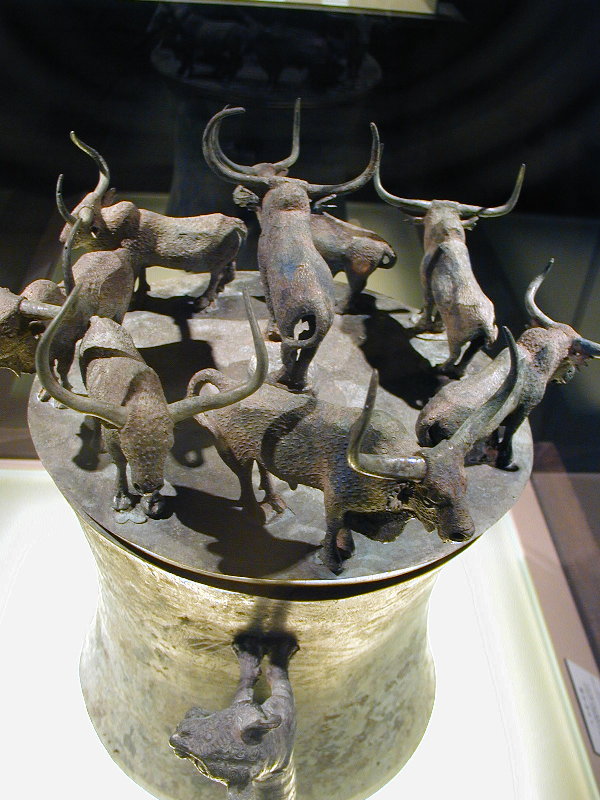
oxenbronze1Hebrew-English Text
I. Summary
The following items are created for the temple: the bronze altar, the “sea” vessel, the lavers, the lampstands, the tables, and the basins. The chapter ends with an inventory of the items that Huram and Solomon each made.

II. Photo
Solomon makes an aesthetic footing for the “sea” vessel: “It stood upon twelve oxen: three faced north, three faced west, three faced south, and three faced east, with the ‘sea’ resting upon them; their haunches were all turned inward.” (v. 4)

III. Important Verses
vv. 3-4: Beneath were figures of oxen set all around it, of 10 cubits, encircling the sea; the oxen were in two rows, cast in one piece with it. It stood upon twelve oxen: three faced north, three faced west, three faced south, and three faced east, with the sea resting upon them; their haunches were all turned inward.
v. 7: He made ten lampstands of gold as prescribed, and placed them in the Great Hall, five on the right and five on the left.
v. 11: Huram made the pails, the shovels, and the basins. With that Huram completed the work he had undertaken for King Solomon in the House of God.
v. 18: Solomon made a very large number of vessels; the weight of the bronze used could not be reckoned.

IV. Outline
1. The bronze altar
2-5. The “sea” vessel
6. The bronze lavers
7. The gold lampstands
8a. The tables
8b. The gold basins
9-10. Positioning the “sea” in the court
11-17. Inventory of Huram’s work
18-22. Inventory of Solomon’s work

V. Comment
No comment today. Stay tuned.

VI. Works Used
(see “Commentaries” page)
De Vries, Simon J. “1 and 2 Chronicles,” The Forms of Old Testament Literature vol. 11 (Grand Rapids, Michigan: Wm. B. Eerdmans Publishing Co., 1989).
Photo taken from http://www.art-fusion.org/Silkroad/Shanghai/bigpictures/oxenbronze1.JPG

2 Chronicles 3 – “The Temple and its Pillars”

pillarHebrew-English Text
I. Summary
The temple construction begins. The building is decorated with gold and jewels, and the two giant pillars are erected.

II. Photo
Solomon erects the temple’s giant pillars: “He erected the columns in front of the Great Hall, one to its right and one to its left; the one to the right was called Jachin, and the one to the left, Boaz.” (v. 17)

III. Important Verses
v. 1: Then Solomon began to build the House of the LORD in Jerusalem on Mount Moriah, where [the LORD] had appeared to his father David, at the place which David had designated, at the threshing floor of Ornan the Jebusite.
vv. 6-7: He studded the House with precious stones for decoration; the gold was from Parvaim. He overlaid the House with gold — the beams, the thresholds, its walls and doors; he carved cherubim on the walls.
v. 10: He made two sculptured cherubim in the Holy of Holies, and they were overlaid with gold.
v. 17: He erected the columns in front of the Great Hall, one to its right and one to its left; the one to the right was called Jachin, and the one to the left, Boaz.

IV. Outline
1-2. The work commences
3-9. Construction of the edifice
10-13. The cherubim
14. The curtain
15-17. The two columns and their accessories

V. Comment
Chapter 3 recounts the beginning of the temple’s construction. One of the main feature of the temple was the two pillars called Jachin and Boaz. Verses 15-17 read as follows: “At the front of the House he made two columns 35 cubits high; the capitals on top of them were 5 cubits high. He made chainwork in the inner Sanctuary and set it on the top of the columns; he made a hundred pomegranates and set them into the chainwork. He erected the columns in front of the Great Hall, one to its right and one to its left; the one to the right was called Jachin, and the one to the left, Boaz.”

While there are discrepancies between the different descriptions of Jachin and Boaz, Myers writes: “the information in the Bible provides a good idea of the physical appearance of the pillars. According to the Kings account, each stood 18 cubits high (ca. 26.5 ft.) and was 12 cubits (ca. 17.5 ft.) in circumference. The pillars were made of cast bronze and were hollow, with the metal being four fingers (ca. 3 inches) thick. Each pillar was surmounted by a bowl-shaped capital (or double capital, so Yeivin 1959) five cubits (ca. 7.5 ft.) in height, giving the pillars a total height of 23 cubits (ca. 34 ft.). The capitals were elaborately decorated, with ‘nets of checker work,’ ‘wreaths of chain work,’ and ‘two rows of pomegranates.’ Although these features cannot be exactly understood, the text (1 Kgs 7:19) apparently summarizes them as ‘lily-work,’ a designation that relates the capitals of Jachin and Boaz to the complex floral capitals that were characteristic of monumental architecture in the ANE. Egyptian architecture in particular is notable for its use of plant forms in structural elements, and the Phoenician workmanship responsible for the Jerusalem temple no doubt meant the use of many of the Egyptianizing forms that characterized Phoenician and W Syrian art.” (Myers, Carol. “Jachin and Boaz” in Anchor Bible Dictionary, Vol. III, pp. 597-598)

Even though the Hebrew Bible describes Jachin and Boaz in many different places, the pillars are shrouded in mystery. Meyers writes: “Once fabricated by Hiram of Tyre, the pillars were erected at the entrance to the temple, the one on the S being called Jachin, perhaps meaning ‘the establisher,’ and the one on the N named Boaz, which is also the name of the great-grandfather of David… Their enigmatic names, their great size, the use of a term (gulla) meaning ‘bowl’ for part of their capitals, and ambiguity about whether they were freestanding or structural elements has led to much speculation about the role of these prominent elements of the Jerusalem temple. They have been called cressets (Albright 1942, following W. R. Smith; cf. Myres 1948); and they have been identified as fire altars, obelisks, phalli, twin mountains, sacred stones, pillars of heaven, and trees of life (see, e.g., Scott 1939; IDB 4: 534–60; Wright 1941; and the summary of the literature in Busink 1970). The variety of suggestions indicates a strong measure of conjecture. All of these suggestions focus upon the symbolic nature of the pillar and upon an understanding of them as freestanding. However, analyzing the Jerusalem temple in relation to contemporary Syrian architecture has led to the supposition (Ouellette 1976) that the pillars were functional, just as were the pillars in an analogous building at Tell Tainat.” (ibid.)

VI. Works Used
(see “Commentaries” page)
De Vries, Simon J. “1 and 2 Chronicles,” The Forms of Old Testament Literature vol. 11 (Grand Rapids, Michigan: Wm. B. Eerdmans Publishing Co., 1989).
Myers, Carol. “Jachin and Boaz” in Anchor Bible Dictionary, Vol. III, pp. 597-598
Photo taken from http://www.muslimcongress.org/newsletter/images/pillar.jpg

2 Chronicles 2 – “Preparations for the Temple Construction”

bambooRaftingHebrew-English Text
I. Summary
Solomon requests men and materials from the king of Tyre in order to build the temple. The king agrees, and sends Solomon all that he asks for. Solomon conscripts a total 153,600 foreign workers for the task.

II. Photo
The king of Tyre sends Solomon what he requests: “We undertake to cut down as many trees of Lebanon as you need, and deliver them to you as rafts by sea to Jaffa; you will transport them to Jerusalem.” (v. 15)

III. Important Verses
vv. 4-5: The House that I intend to build will be great, inasmuch as our God is greater than all gods. Who indeed is capable of building a House for Him! Even the heavens to their uttermost reaches cannot contain Him, and who am I that I should build Him a House — except as a place for making burnt offerings to Him?
v. 6: Now send me a craftsman to work in gold, silver, bronze, and iron, and in purple, crimson, and blue yarn, and who knows how to engrave, alongside the craftsmen I have here in Judah and in Jerusalem, whom my father David provided.
vv. 16-17: Solomon took a census of all the aliens who were in the land of Israel, besides the census taken by his father David, and they were found to be 153,600. He made 70,000 of them basket carriers, and 80,000 of them quarriers, with 3,600 supervisors to see that the people worked.

IV. Outline
1. Solomon prepares a workforce
2-9. Solomon requests materials and workers from the king of Tyre
10-15. The king agrees to assist Solomon
16-17. Census of the foreign workers

V. Comment
Chapter 2 recounts how Solomon prepared the labor to build the temple in Jerusalem. When examining the books of Chronicles and Kings it becomes apparent that Solomon appears more upstanding and righteous in the Chronicler’s account. Collins writes: “In 2 Chronicles 2 Solomon turns his attention to building the temple. As in 1 Kings, he makes an arrangement with Hiram (Huram in Chronicles) of Tyre for supplies of wood and craftsmen. According to 1 Kgs 9:20-22, Solomon conscripted the Amorites and other peoples who were left in the land for slave labor, but did not make slaves of the Israelites. In 1 Kgs 5:13, however, we read that Solomon conscripted forced labor out of Israel, thirty thousand men, specifically in connection with the temple project. Chronicles makes no mention of forced labor from Israel and has Solomon take a census of aliens before he embarks on the temple building. In Chronicles, then, all the forced labor is imposed on aliens, whatever their origin.” (450)

Solomon asks Huram (Hiram) king of Tyre for his assistance in building the Temple. It is interesting to note that Tyre, which is now a peninsula, was once an Island (the causeway was built in the summer of 332 BCE). This fact is attested to in Ezek 27:32 which says, “Who was like Tyre when she was silenced In the midst of the sea?” Before Hiram’s time Tyre was actually two islands, but he combined the two (this was one of his many building projects). (Katzenstein, H. J. “Tyre (Place)” in Anchor Bible Dictionary, Vol. VI, pp. 686-692)

A Roman portrait bust said to be of Josephus

Whitelman notes that Josephus quotes two non-biblical sources when speaking of Hiram, the ancient historians Dius and Menander of Ephesus. Whitelman summarizes Josephus as follows: “Dius reportedly credits Hiram with the construction of embankments to level the eastern part of the city, the enlargement of the city, the creation of a causeway to the temple of Zeus (Baal) and the logging of timber from Lebanon for the construction of temples. Dius also reports that Hiram and Solomon used to set riddles for each other as part of a wager: Hiram, it seems, lost a large part of his wealth gambling with Solomon until Abdemun (“Abdemon” in Ant 8.149) solved them and recuperated even more money from Solomon, who was unable to solve the riddles he posed. Josephus claims (AgAp 1.111) that much of this correspondence was still preserved in the Tyrian archives during his own time. His other source, Menander of Ephesus, adds further information about Hiram (AgAp 1.116–121; Ant 8.144–460). He reports that Hiram succeeded his father Abibaal (Abibalos), lived for fifty-three years and reigned for thirty-four years. Apart from the general building program mentioned by Dius, Menander recounts that Hiram also demolished a number of temples, built shrines to Heracles (Melkart) and Ashtarte, and conducted a successful campaign against Utica for its refusal to pay tribute. The reliability of Josephus’ information is difficult to assess without further independent evidence, particularly in light of the apologetic nature of his writings.” (Whitelam, Keith W. “Hiram (Person)” in Anchor Bible Dictionary, Vol. III, pp. 203-25)

VI. Works Used
(see “Commentaries” page)
Collins, John J. “Introduction to the Hebrew Bible” (Minneapolis: Fortress Press, 2004).
De Vries, Simon J. “1 and 2 Chronicles,” The Forms of Old Testament Literature vol. 11 (Grand Rapids, Michigan: Wm. B. Eerdmans Publishing Co., 1989).
Katzenstein, H. J. “Tyre (Place)” in Anchor Bible Dictionary, Vol. VI, pp. 686-692
Whitelam, Keith W. “Hiram (Person)” in Anchor Bible Dictionary, Vol. III, pp. 203-25
Photo #1 taken from http://assamforest.in/forestGlance/images/bambooRafting.jpg

Photo #2 taken from http://en.wikipedia.org/wiki/File:Josephusbust.jpg

2 Chronicles 1 – “Solomon’s Prosperous Rule”

image_gold

Hebrew-English Text
I. Summary
Solomon assembles the people at the Tent of Meeting in Gibeon and offers a thousand sacrifices. He has a dream, and in it God grants him wisdom and success. The chapter ends with a description of Solomon’s great wealth and the affluence he engenders in Jerusalem.

II. Photo
Solomon and his people live in opulence: “The king made silver and gold as plentiful in Jerusalem as stones, and cedars as plentiful as the sycamores in the Shephelah.” (v. 15)

III. Important Verses
v. 1: Solomon son of David took firm hold of his kingdom, for the LORD his God was with him and made him exceedingly great.
v. 3: Then Solomon, and all the assemblage with him, went to the shrine at Gibeon, for the Tent of Meeting, which Moses the servant of the LORD had made in the wilderness, was there.
v. 6: There Solomon ascended the bronze altar before the LORD, which was at the Tent of Meeting, and on it sacrificed a thousand burnt offerings.
vv. 7-12: That night, the LORD appeared to Solomon and said to him, “Ask, what shall I grant you?” Solomon said to God, “You dealt most graciously with my father David, and now You have made me king in his stead. Now, O LORD God, let Your promise to my father David be fulfilled; for You have made me king over a people as numerous as the dust of the earth. Grant me then the wisdom and the knowledge to lead this people, for who can govern Your great people?”  God said to Solomon, “Because you want this, and have not asked for wealth, property, and glory, nor have you asked for the life of your enemy, or long life for yourself, but you have asked for the wisdom and the knowledge to be able to govern My people over whom I have made you king, wisdom and knowledge are granted to you, and I grant you also wealth, property, and glory, the like of which no king before you has had, nor shall any after you have.”
v. 15: The king made silver and gold as plentiful in Jerusalem as stones, and cedars as plentiful as the sycamores in the Shephelah.
v. 18: Then Solomon resolved to build a House for the name of the LORD.

IV. Outline
1-6. Solomon assembles the people at Gibeon and offers 1,000 offerings
7-12. Solomon’s dream: God grants him wisdom, wealth, and glory
13. Solomon’s return to Jerusalem
14-15. Solomon’s prosperous rule
16-17. The horse and chariot trade
18. Solomon resolves to build the temple

V. Comment
2 Chronicles begins with an account of Solomon’s success as a ruler. Klein observes that “the division [of Chronicles] into two books appears first in the LXX and has been standard in Hebrew Bibles since the 15th century.” (“Chronicles, Book of 1-2” in Anchor Bible Dictionary, Vol. I, pp. 992-1002) Collins notes that the book’s style is similar to its predecessor. He writes: “The account of Solomon’s reign is idealized in a way similar to that of David, and focuses on the building of the temple. It begins with Solomon’s dream at Gibeon, in which he asks for wisdom. The choice of Gibeon is justified by the statement that the tent of meeting was there (in 1 Kgs 3:4 it was “the great high place”). Nothing is said of Solomon’s elimination of his rivals (1 Kings 2). Neither is there any mention of his dubious display of wisdom between the two prostitutes who claimed the same child (1 Kgs 3:16-28). Solomon is presented in Chronicles as a model of piety, and so his worthiness for building the temple is not jeopardized.” (450)

Collins mentioned the disparity between the account of Solomon’s ascension to the throne  in 1 Kgs 2 and 2 Chr 1. While Solomon is willingly accepted by the people in our chapter, 1 Kgs 2:25-46 recounts how he has to imperiously solidify his rule:
And Solomon instructed Benaiah son of Jehoiada, who struck Adonijah down; and so he died.
To the priest Abiathar, the king said, “Go to your estate at Anathoth! You deserve to die, but I shall not put you to death at this time, because you carried the Ark of my Lord GOD before my father David and because you shared all the hardships that my father endured.” So Solomon dismissed Abiathar from his office of priest of the LORD — thus fulfilling what the LORD had spoken at Shiloh regarding the house of Eli.
When the news reached Joab, he fled to the Tent of the LORD and grasped the horns of the altar — for Joab had sided with Adonijah, though he had not sided with Absalom. King Solomon was told that Joab had fled to the Tent of the LORD and that he was there by the altar; so Solomon sent Benaiah son of Jehoiada, saying, “Go and strike him down.” Benaiah went to the Tent of the LORD and said to him, “Thus said the king: Come out!” “No!” he replied; “I will die here.” Benaiah reported back to the king that Joab had answered thus and thus, and the king said, “Do just as he said; strike him down and bury him, and remove guilt from me and my father’s house for the blood of the innocent that Joab has shed. Thus the LORD will bring his blood guilt down upon his own head, because, unbeknown to my father, he struck down with the sword two men more righteous and honorable than he — Abner son of Ner, the army commander of Israel, and Amasa son of Jether, the army commander of Judah. May the guilt for their blood come down upon the head of Joab and his descendants forever, and may good fortune from the LORD be granted forever to David and his descendants, his house and his throne.” So Benaiah son of Jehoiada went up and struck him down. And he was buried at his home in the wilderness. In his place, the king appointed Benaiah son of Jehoiada over the army, and in place of Abiathar, the king appointed the priest Zadok.
Then the king summoned Shimei and said to him, “Build yourself a house in Jerusalem and stay there — do not ever go out from there anywhere else. On the very day that you go out and cross the Wadi Kidron, you can be sure that you will die; your blood shall be on your own head.” “That is fair,” said Shimei to the king, “your servant will do just as my lord the king has spoken.” And for a long time, Shimei remained in Jerusalem.
Three years later, two slaves of Shimei ran away to King Achish son of Maacah of Gath. Shimei was told, “Your slaves are in Gath.” Shimei thereupon saddled his ass and went to Achish in Gath to claim his slaves; and Shimei returned from Gath with his slaves. Solomon was told that Shimei had gone from Jerusalem to Gath and back, and the king summoned Shimei and said to him, “Did I not adjure you by the LORD and warn you, ‘On the very day that you leave and go anywhere else, you can be sure that you will die,’ and did you not say to me, ‘It is fair; I accept’? Why did you not abide by the oath before the LORD and by the orders which I gave you?” The king said further to Shimei, “You know all the wrong, which you remember very well, that you did to my father David. Now the LORD brings down your wrongdoing upon your own head. But King Solomon shall be blessed, and the throne of David shall be established before the LORD forever.”
The king gave orders to Benaiah son of Jehoiada and he went out and struck Shimei down; and so he died. Thus the kingdom was secured in Solomon’s hands.

VI. Works Used
(see “Commentaries” page)
Collins, John J. “Introduction to the Hebrew Bible” (Minneapolis: Fortress Press, 2004).
De Vries, Simon J. “1 and 2 Chronicles,” The Forms of Old Testament Literature vol. 11 (Grand Rapids, Michigan: Wm. B. Eerdmans Publishing Co., 1989).

Klein, Ralph W. “Chronicles, Book of 1-2” in Anchor Bible Dictionary, Vol. I, pp. 992-1002

Photo taken from